
Direct answer
Cable managers should preserve bend radius, connector access, pathway separation and traceable patching at both initial and future occupancy. Size horizontal and vertical capacity from cable diameter and fill assumptions, coordinate it with doors and equipment handles, and leave a defined route for moves and additions.
Within the broader Racks & Network Infrastructure workflow, this article focuses on rack cable manager selection: design rack cable management around patch density, route separation and future changes. Confirm patch-cord count and the evidence for the offered product before final engineering approval.
Inputs required before any calculation
Design rack cable management around patch density, route separation and future changes. Start with the operating requirement and installation boundary, then separate system requirements from product claims so each supplier knows which evidence must accompany the offered configuration.
- Estimate cable volume at initial and planned occupancy.
- Separate fibre, copper and power routes where required.
- Protect bend radius at every turn and manager exit.
Estimate cable volume at initial and planned occupancy
Capture Patch-cord count, then use Horizontal manager as a practical comparison point: Patch fields need row-level routing. Before approval, verify this point: Finger spacing, cover and unit height.
Separate fibre, copper and power routes where required
Capture Cable diameters, then use Vertical manager as a practical comparison point: High cable volume runs rack height. Before approval, verify this point: Cross-section, door clearance and fill.
Protect bend radius at every turn and manager exit
Capture Growth allowance, then use Overhead or underfloor handoff as a practical comparison point: Rack connects to a shared pathway. Before approval, verify this point: Drop position and transition bend.
A traceable sizing and verification workflow
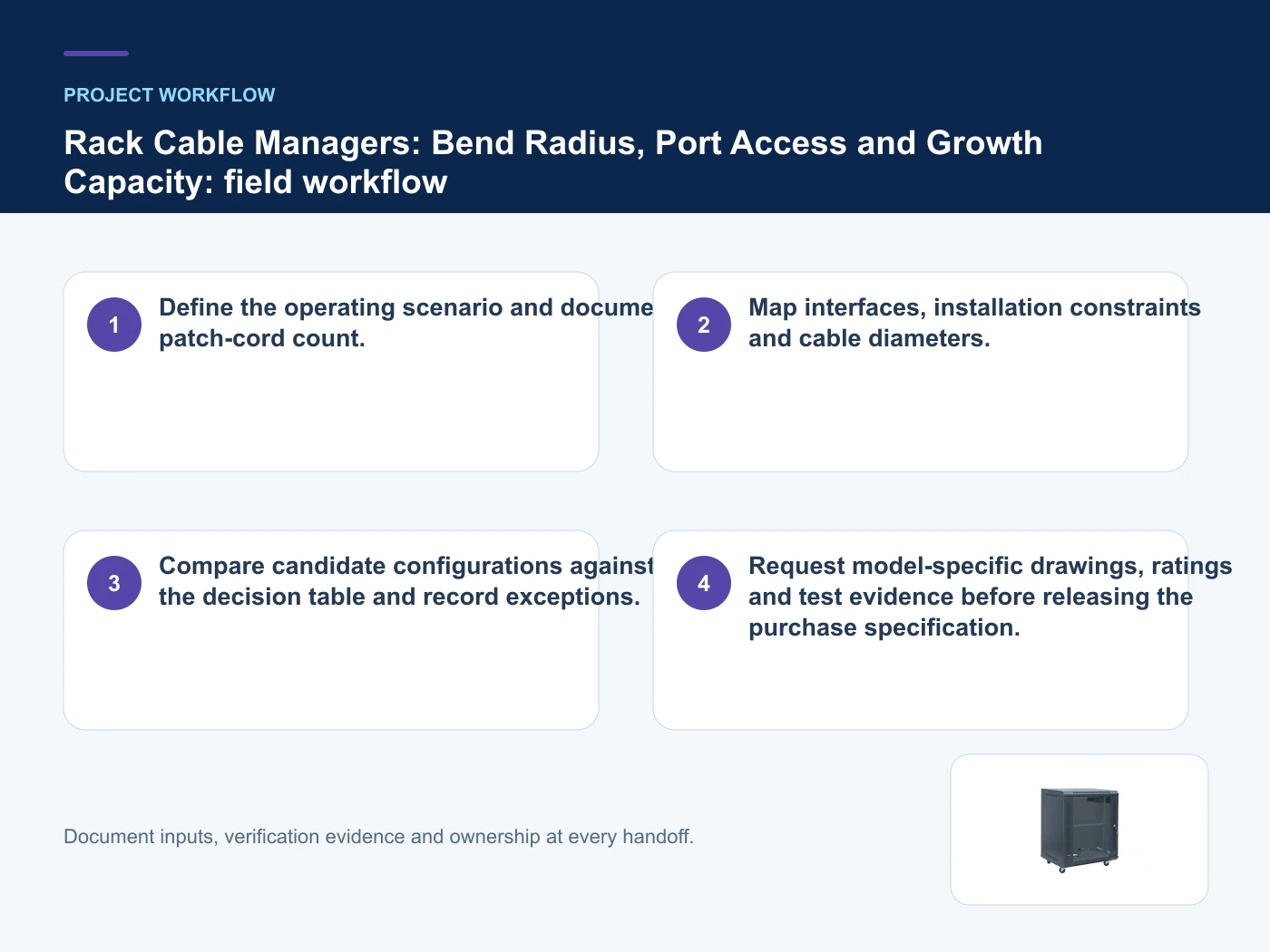
- Step 1: Define the operating scenario and document patch-cord count. Record Patch-cord count as an explicit input. Finger spacing, cover and unit height.
- Step 2: Map interfaces, installation constraints and cable diameters. Record Cable diameters as an explicit input. Cross-section, door clearance and fill.
- Step 3: Compare candidate configurations against the decision table and record exceptions. Record Growth allowance as an explicit input. Drop position and transition bend.
Calculation boundaries and acceptance limits
This table connects rack form factor, accessory compatibility, cable management, rack power, airflow control, grounding and service access to the decision on rack cable manager selection. It is a decision aid rather than a universal performance table: exact capacity, environmental class, electrical or optical limits and certifications must come from the selected model, applicable project documents and verifiable test evidence.
| Option or input | When it fits | What must be verified |
|---|---|---|
| Horizontal manager | Patch fields need row-level routing | Finger spacing, cover and unit height |
| Vertical manager | High cable volume runs rack height | Cross-section, door clearance and fill |
Reference point: TIA-942 data center infrastructure standard overview and ISO/IEC 22237-4: Data centre facilities and infrastructures — Environmental control frame the terminology or method used for this rack cable manager selection comparison. They do not approve a product configuration; apply the edition named by the contract and local authority.
Relevant products from our communications portfolio
The products below connect the rack cable manager selection decision to real catalogue families and verified site photography. They are starting points, not a claim that every configuration described here is a standard stock item; confirm model, interface, rating, drawing and testing scope with the project team.
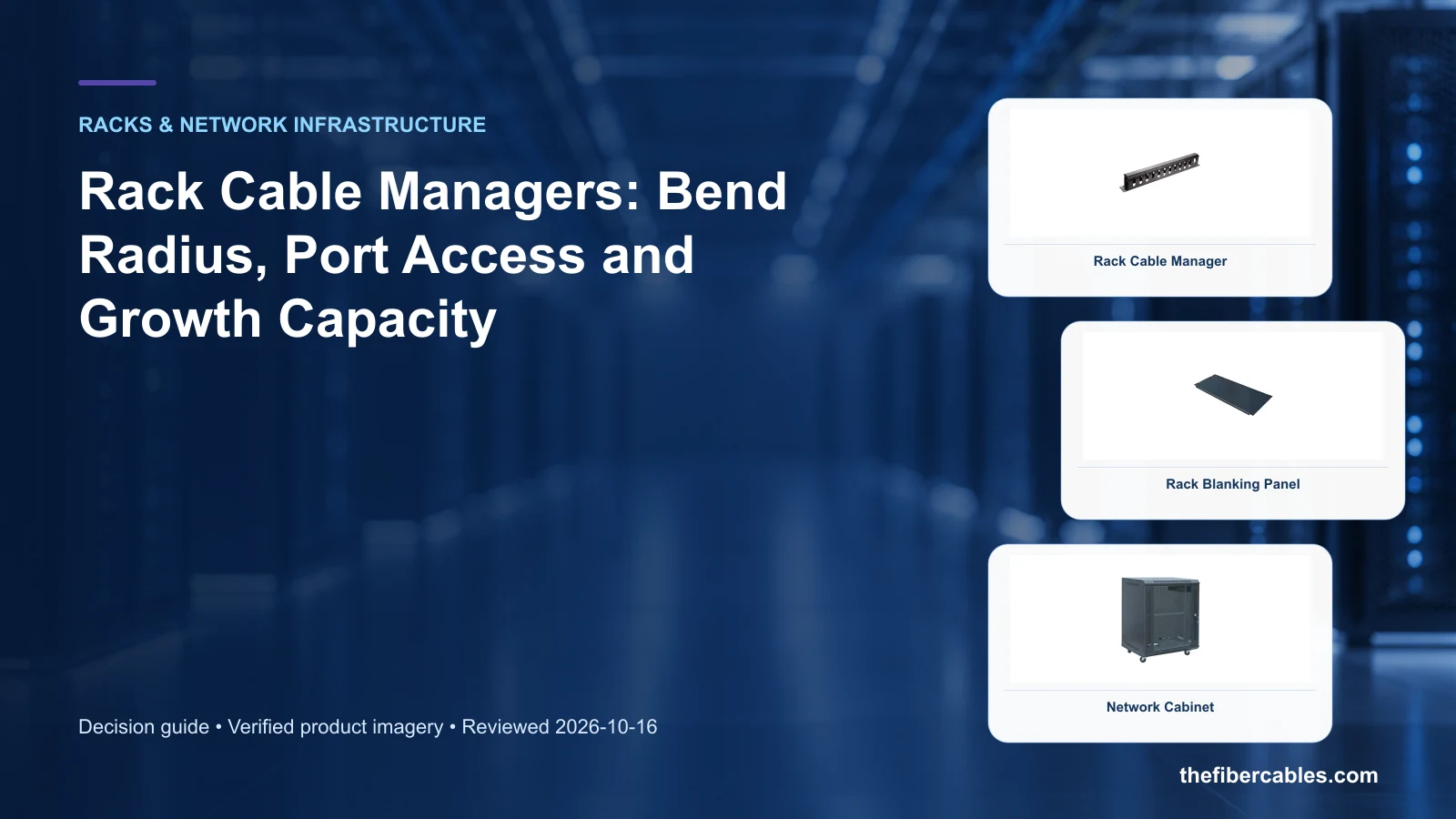
- Rack Cable Manager — use this product page as a configuration reference when you estimate cable volume at initial and planned occupancy. Confirm the offered model, interfaces, drawings and available evidence before quotation.
- Rack Blanking Panel — use this product page as a configuration reference when you separate fibre, copper and power routes where required. Confirm the offered model, interfaces, drawings and available evidence before quotation.
- Network Cabinet — use this product page as a configuration reference when you protect bend radius at every turn and manager exit. Confirm the offered model, interfaces, drawings and available evidence before quotation.
For adjacent configurations, browse Data Center & Network Infrastructure and compare those options against the rack cable manager selection inputs above, including patch-cord count.
What to include in the RFQ or design input
For rack cable manager selection, a complete request reduces back-and-forth and prevents a catalogue image from being mistaken for a verified configuration. Record the following fields, identify which values are mandatory or provisional and attach route, interface or layout drawings where relevant.
- Patch-cord count
- Cable diameters
- Growth allowance
- Rack dimensions
- Route separation
- Door and port clearance
Common mistakes to avoid
- Selecting from a catalogue image before patch-cord count is fixed.
- Treating a category-page description as model-specific compliance evidence.
Questions engineers and buyers ask
How should horizontal manager be evaluated for rack cable manager selection?
Use patch fields need row-level routing as the operating context, record patch-cord count, and verify finger spacing, cover and unit height for the exact offered configuration.
Which project input can change the rack cable manager selection decision?
Estimate cable volume at initial and planned occupancy. Recheck that decision when cable diameters or growth allowance changes.
Sources and standards
Use these primary references to check the engineering boundary for rack cable manager selection. Product compliance still requires model-specific drawings, declarations and test evidence for the configured system.
- TIA-942 data center infrastructure standard overview (ANSI/TIA-942-C, 05/2024). Use it to verify the terminology and scope relevant to rack cable manager selection; the source does not certify a specific offered product.
- ISO/IEC 22237-4: Data centre facilities and infrastructures — Environmental control (2021). Use it to verify the terminology and scope relevant to rack cable manager selection; the source does not certify a specific offered product.
- TIA: ANSI/TIA-568.3-E Optical Fiber Cabling Component Standard (09/2022). Use it to verify the terminology and scope relevant to rack cable manager selection; the source does not certify a specific offered product.
Source review: Links and cited editions for rack cable manager selection were checked on 2026-10-16. Confirm the edition adopted by the project contract and the authority having jurisdiction.
Related guidance
Two-Post Open Frame Rack vs Enclosed Network Cabinet • Rack PDU Selection: Input, Outlets, Branch Protection and Load Visibility • Blanking Panels and Rack Fan Modules: Controlling Bypass Air Without Guesswork
Prepare a rack cable manager selection configuration for review
Share patch-cord count, cable diameters, growth allowance plus the intended installation and order quantity. We will map those inputs to a product family and a reviewable project configuration.
——END——