


Central offices and equipment rooms
Organize high-capacity termination, cross-connection and patching with defined service access.

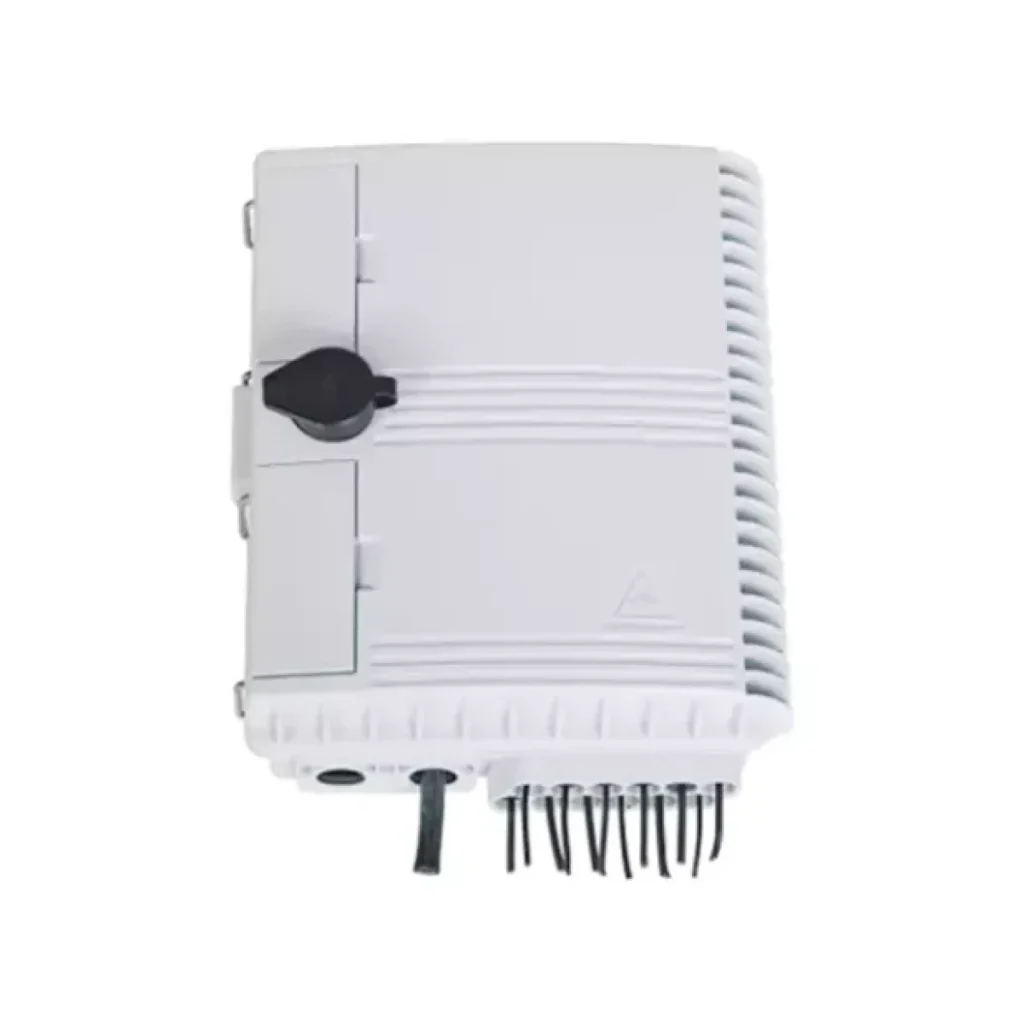
Fiber Optic Termination Box organizes cable fixing, splicing, termination and protected distribution for access-network handoff points.
The verified scope covers cable-end fixing, cable-to-pigtail splicing and storage of residual fiber. Straight-through and branch connections are described; their actual arrangement must follow the configured internal drawing.
The Fiber Optic Termination Box provides a cable-end handoff where incoming fibers are spliced to pigtails or carried onward through a planned branch. Its primary role is to contain the cable-end work and protect stored fiber at the terminal location.
This record describes a product family without a fixed capacity table. Choose the actual enclosure from the cable and interface schedule rather than assuming every termination box uses the same tray or adapter.
Define splice count, pigtail exits and fiber reserve length. Confirm whether connectors must be presented on adapters or only protected within the enclosure, then check mounting and access.
Huijue Group can assess OEM termination-box manufacture, private labels and a sample or drawing defining the required handoff. Engineering feasibility, tooling, acceptance tests, quantities and delivery scope need confirmation.
Send cable construction, splice topology, desired enclosure size, pigtail exit style and mounting conditions.
Terminal wiring in optical transmission networks, including direct cable-end splicing and local branch handoffs.
No fixed ingress rating is established. Distinguish the cable's outdoor route from the actual environment where the box is mounted.
Buyer Questions
Answers specific to Fiber Optic Termination Box selection, configuration and purchasing.
The box location determines enclosure requirements. Specify whether it is exposed or installed inside a protected room or cabinet.
No single capacity is defined in this record. Provide working and reserve counts for a reviewed configuration.
Use the deployment context to narrow the configuration before comparing dimensions, capacities and options.
Organize high-capacity termination, cross-connection and patching with defined service access.
Place splitter, terminal and distribution boxes at the correct feeder-to-drop transition.
Protect branching and splicing around cable entries, sealing, tray capacity and mounting method.
Reserve fibers, ports and internal routing space for staged subscriber or backbone growth.
Before quotation: confirm capacity, interfaces, installation environment, power conditions, quantity and required options.