
Direct answer
A telecom cabinet FAT should verify the approved configuration and interfaces, not attempt to repeat every laboratory type test. Start with document identity: drawing revision, bill of materials, wiring diagrams, component models and inspection records. Inspect dimensions, doors, seals, locks, mounting rails, compartments, finish, labels, grounding, cable entries and supplied accessories. For an integrated cabinet, verify wiring continuity, protective devices, controller settings, alarms, sensors, fans, heat exchangers or air conditioners using an agreed functional procedure. Review the evidence supporting any specified ingress, impact or environmental requirement and record where that evidence applies. Photograph important interfaces, log deviations and require closure before release. The final FAT pack should make the delivered unit traceable to the configuration that was approved.
Within the broader Outdoor Cabinet Manufacturing & Customization workflow, this article focuses on telecom cabinet FAT checklist: define a project-specific factory acceptance test that checks the approved cabinet configuration before shipment. Confirm approved drawing and bom revision and the evidence for the offered product before final engineering approval.
Scope boundary: This guide verifies enclosure fabrication, assembly and project configuration at the factory. It does not replace the site-energy FAT/SAT checks for live sources, batteries, controls and field interfaces.
Inspection points to agree before the cabinet is built
Define a project-specific factory acceptance test that checks the approved cabinet configuration before shipment. Start with the operating requirement and installation boundary, then separate system requirements from product claims so each supplier knows which evidence must accompany the offered configuration.
- Base FAT acceptance on approved drawings and the controlled bill of materials.
- Distinguish visual, dimensional and functional checks from type-test evidence.
- Test integrated components with project-specific settings where practical.
- Close deviations and preserve traceable records before shipment release.
Base FAT acceptance on approved drawings and the controlled bill of materials
Capture Approved drawing and BOM revision, then use Configuration as a practical comparison point: Drawings, BOM, dimensions and components. Before approval, verify this point: Confirms that the correct unit was built.
Distinguish visual, dimensional and functional checks from type-test evidence
Capture Inspection and test plan, then use Function as a practical comparison point: Wiring, alarms, cooling and interfaces. Before approval, verify this point: Confirms integrated operation before shipment.
Test integrated components with project-specific settings where practical
Capture Dimensional and workmanship checklist, then use Evidence as a practical comparison point: Inspection records, reports and deviation closure. Before approval, verify this point: Supports final acceptance and traceability.
Close deviations and preserve traceable records before shipment release
Capture Electrical functional test scope, then use Configuration as a practical comparison point: Drawings, BOM, dimensions and components. Before approval, verify this point: Confirms that the correct unit was built.
From drawing approval to FAT closeout
- Step 1: Freeze the acceptance baseline. Record Approved drawing and BOM revision as an explicit input. Confirms that the correct unit was built.
- Step 2: Inspect construction and configuration. Record Inspection and test plan as an explicit input. Confirms integrated operation before shipment.
- Step 3: Run agreed electrical and thermal functions. Record Dimensional and workmanship checklist as an explicit input. Supports final acceptance and traceability.
- Step 4: Record results, close deviations and release shipment. Record Electrical functional test scope as an explicit input. Confirms that the correct unit was built.
Factory checks and their acceptance boundary
This table connects requirements capture, DFM, factory capability, quotation normalization, configuration control and FAT evidence for custom outdoor cabinets to the decision on telecom cabinet FAT checklist. It is a decision aid rather than a universal performance table: exact capacity, environmental class, electrical or optical limits and certifications must come from the selected model, applicable project documents and verifiable test evidence.
| Option or input | When it fits | What must be verified |
|---|---|---|
| Configuration | Drawings, BOM, dimensions and components | Confirms that the correct unit was built |
| Function | Wiring, alarms, cooling and interfaces | Confirms integrated operation before shipment |
| Evidence | Inspection records, reports and deviation closure | Supports final acceptance and traceability |
Reference point: IEC 62208:2023 — Empty enclosures for low-voltage switchgear and controlgear assemblies and IEC 60529: Degrees of protection provided by enclosures (IP Code) frame the terminology or method used for this telecom cabinet FAT checklist comparison. They do not approve a product configuration; apply the edition named by the contract and local authority.
Common mistakes to avoid
- Testing against a sales brochure instead of approved drawings.
- Claiming FAT proves a laboratory enclosure classification.
- Shipping with unresolved deviations or incomplete records.
Relevant products from our communications portfolio
The products below connect the telecom cabinet FAT checklist decision to real catalogue families and verified site photography. They are starting points, not a claim that every configuration described here is a standard stock item; confirm model, interface, rating, drawing and testing scope with the project team.
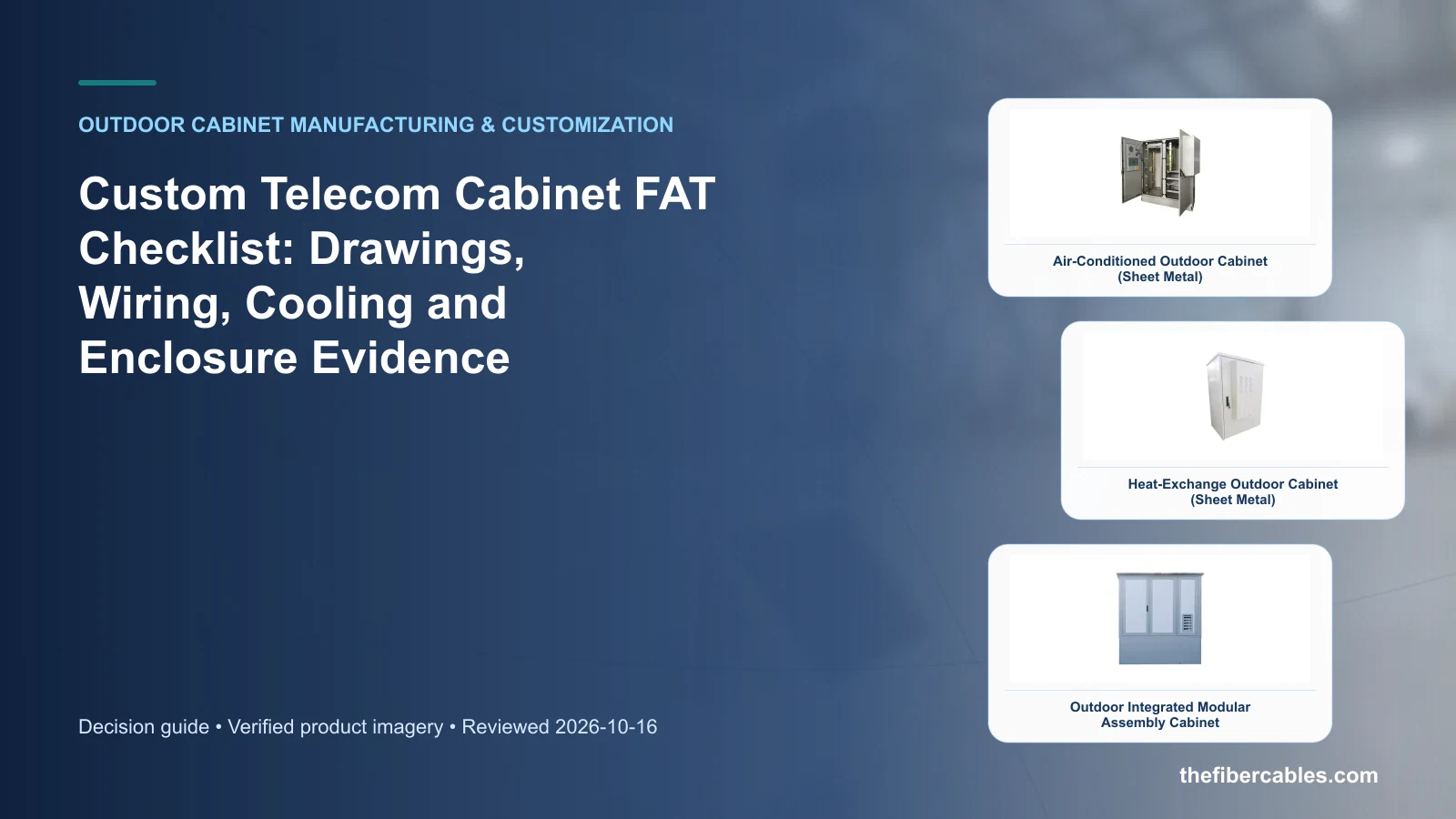
- Air-Conditioned Outdoor Cabinet (Sheet Metal) — use this product page as a configuration reference when you base FAT acceptance on approved drawings and the controlled bill of materials. Confirm the offered model, interfaces, drawings and available evidence before quotation.
- Heat-Exchanger-Cooled Outdoor Telecom Cabinet (HJ-XDF-JF41) — use this product page as a configuration reference when you distinguish visual, dimensional and functional checks from type-test evidence. Confirm the offered model, interfaces, drawings and available evidence before quotation.
- Outdoor Integrated Modular Assembly Cabinet — use this product page as a configuration reference when you test integrated components with project-specific settings where practical. Confirm the offered model, interfaces, drawings and available evidence before quotation.
For adjacent configurations, browse Outdoor Cabinets & Site Infrastructure and compare those options against the telecom cabinet FAT checklist inputs above, including approved drawing and bom revision.
What to include in the RFQ or design input
For telecom cabinet FAT checklist, a complete request reduces back-and-forth and prevents a catalogue image from being mistaken for a verified configuration. Record the following fields, identify which values are mandatory or provisional and attach route, interface or layout drawings where relevant.
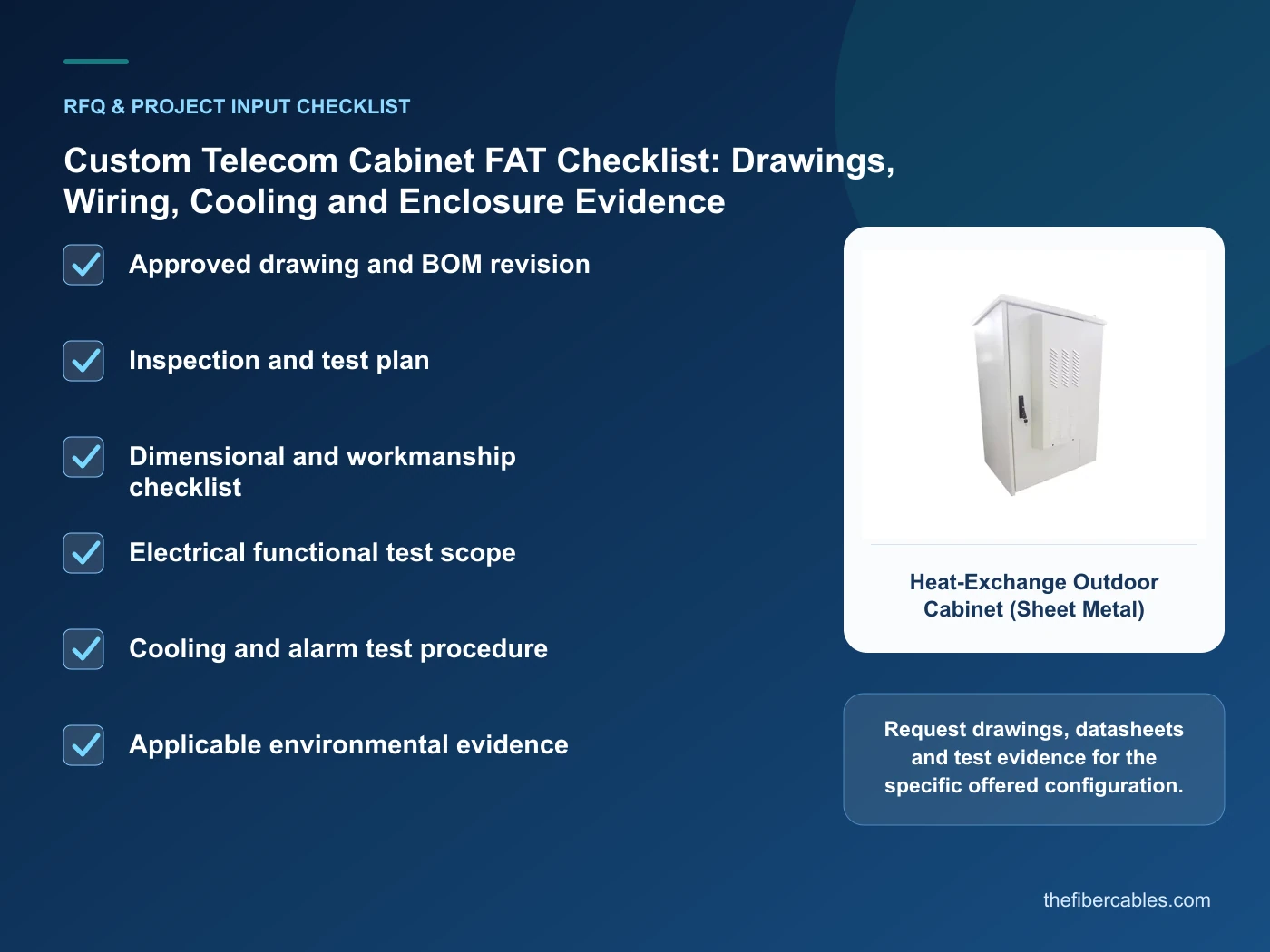
- Approved drawing and BOM revision
- Inspection and test plan
- Dimensional and workmanship checklist
- Electrical functional test scope
- Cooling and alarm test procedure
- Applicable environmental evidence
- Photo and record requirements
- Deviation and release authority
Questions engineers and buyers ask
How should configuration be evaluated for telecom cabinet FAT checklist?
Use drawings, bom, dimensions and components as the operating context, record approved drawing and bom revision, and verify confirms that the correct unit was built for the exact offered configuration.
Which project input can change the telecom cabinet FAT checklist decision?
Base FAT acceptance on approved drawings and the controlled bill of materials. Recheck that decision when inspection and test plan or dimensional and workmanship checklist changes.
Sources and standards
Use these primary references to check the engineering boundary for telecom cabinet FAT checklist. Product compliance still requires model-specific drawings, declarations and test evidence for the configured system.
- IEC 62208:2023 — Empty enclosures for low-voltage switchgear and controlgear assemblies (2023, Ed. 3). Use it to verify the terminology and scope relevant to telecom cabinet FAT checklist; the source does not certify a specific offered product.
- IEC 60529: Degrees of protection provided by enclosures (IP Code) (Ed. 2.2, consolidated version; reviewed 2026-10-16). Use it to verify the terminology and scope relevant to telecom cabinet FAT checklist; the source does not certify a specific offered product.
- IEC 62262: Degrees of protection provided by enclosures against external mechanical impacts (IK code) (Ed. 1.1, consolidated version; reviewed 2026-10-16). Use it to verify the terminology and scope relevant to telecom cabinet FAT checklist; the source does not certify a specific offered product.
- ETSI TR 102 489: Thermal management guidance for telecommunications equipment (V1.3.1, 06/2013). Use it to verify the terminology and scope relevant to telecom cabinet FAT checklist; the source does not certify a specific offered product.
Source review: Links and cited editions for telecom cabinet FAT checklist were checked on 2026-10-16. Confirm the edition adopted by the project contract and the authority having jurisdiction.
Related guidance
How to Specify a Custom Outdoor Telecom Cabinet: A Manufacturer’s Design Input Checklist • Telecom Site Energy FAT and SAT Checklist • How to Write an Outdoor Telecom Cabinet Technical Specification Without Hidden Gaps
Prepare a telecom cabinet FAT checklist configuration for review
Share approved drawing and bom revision, inspection and test plan, dimensional and workmanship checklist plus the intended installation and order quantity. We will map those inputs to a product family and a reviewable project configuration.
——END——