
Direct answer
Choose the strength member from the installation route, not from fibre count alone. Non-metallic constructions avoid a conductive path, metallic self-supporting constructions can suit defined aerial drops, and non-metallic self-supporting designs provide another option where span support is required; the final choice still depends on span, attachment method, bend control, local electrical rules and the offered cable datasheet.
This pillar guide connects route survey, cable construction, pulling and handling, drop-cable deployment and field termination boundaries. Use it to define project inputs before narrowing to a product family.
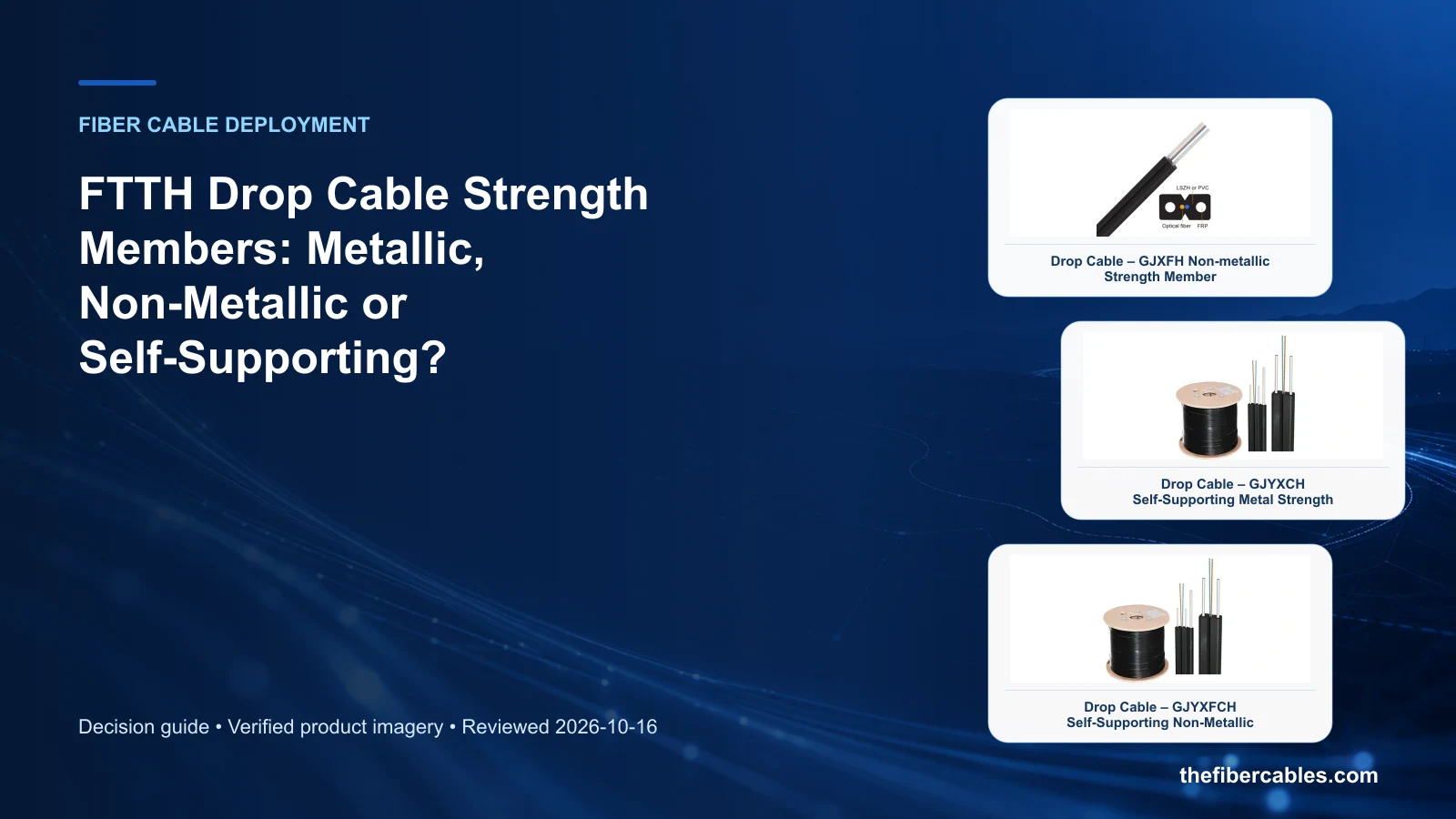
System boundaries to define before product selection
Choose a drop-cable construction that matches span, routing, grounding and installation constraints. Start with the operating requirement and installation boundary, then separate system requirements from product claims so each supplier knows which evidence must accompany the offered configuration.
- Separate indoor routing from the outdoor drop span.
- Confirm whether a conductive strength member is permitted.
- Define span, attachment hardware and expected handling loads.
- Protect bend radius at entries, turns and customer termination points.
Separate indoor routing from the outdoor drop span
Capture Route and span, then use Non-metallic indoor drop as a practical comparison point: Short indoor or protected access routing. Before approval, verify this point: Jacket, bend radius and fire requirement.
Confirm whether a conductive strength member is permitted
Capture Indoor and outdoor segments, then use Metallic self-supporting drop as a practical comparison point: Aerial drop with defined support method. Before approval, verify this point: Grounding rules, span and messenger details.
Define span, attachment hardware and expected handling loads
Capture Strength-member restriction, then use Non-metallic self-supporting drop as a practical comparison point: Aerial routing where conductive members are restricted. Before approval, verify this point: Span rating, clamps and wind exposure.
Protect bend radius at entries, turns and customer termination points
Capture Fibre grade and count, then use Non-metallic indoor drop as a practical comparison point: Short indoor or protected access routing. Before approval, verify this point: Jacket, bend radius and fire requirement.
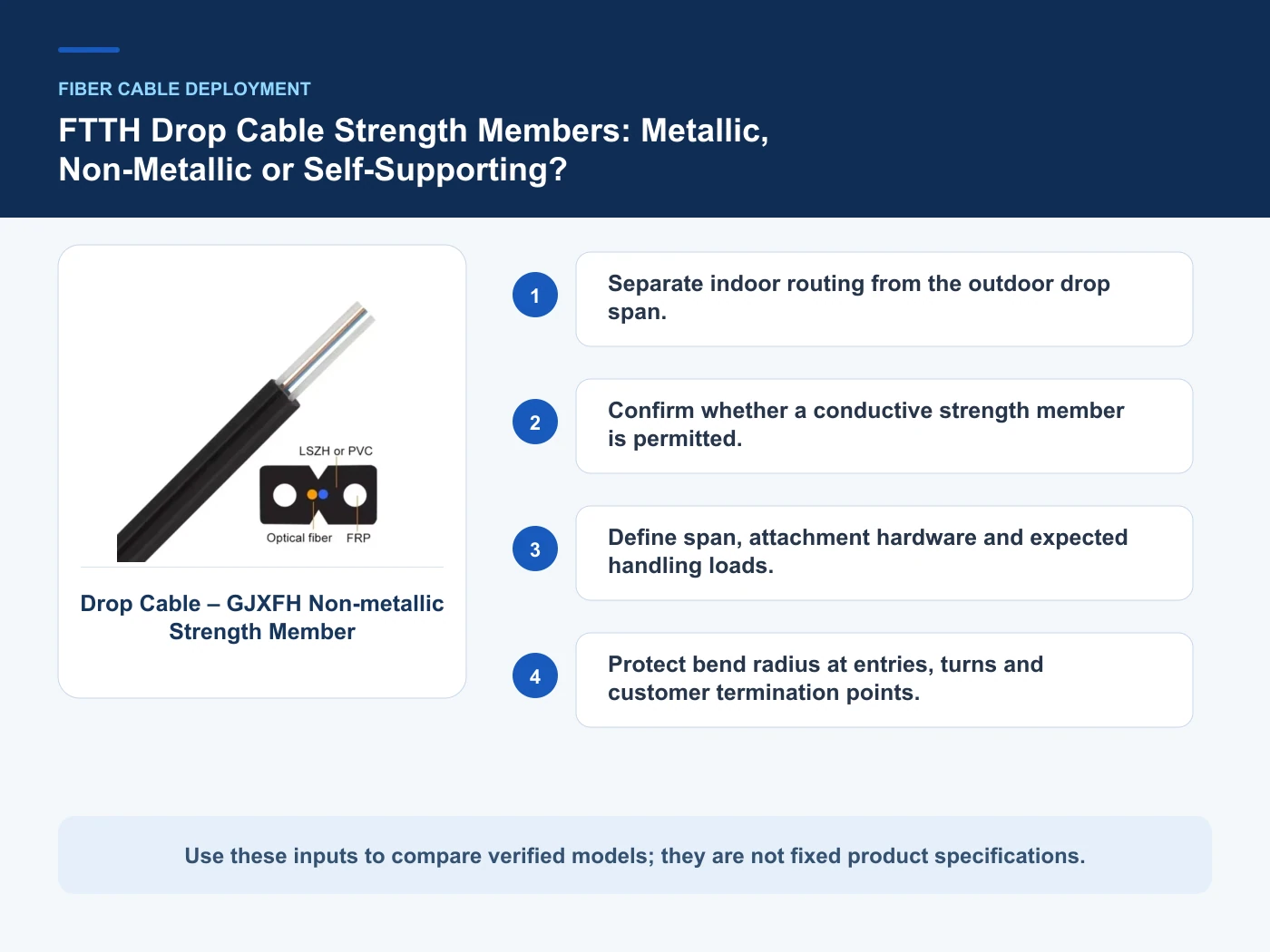
Architecture choices and verification boundaries
This table connects route survey, cable construction, pulling and handling, drop-cable deployment and field termination boundaries to the decision on FTTH drop cable strength member. It is a decision aid rather than a universal performance table: exact capacity, environmental class, electrical or optical limits and certifications must come from the selected model, applicable project documents and verifiable test evidence.
| Option or input | When it fits | What must be verified |
|---|---|---|
| Non-metallic indoor drop | Short indoor or protected access routing | Jacket, bend radius and fire requirement |
| Metallic self-supporting drop | Aerial drop with defined support method | Grounding rules, span and messenger details |
| Non-metallic self-supporting drop | Aerial routing where conductive members are restricted | Span rating, clamps and wind exposure |
Reference point: ITU-T G.657: Bend-insensitive single-mode optical fibre and cable and IEC 60794-1-1: Optical fibre cables — Generic specification frame the terminology or method used for this FTTH drop cable strength member comparison. They do not approve a product configuration; apply the edition named by the contract and local authority.
From requirements to an auditable project decision
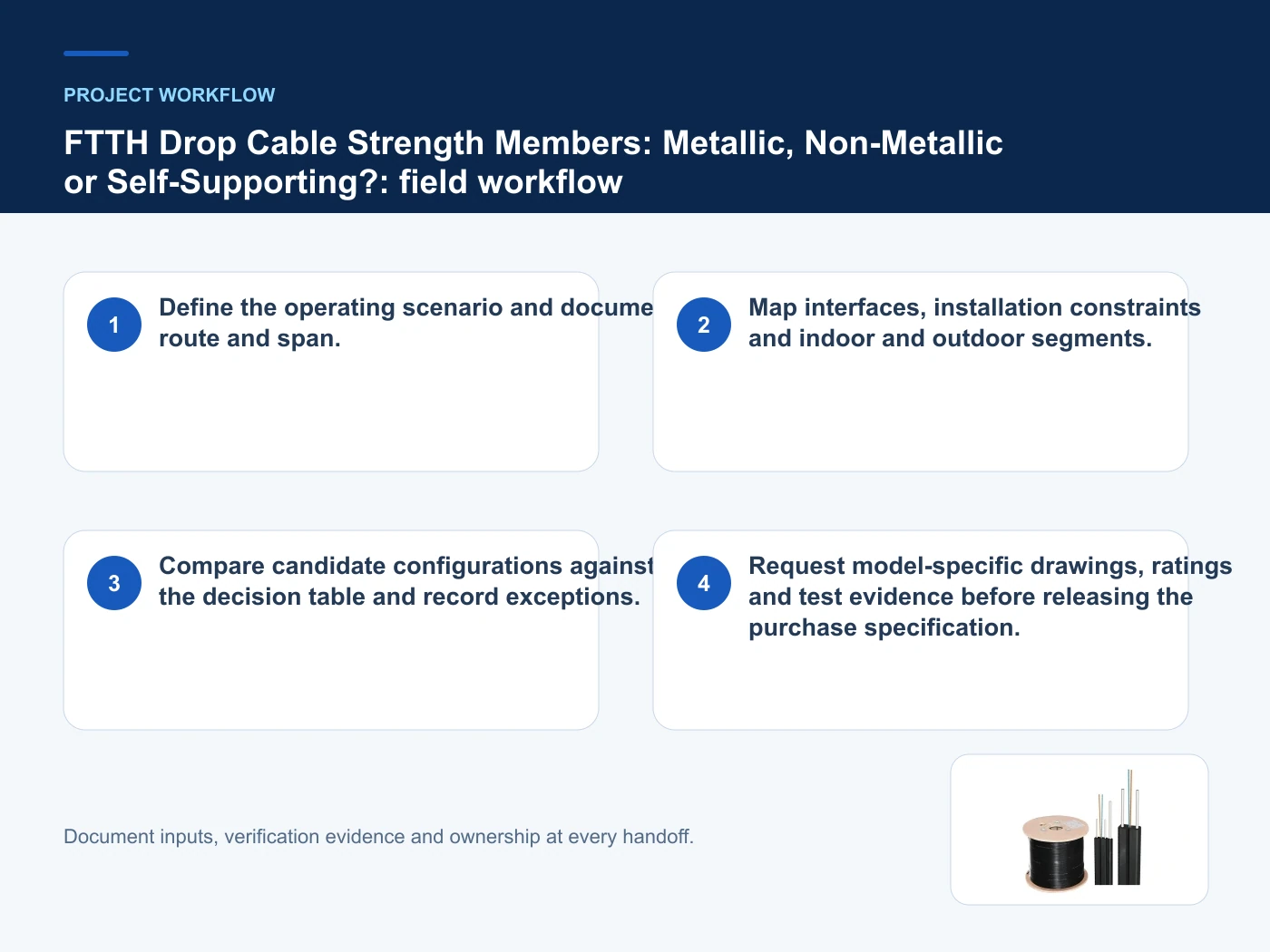
- Step 1: Define the operating scenario and document route and span. Record Route and span as an explicit input. Jacket, bend radius and fire requirement.
- Step 2: Map interfaces, installation constraints and indoor and outdoor segments. Record Indoor and outdoor segments as an explicit input. Grounding rules, span and messenger details.
- Step 3: Compare candidate configurations against the decision table and record exceptions. Record Strength-member restriction as an explicit input. Span rating, clamps and wind exposure.
- Step 4: Request model-specific drawings, ratings and test evidence before releasing the purchase specification. Record Fibre grade and count as an explicit input. Jacket, bend radius and fire requirement.
Relevant products from our communications portfolio
The products below connect the FTTH drop cable strength member decision to real catalogue families and verified site photography. They are starting points, not a claim that every configuration described here is a standard stock item; confirm model, interface, rating, drawing and testing scope with the project team.
- Drop Cable – GJXFH Non-metallic Strength Member — use this product page as a configuration reference when you separate indoor routing from the outdoor drop span. Confirm the offered model, interfaces, drawings and available evidence before quotation.
- Drop Cable – GJYXCH Self-Supporting Metal Strength Member — use this product page as a configuration reference when you confirm whether a conductive strength member is permitted. Confirm the offered model, interfaces, drawings and available evidence before quotation.
- Drop Cable – GJYXFCH Self-Supporting Non-Metallic Strength Member — use this product page as a configuration reference when you define span, attachment hardware and expected handling loads. Confirm the offered model, interfaces, drawings and available evidence before quotation.
For adjacent configurations, browse Fiber Optic Cables and compare those options against the FTTH drop cable strength member inputs above, including route and span.
Common mistakes to avoid
- Selecting from a catalogue image before route and span is fixed.
- Treating a category-page description as model-specific compliance evidence.
- Leaving drum or coil length undefined until after quotation.
What to include in the RFQ or design input
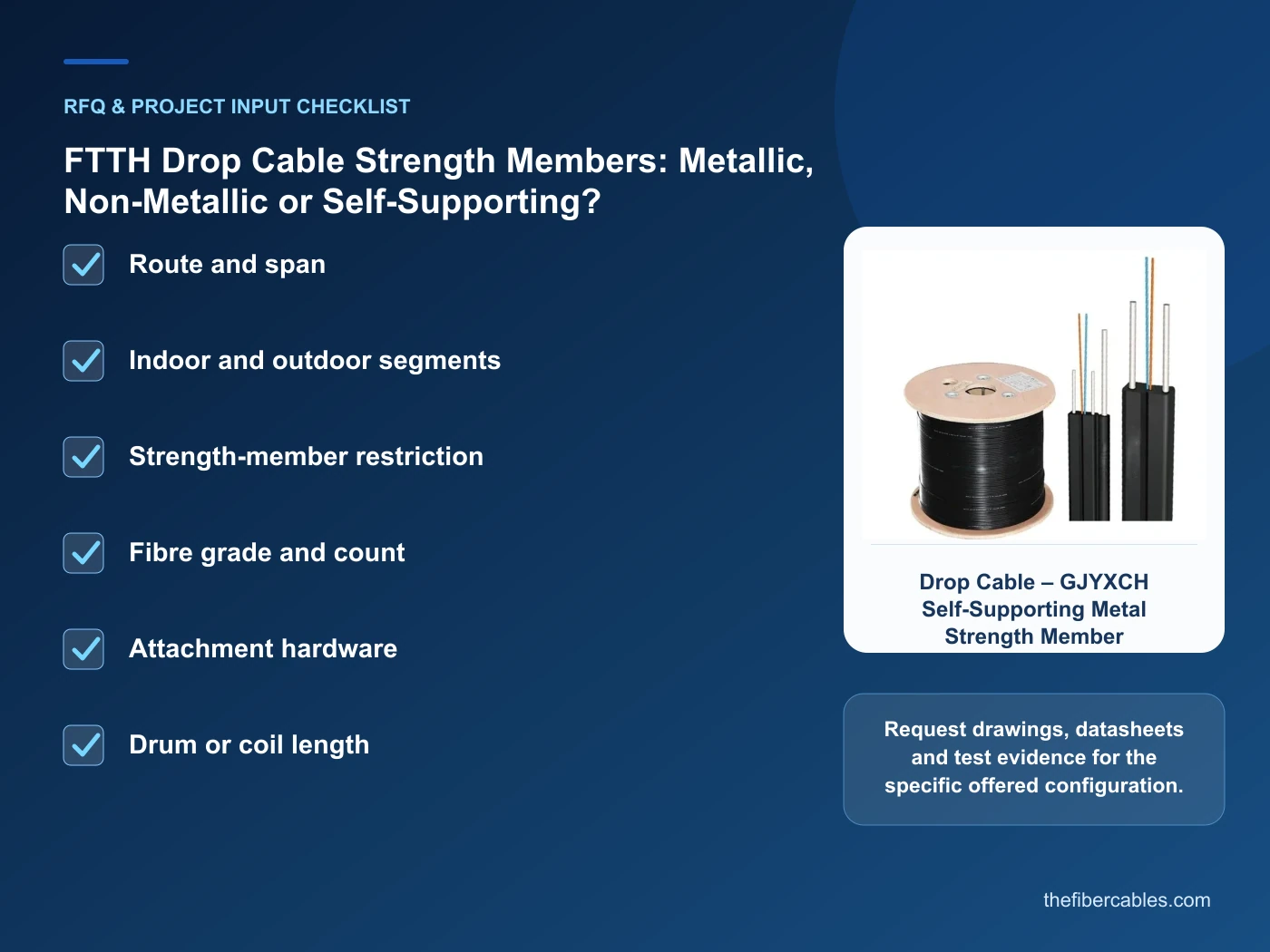
For FTTH drop cable strength member, a complete request reduces back-and-forth and prevents a catalogue image from being mistaken for a verified configuration. Record the following fields, identify which values are mandatory or provisional and attach route, interface or layout drawings where relevant.
- Route and span
- Indoor and outdoor segments
- Strength-member restriction
- Fibre grade and count
- Attachment hardware
- Drum or coil length
Questions engineers and buyers ask
How should non-metallic indoor drop be evaluated for FTTH drop cable strength member?
Use short indoor or protected access routing as the operating context, record route and span, and verify jacket, bend radius and fire requirement for the exact offered configuration.
Which project input can change the FTTH drop cable strength member decision?
Separate indoor routing from the outdoor drop span. Recheck that decision when indoor and outdoor segments or strength-member restriction changes.
Sources and standards
Use these primary references to check the engineering boundary for FTTH drop cable strength member. Product compliance still requires model-specific drawings, declarations and test evidence for the configured system.
- ITU-T G.657: Bend-insensitive single-mode optical fibre and cable (08/2024). Use it to verify the terminology and scope relevant to FTTH drop cable strength member; the source does not certify a specific offered product.
- IEC 60794-1-1: Optical fibre cables — Generic specification (2023, Ed.5). Use it to verify the terminology and scope relevant to FTTH drop cable strength member; the source does not certify a specific offered product.
- ITU-T L.103: Optical fibre cables for indoor application (08/2024). Use it to verify the terminology and scope relevant to FTTH drop cable strength member; the source does not certify a specific offered product.
Source review: Links and cited editions for FTTH drop cable strength member were checked on 2026-10-16. Confirm the edition adopted by the project contract and the authority having jurisdiction.
Related guidance
Duct vs Direct-Buried Fiber Cable: Armor, Water Blocking and Route Inputs • Armored Flame-Retardant Fiber Cable for Building-Entrance Transitions • Fiber Cable Drum Length and Reel Handling for Long Outside-Plant Routes
Prepare a FTTH drop cable strength member configuration for review
Share route and span, indoor and outdoor segments, strength-member restriction plus the intended installation and order quantity. We will map those inputs to a product family and a reviewable project configuration.
——END——