
Campus and backbone routes
Select indoor, outdoor or armored constructions around fiber count, route length and installation method.
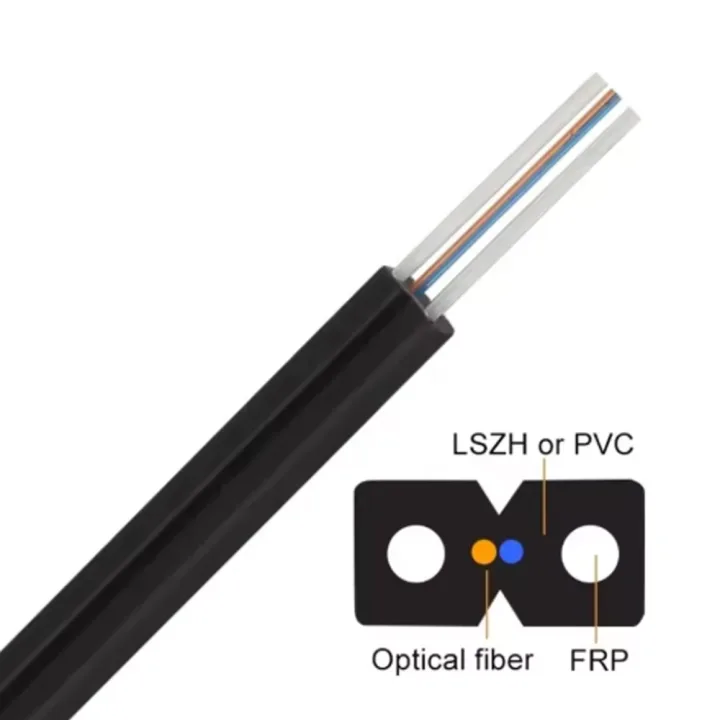
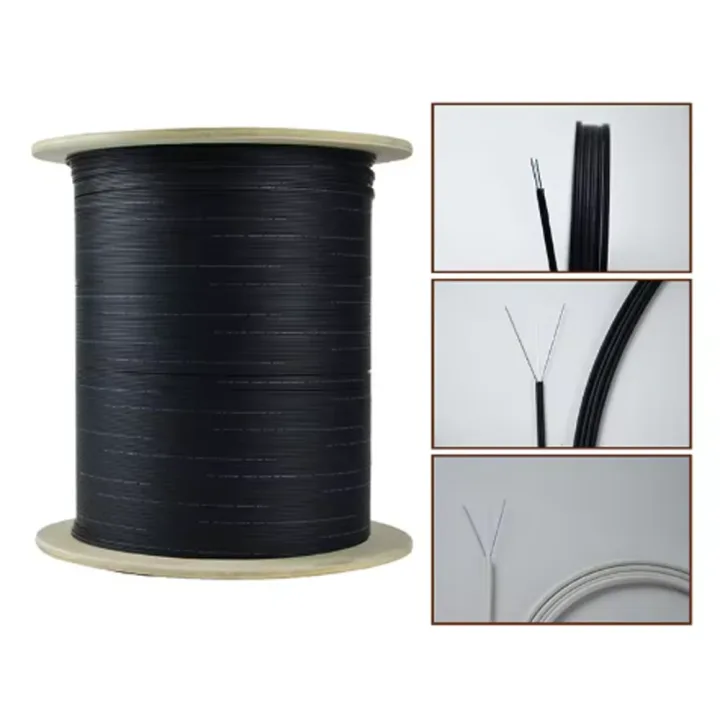
A 2.0 × 3.0 mm butterfly drop cable using paired FRP strength members and an LSZH sheath for subscriber connections within FTTH and related access routes.
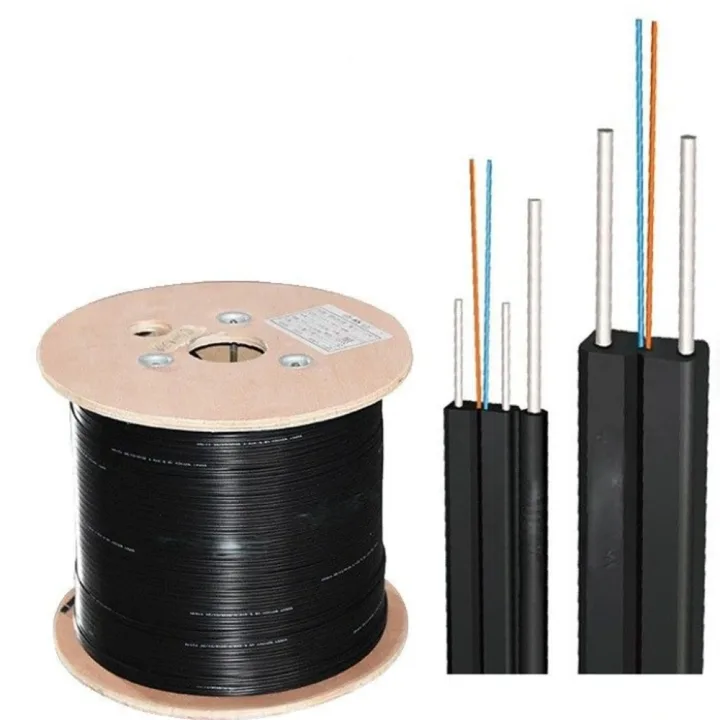
GJXFH places the optical fibers between two parallel FRP members inside a flat butterfly profile. It serves subscriber-drop routes in FTTH, FTTO and FTTB networks, with a center groove that assists sheath opening and fiber preparation.
This construction uses non-metallic strength members alongside the fibers. It does not include the independent steel messenger described on self-supporting drop-cable variants, so the route’s support requirements must be checked separately.
Select the fiber grade with the route's bends in mind. The table distinguishes static/dynamic bend limits: 30/60 mm for B1.1/B1.3, 15/30 mm for B6a and 10/25 mm for B6b. Confirm the required grade and finished-cable limits on the order sheet. The listed crush references are 1000/2200 N per 100 mm for long-/short-term duty.
Huijue Group can review OEM GJXFH cable, private-label sheath printing and sample- or drawing-based lengths and termination requirements. FRP and jacket changes, tooling, optical/mechanical tests, quantity and delivery scope require engineering confirmation.
Provide fiber grade/count, white or black sheath, route geometry, pulling conditions, required lengths, termination plan and the jacket test requirements.
| Parameter | Technical Specification | |||||||
|---|---|---|---|---|---|---|---|---|
| Product Model | GJXFH-4 cores and below | |||||||
| Product Type | Non-metallic Strength Member Butterfly Drop Cable | |||||||
| Fiber Count | 4 cores and below | |||||||
| Fiber Type | B1.1 / B1.3 / B6a / B6b | |||||||
| Strength Member | Two parallel FRP non-metallic strength members | |||||||
| Sheath Material | LSZH flame-retardant sheath | |||||||
| Sheath Color | White / Black | |||||||
| Dimensions | 2.0mm × 3.0mm | |||||||
| Applicable Networks | FTTH / FTTO / FTTB | |||||||
| Operating Wavelength | B1.1, B1.3 (G.652) | B6a (G.657A) | B6b (G.657B) | |||||
| 1310nm | ≤0.40dB/km | ≤0.40dB/km | ≤0.60dB/km | |||||
| 1550nm | ≤0.30dB/km | ≤0.30dB/km | ≤0.50dB/km | |||||
| Cable Model | Fiber Count | Fiber Type | Allowable Tensile Load (N) | Allowable Crush Load (N/100mm) | Bend Radius (mm) | |||
| Long-term | Short-term | Long-term | Short-term | Static | Dynamic | |||
| GJXFH | 4 cores and below | B1.1, B1.3 | 100 | 200 | 1000 | 2200 | 30 | 60 |
| B6a | 100 | 200 | 1000 | 2200 | 15 | 30 | ||
| B6b | 100 | 200 | 1000 | 2200 | 10 | 25 |
For subscriber access drops and compact building-entry or indoor routing where the selected GJXFH construction meets pathway requirements.
Confirm the actual installation exposure and required fire criteria for the LSZH sheath. No numerical temperature range is established in this product's local model table.
Buyer Questions
Answers specific to Drop Cable – GJXFH Non-metallic Strength Member selection, configuration and purchasing.
No separate messenger is described in this construction. It has two FRP members alongside the fiber; aerial support requirements need separate review.
The table assigns different limits to B1.1/B1.3, B6a and B6b variants. Select the fiber grade explicitly and use its approved cable limits.
Use the deployment context to narrow the configuration before comparing dimensions, capacities and options.
Select indoor, outdoor or armored constructions around fiber count, route length and installation method.
Coordinate feeder, distribution and drop cables with the building-entry and subscriber topology.
Match tensile, crush, moisture and armor requirements to poles, ducts or direct-buried routes.
Use FTTA or hybrid constructions where optical transmission and site power share a route.
Before quotation: confirm capacity, interfaces, installation environment, power conditions, quantity and required options.