
Direct answer
Outdoor battery cabinet design begins with the actual battery modules, not a target kWh value. Record module dimensions, mass, orientation, terminal access, lifting method, cable bend, protective devices and BMS connections. Shelves and restraints must support the installed load and allow module removal without damaging adjacent wiring. The layout should provide isolation, grounding, controlled cable routes, sensor placement and the heating or cooling interfaces required by the battery documentation. Also review floor or plinth loading, transport, door opening, water paths and the sequence for replacing a failed module. Environmental or safety standards can guide requirements, but project acceptance needs evidence for the selected batteries, cabinet construction and integrated configuration rather than a generic enclosure claim.
Within the broader Outdoor Cabinet Applications workflow, this article focuses on outdoor battery cabinet design: configure the mechanical, electrical and service layout of an outdoor cabinet for a defined battery system. Confirm battery model, quantity and arrangement and the evidence for the offered product before final engineering approval.
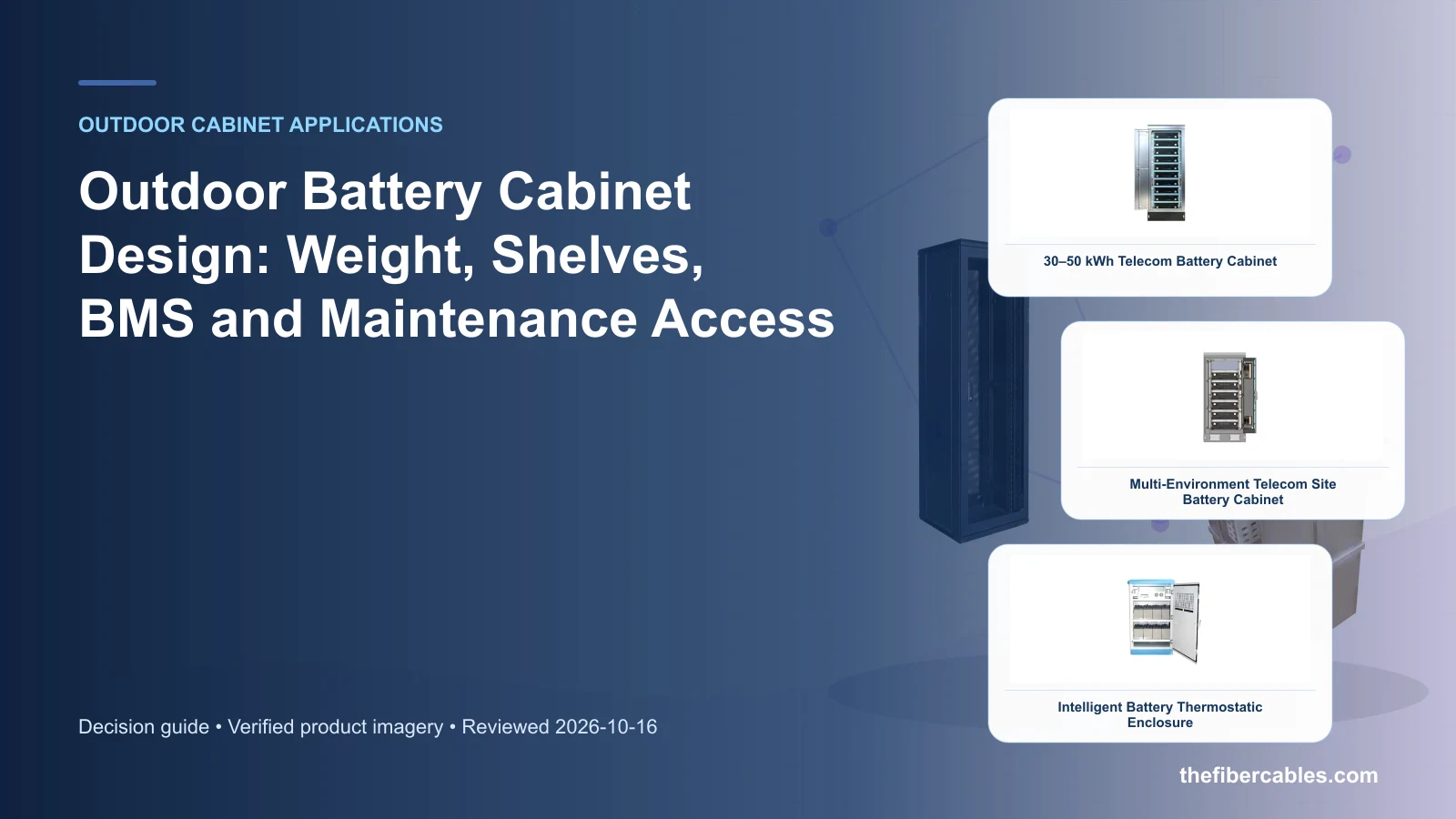
Project inputs that narrow the product family
Configure the mechanical, electrical and service layout of an outdoor cabinet for a defined battery system. Start with the operating requirement and installation boundary, then separate system requirements from product claims so each supplier knows which evidence must accompany the offered configuration.
- Design shelves and restraints for the selected module mass and geometry.
- Provide isolation and cable access without removing unrelated modules.
- Coordinate BMS, sensors and thermal devices in one controlled layout.
Design shelves and restraints for the selected module mass and geometry
Capture Battery model, quantity and arrangement, then use Mechanical as a practical comparison point: Mass, shelves, restraint and lifting. Before approval, verify this point: Design around actual modules.
Provide isolation and cable access without removing unrelated modules
Capture Module dimensions and mass, then use Electrical as a practical comparison point: Isolation, protection, cables and BMS. Before approval, verify this point: Keep interfaces accessible and traceable.
Coordinate BMS, sensors and thermal devices in one controlled layout
Capture Terminal and cable orientation, then use Service as a practical comparison point: Doors, replacement path and monitoring. Before approval, verify this point: Support safe maintenance throughout life.
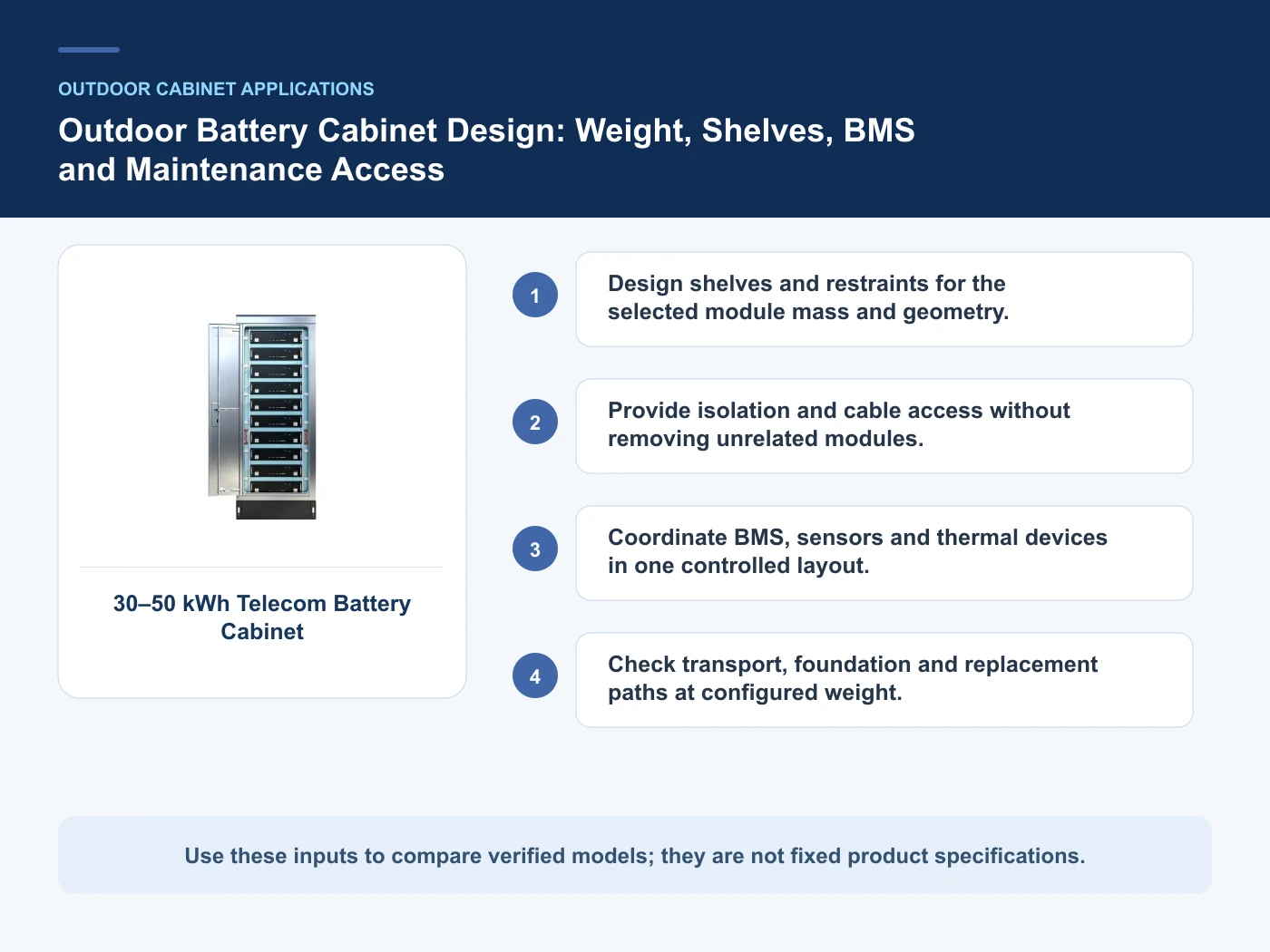
Relevant products from our communications portfolio
The products below connect the outdoor battery cabinet design decision to real catalogue families and verified site photography. They are starting points, not a claim that every configuration described here is a standard stock item; confirm model, interface, rating, drawing and testing scope with the project team.
- 30–50 kWh Telecom Battery Cabinet — use this product page as a configuration reference when you design shelves and restraints for the selected module mass and geometry. Confirm the offered model, interfaces, drawings and available evidence before quotation.
- Multi-Environment Telecom Site Battery Cabinet — use this product page as a configuration reference when you provide isolation and cable access without removing unrelated modules. Confirm the offered model, interfaces, drawings and available evidence before quotation.
- Intelligent Battery Thermostatic Enclosure — use this product page as a configuration reference when you coordinate BMS, sensors and thermal devices in one controlled layout. Confirm the offered model, interfaces, drawings and available evidence before quotation.
For adjacent configurations, browse Outdoor Cabinets & Site Infrastructure and compare those options against the outdoor battery cabinet design inputs above, including battery model, quantity and arrangement.
Selection boundaries to verify
This table connects edge, battery, emergency, non-metallic, shelter and integrated-site applications with installation-specific trade-offs to the decision on outdoor battery cabinet design. It is a decision aid rather than a universal performance table: exact capacity, environmental class, electrical or optical limits and certifications must come from the selected model, applicable project documents and verifiable test evidence.
| Option or input | When it fits | What must be verified |
|---|---|---|
| Mechanical | Mass, shelves, restraint and lifting | Design around actual modules |
| Electrical | Isolation, protection, cables and BMS | Keep interfaces accessible and traceable |
Reference point: IEC 62619: Safety requirements for secondary lithium cells and batteries for industrial applications and IEC 62208:2023 — Empty enclosures for low-voltage switchgear and controlgear assemblies frame the terminology or method used for this outdoor battery cabinet design comparison. They do not approve a product configuration; apply the edition named by the contract and local authority.
A practical product-selection workflow
- Step 1: Confirm the battery configuration. Record Battery model, quantity and arrangement as an explicit input. Design around actual modules.
- Step 2: Design supports, cables and isolation. Record Module dimensions and mass as an explicit input. Keep interfaces accessible and traceable.
- Step 3: Integrate thermal control and monitoring. Record Terminal and cable orientation as an explicit input. Support safe maintenance throughout life.
Common mistakes to avoid
- Designing shelves from cabinet capacity instead of module mass.
- Blocking battery terminals or removal paths.
What to include in the RFQ or design input
For outdoor battery cabinet design, a complete request reduces back-and-forth and prevents a catalogue image from being mistaken for a verified configuration. Record the following fields, identify which values are mandatory or provisional and attach route, interface or layout drawings where relevant.
- Battery model, quantity and arrangement
- Module dimensions and mass
- Terminal and cable orientation
- Isolation and protection devices
- BMS and sensor interfaces
- Heating and cooling requirements
- Foundation and transport constraints
Questions engineers and buyers ask
How should mechanical be evaluated for outdoor battery cabinet design?
Use mass, shelves, restraint and lifting as the operating context, record battery model, quantity and arrangement, and verify design around actual modules for the exact offered configuration.
Which project input can change the outdoor battery cabinet design decision?
Design shelves and restraints for the selected module mass and geometry. Recheck that decision when module dimensions and mass or terminal and cable orientation changes.
Sources and standards
Use these primary references to check the engineering boundary for outdoor battery cabinet design. Product compliance still requires model-specific drawings, declarations and test evidence for the configured system.
- IEC 62619: Safety requirements for secondary lithium cells and batteries for industrial applications (2022, Ed. 2). Use it to verify the terminology and scope relevant to outdoor battery cabinet design; the source does not certify a specific offered product.
- IEC 62208:2023 — Empty enclosures for low-voltage switchgear and controlgear assemblies (2023, Ed. 3). Use it to verify the terminology and scope relevant to outdoor battery cabinet design; the source does not certify a specific offered product.
- ETSI EN 300 019-1-4: Environmental conditions and environmental tests for telecommunications equipment — stationary use at non-weatherprotected locations (V3.1.1, 2026). Use it to verify the terminology and scope relevant to outdoor battery cabinet design; the source does not certify a specific offered product.
- ETSI TR 102 489: Thermal management guidance for telecommunications equipment (V1.3.1, 06/2013). Use it to verify the terminology and scope relevant to outdoor battery cabinet design; the source does not certify a specific offered product.
Source review: Links and cited editions for outdoor battery cabinet design were checked on 2026-10-16. Confirm the edition adopted by the project contract and the authority having jurisdiction.
Related guidance
5G Edge Cabinet Design: Radio, Transport, Power and Cooling in a Small Footprint • Can Batteries and Telecom Electronics Share One Outdoor Cabinet? • Portable Emergency Communication Cabinet: Load, Runtime and Deployment Checklist
Prepare a outdoor battery cabinet design configuration for review
Share battery model, quantity and arrangement, module dimensions and mass, terminal and cable orientation plus the intended installation and order quantity. We will map those inputs to a product family and a reviewable project configuration.
——END——