
Passive optical distribution
Match splitter or WDM architecture to wavelength plan, ratio, package and insertion-loss targets.
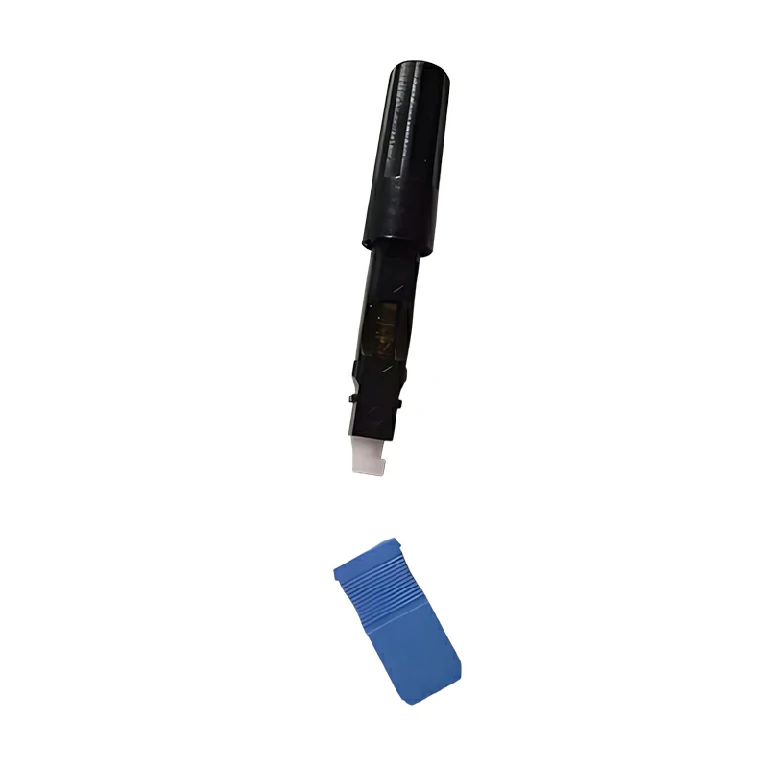
SC-format field-installable fiber connectors for terminating drop cable on site, with mechanical and fusion-splice assembly approaches.
Field-Installable Fiber Optic Connectors allow an installer to terminate a drop cable at the work site instead of ordering a factory-finished patch cord. The current family distinguishes mechanical and fusion-splice approaches; the mechanical version uses a pre-embedded fiber, matching medium and a heat-resistant V-groove arrangement.
Field assembly reduces the need to predict every finished length, but connector quality depends strongly on fiber preparation, cleave condition, compatible cable and technician procedure. It should be selected as part of an approved installation method rather than as a universal connector for any drop cable.
Specify SC/UPC or SC/APC, mechanical or fusion method, fiber and cable dimensions, required tools and the installer's acceptance test. The table lists different insertion-loss limits for standard and arbitrary mating plugs, so the project test method must be agreed.
Huijue Group can review OEM field-connector kits, private-label bags and tool/connector bundles from a cable sample or cross-section drawing. Fit, cleave length, assembly sequence, test criteria, shelf-life controls and volume require engineering and quality approval.
| Test Item | Mechanical Type | Fusion Splicing Type | ||
| Average Value | Maximum Value | Average Value | Maximum Value | |
| Insertion Loss | ≤ 0.25 | Test with Standard Plug and Adapter: ≤ 0.5; Test with Any Plug and Adapter: ≤ 0.7 | ≤ 0.2 | Test with Standard Plug and Adapter: ≤ 0.4; Test with Any Plug and Adapter: ≤ 0.7 |
| Return Loss | —— | ≥ 50 (UPC); ≥ 55 (APC) | —— | ≥ 50 (UPC); ≥ 60 (APC) |
Note: The optical performance requirements of fiber optic field connectors are in dB.
Prepare and assemble the fiber in a clean, controlled work area where practical. Keep matching surfaces free of dust and moisture, follow the defined cleave length and test each completed connector before closing the enclosure.
Buyer Questions
Answers specific to Field-Installable Fiber Optic Connectors selection, configuration and purchasing.
It is considered when on-site termination is needed and the cable, cleaver, preparation process and acceptance test are controlled.
No. The current table gives different average insertion-loss limits and return-loss values, so the method must be specified.
No. Cable geometry and fiber preparation dimensions must match the connector design.
Use the deployment context to narrow the configuration before comparing dimensions, capacities and options.
Match splitter or WDM architecture to wavelength plan, ratio, package and insertion-loss targets.
Coordinate connector, polish, fiber grade, polarity and cable length across patching points.
Plan MPO/MTP trunks and harnesses around port mapping, breakout format and rack density.
Select splicing, cleaning and test tools for the connector types and measurements used on site.
Before quotation: confirm capacity, interfaces, installation environment, power conditions, quantity and required options.