
Direct answer
An aesthetic radome can reduce the visual impact of antennas, but appearance is only one part of the selection. The project must confirm the supported antenna envelope, material and thickness consistency, radio-frequency performance evidence, drainage and ventilation, wind and structural interfaces, access, colour/finish durability, lightning and grounding boundaries, and local planning approval. Do not infer RF loss or wind capacity from photographs.
Within the broader Outdoor Telecom & Edge Sites workflow, this article focuses on aesthetic antenna radome: coordinate visual integration with radio, structural and approval requirements. Confirm antenna dimensions/bands and the evidence for the offered product before final engineering approval.
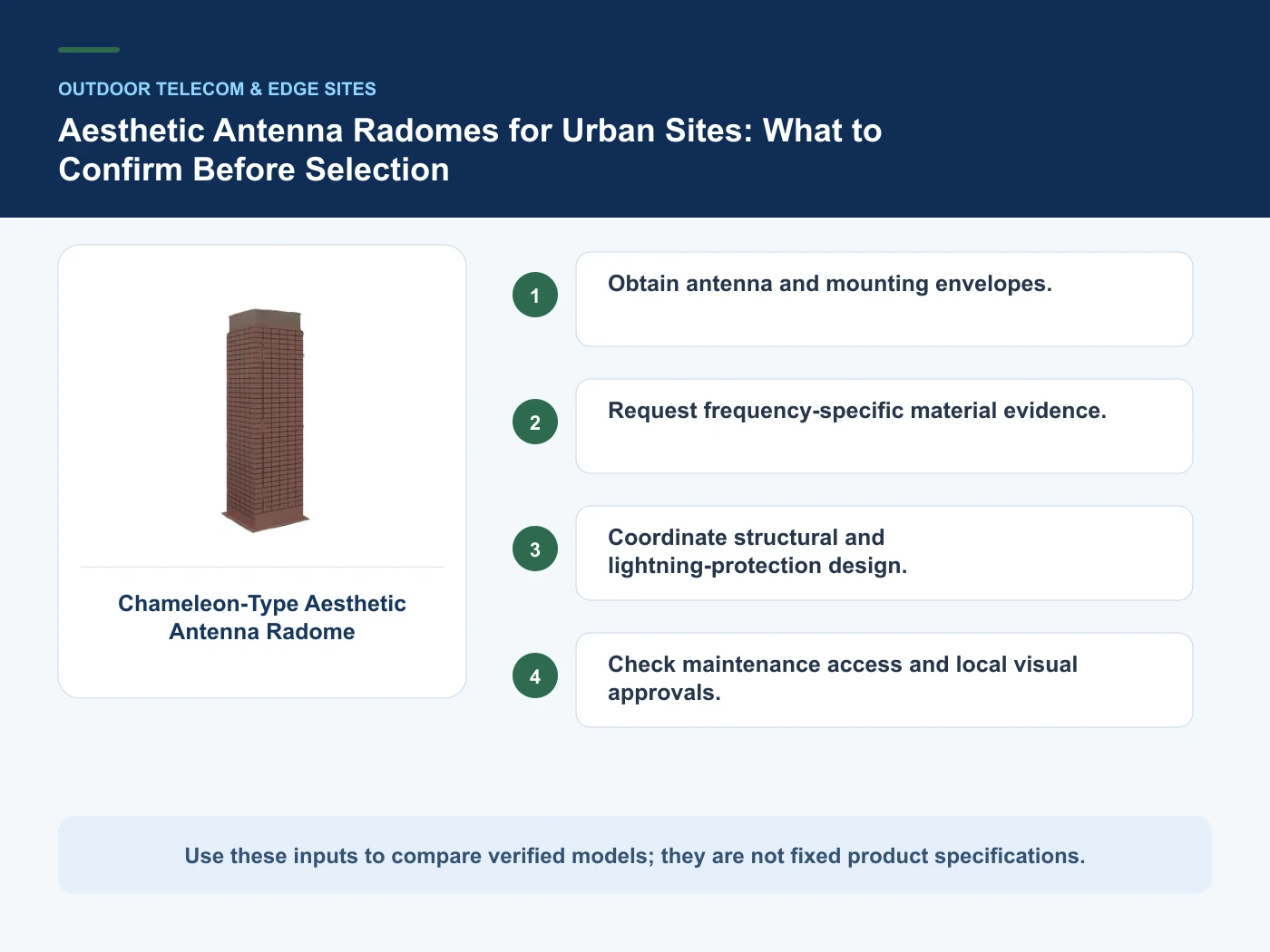
Project inputs that narrow the product family
Coordinate visual integration with radio, structural and approval requirements. Start with the operating requirement and installation boundary, then separate system requirements from product claims so each supplier knows which evidence must accompany the offered configuration.
- Obtain antenna and mounting envelopes.
- Request frequency-specific material evidence.
- Coordinate structural and lightning-protection design.
- Check maintenance access and local visual approvals.
Obtain antenna and mounting envelopes
Capture Antenna dimensions/bands, then use Visual form as a practical comparison point: Matches urban context. Before approval, verify this point: Must not obstruct access or drainage.
Request frequency-specific material evidence
Capture Required appearance, then use RF enclosure as a practical comparison point: Protects/conceals antennas. Before approval, verify this point: Require evidence for intended bands and geometry.
Coordinate structural and lightning-protection design
Capture RF evidence, then use Structure as a practical comparison point: Transfers wind and equipment loads. Before approval, verify this point: Project engineer confirms mounting and foundation.
Check maintenance access and local visual approvals
Capture Wind/structural inputs, then use Approval as a practical comparison point: Local planning/landlord requirements. Before approval, verify this point: Varies by jurisdiction and site.
Relevant products from our communications portfolio
The products below connect the aesthetic antenna radome decision to real catalogue families and verified site photography. They are starting points, not a claim that every configuration described here is a standard stock item; confirm model, interface, rating, drawing and testing scope with the project team.
- Antenna Concealment Radome — use this product page as a configuration reference when you obtain antenna and mounting envelopes. Confirm the offered model, interfaces, drawings and available evidence before quotation.
- Outdoor Integrated Cabinet — use this product page as a configuration reference when you request frequency-specific material evidence. Confirm the offered model, interfaces, drawings and available evidence before quotation.
For adjacent configurations, browse Outdoor Cabinets & Site Infrastructure and compare those options against the aesthetic antenna radome inputs above, including antenna dimensions/bands.
Selection boundaries to verify
This table connects enclosures, thermal management, environmental exposure, site integration and maintenance access to the decision on aesthetic antenna radome. It is a decision aid rather than a universal performance table: exact capacity, environmental class, electrical or optical limits and certifications must come from the selected model, applicable project documents and verifiable test evidence.
| Option or input | When it fits | What must be verified |
|---|---|---|
| Visual form | Matches urban context | Must not obstruct access or drainage |
| RF enclosure | Protects/conceals antennas | Require evidence for intended bands and geometry |
| Structure | Transfers wind and equipment loads | Project engineer confirms mounting and foundation |
| Approval | Local planning/landlord requirements | Varies by jurisdiction and site |
Reference point: ETSI EN 300 019-1-4 environmental conditions for non-weatherprotected locations and IEC 62305-2: Protection against lightning — Risk management frame the terminology or method used for this aesthetic antenna radome comparison. They do not approve a product configuration; apply the edition named by the contract and local authority.
A practical product-selection workflow
- Step 1: Freeze antenna and band requirements. Record Antenna dimensions/bands as an explicit input. Must not obstruct access or drainage.
- Step 2: Select form/material with test evidence. Record Required appearance as an explicit input. Require evidence for intended bands and geometry.
- Step 3: Engineer structure, lightning and access. Record RF evidence as an explicit input. Project engineer confirms mounting and foundation.
- Step 4: Obtain site approvals before manufacture. Record Wind/structural inputs as an explicit input. Varies by jurisdiction and site.
Common mistakes to avoid
- Treating visual similarity as RF compatibility.
- Quoting universal wind capacity without project design.
- Concealing access panels needed for maintenance.
What to include in the RFQ or design input
For aesthetic antenna radome, a complete request reduces back-and-forth and prevents a catalogue image from being mistaken for a verified configuration. Record the following fields, identify which values are mandatory or provisional and attach route, interface or layout drawings where relevant.
- Antenna dimensions/bands
- Required appearance
- RF evidence
- Wind/structural inputs
- Lightning/grounding
- Access and approvals
Questions engineers and buyers ask
What should a buyer specify first for aesthetic antenna radome?
Begin with antenna dimensions/bands, required appearance, rf evidence; these inputs narrow the product family before optional features are compared.
Does a product photo confirm the final configuration?
No. Treat the image as a visual reference and confirm the model, drawing, interfaces, ratings and test evidence for the offered unit.
Sources and standards
For aesthetic antenna radome, the references below define relevant terminology, scope or test methods. ETSI EN 300 019-1-4 environmental conditions for non-weatherprotected locations is one documented boundary for this topic; neither a standards catalogue page nor a category page proves certification of the offered product. Apply the edition adopted by the contract, destination market and authority having jurisdiction.
- ETSI EN 300 019-1-4 environmental conditions for non-weatherprotected locations (V3.1.1, 05/2026; current edition). Use it to verify the terminology and scope relevant to aesthetic antenna radome; the source does not certify a specific offered product.
- IEC 62305-2: Protection against lightning — Risk management (2024, Ed.3 with corrigenda). Use it to verify the terminology and scope relevant to aesthetic antenna radome; the source does not certify a specific offered product.
- ITU-T K.56: Protection of radio base stations against lightning discharges (05/2021). Use it to verify the terminology and scope relevant to aesthetic antenna radome; the source does not certify a specific offered product.
- 3GPP TS 38.104: NR base-station radio transmission and reception (Under change control; reviewed 2026-10-15). Use it to verify the terminology and scope relevant to aesthetic antenna radome; the source does not certify a specific offered product.
Source review: Links and cited editions for aesthetic antenna radome were checked on 2026-10-15. Confirm the edition adopted by the project contract and the authority having jurisdiction.
Related guidance
Outdoor Telecom Site Design: Cabinets, Cooling, Power and Equipment Shelters • Outdoor Telecom Cabinet vs Equipment Shelter: Footprint, Service and Expansion • Fan Cooling vs Heat Exchanger vs Air Conditioner for Outdoor Telecom Cabinets
Prepare a aesthetic antenna radome configuration for review
Send antenna dimensions/bands, required appearance, rf evidence, wind/structural inputs, together with quantity and delivery destination. We will help narrow the relevant product family and identify the drawings or test evidence needed for quotation.
——END——