
Direct answer
Weak-grid and off-grid telecom sites require different source roles even when both use PV, batteries and a generator. A weak-grid design starts with measured outage frequency, duration, voltage quality and tariff behavior, then decides when the grid remains useful. An off-grid design must establish the complete seasonal energy balance, autonomy target, recovery path and backup-fuel strategy without assuming utility support. For either case, separate the critical telecom load from cooling and auxiliary loads, model worst-season generation, include battery operating limits and define source-priority, low-energy and failure modes. The selected cabinet and controller should follow the architecture rather than define it. Use standards to frame interfaces and battery safety, while project-specific resource data, load measurements, local rules and exact product evidence remain mandatory.
This pillar guide connects integrated site architecture, hybrid energy, batteries, BMS, monitoring, energy metrics and FAT/SAT handover. Use it to define project inputs before narrowing to a product family.
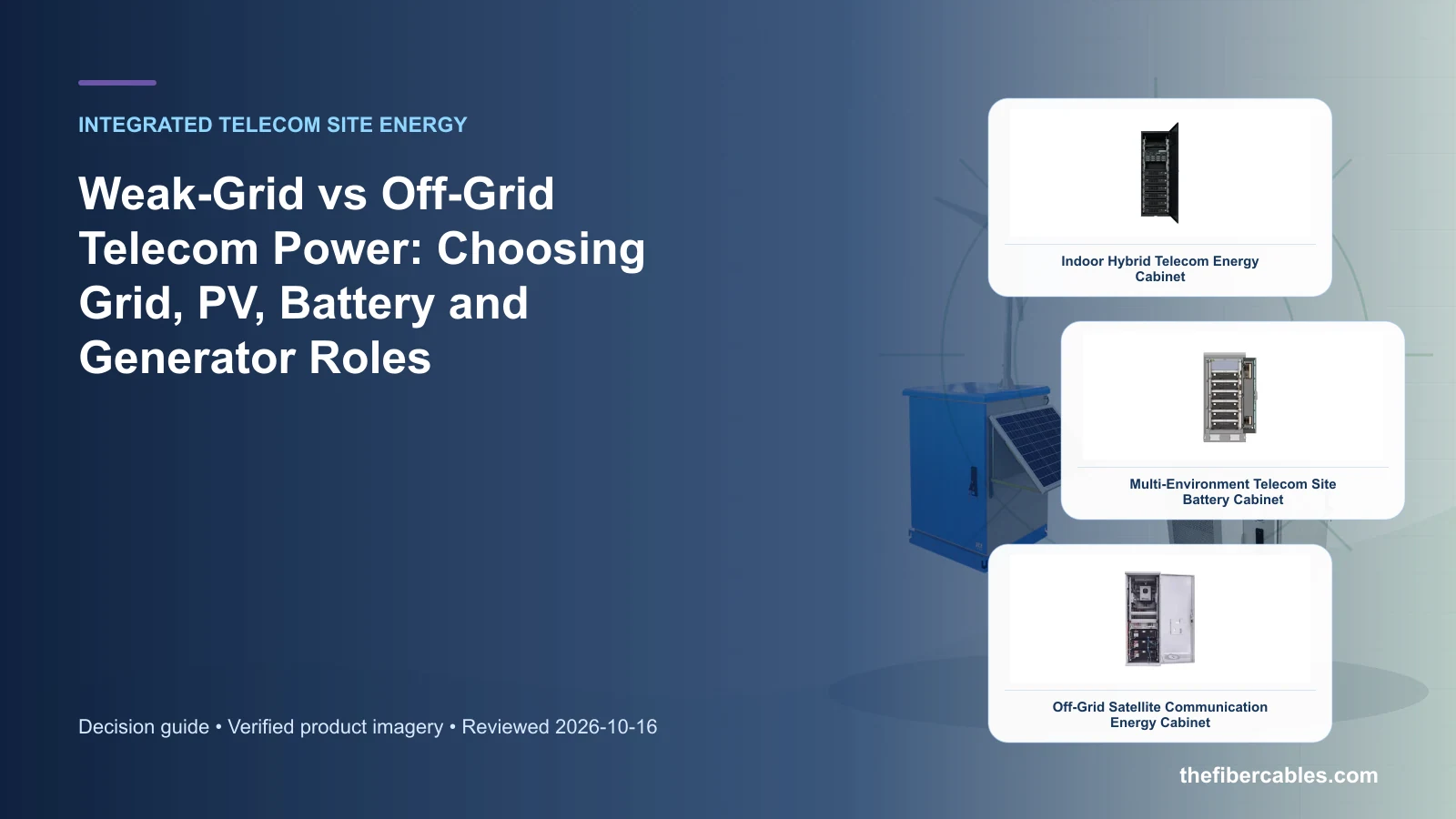
System boundaries to define before product selection
Choose a telecom site-energy architecture from source availability, load profile and service objectives. Start with the operating requirement and installation boundary, then separate system requirements from product claims so each supplier knows which evidence must accompany the offered configuration.
- Classify the grid from measured availability and quality rather than a connected or disconnected label.
- Build hourly and seasonal load cases for telecom, cooling and auxiliary equipment.
- Assign normal, backup and recovery roles to PV, battery, grid and generator sources.
Classify the grid from measured availability and quality rather than a connected or disconnected label
Capture Hourly load profile, then use Weak-grid hybrid as a practical comparison point: Utility is useful but outages or quality problems are material. Before approval, verify this point: Grid acceptance, source priority and battery cycling.
Build hourly and seasonal load cases for telecom, cooling and auxiliary equipment
Capture Grid outage and voltage-quality record, then use Off-grid solar plus storage as a practical comparison point: No dependable utility source is available. Before approval, verify this point: Worst-season balance, autonomy and recovery.
Assign normal, backup and recovery roles to PV, battery, grid and generator sources
Capture Solar resource and shading data, then use Off-grid with generator backup as a practical comparison point: Renewables and storage need a dispatchable recovery source. Before approval, verify this point: Fuel logistics, start logic and minimum loading.
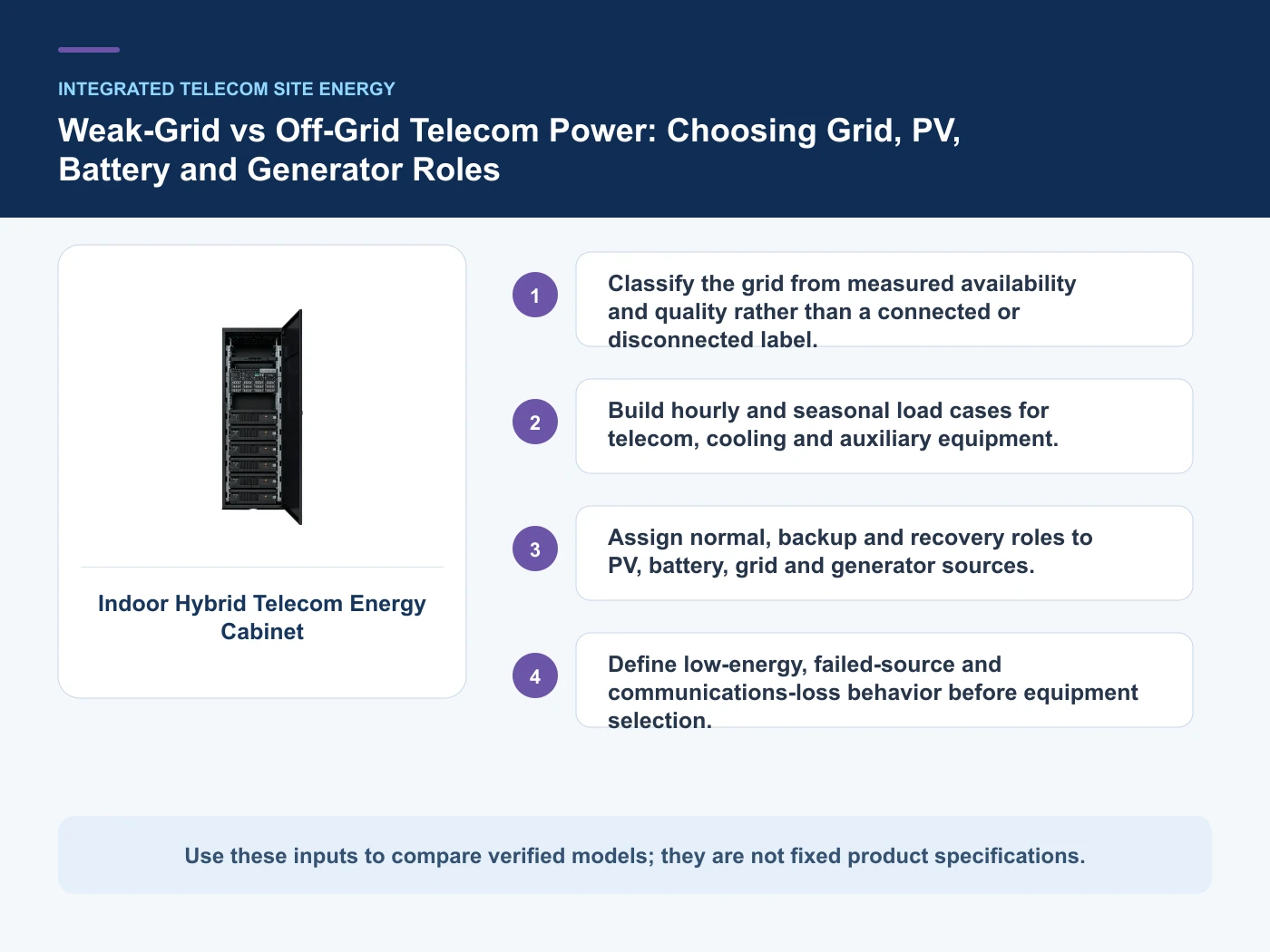
Architecture choices and verification boundaries
This table connects integrated site architecture, hybrid energy, batteries, BMS, monitoring, energy metrics and FAT/SAT handover to the decision on weak grid vs off grid telecom power. It is a decision aid rather than a universal performance table: exact capacity, environmental class, electrical or optical limits and certifications must come from the selected model, applicable project documents and verifiable test evidence.
| Option or input | When it fits | What must be verified |
|---|---|---|
| Weak-grid hybrid | Utility is useful but outages or quality problems are material | Grid acceptance, source priority and battery cycling |
| Off-grid solar plus storage | No dependable utility source is available | Worst-season balance, autonomy and recovery |
Reference point: ITU-T L.1210: Sustainable power-feeding solutions for 5G network and IEC 60364-7-712: Solar photovoltaic power supply installations frame the terminology or method used for this weak grid vs off grid telecom power comparison. They do not approve a product configuration; apply the edition named by the contract and local authority.
Classify the supply problem before choosing sources
A weak-grid site, an intermittently supplied site and a fully off-grid site have different failure patterns. Use outage duration, voltage quality, seasonal resource, fuel access and restoration behavior to define the problem rather than grouping all unreliable sites under one hybrid label.
Build an hourly or otherwise appropriate load profile that includes communications equipment, cooling, conversion losses, controls and battery charging. Peak nameplate values and daily energy answer different design questions.
Coordinate source priority and reserve
PV, wind, grid and generator inputs need a documented operating sequence covering normal supply, low renewable production, battery reserve, recharge and fault recovery. State which loads can be curtailed and which communications functions must remain available.
Check source and storage sizing against seasonal cases. A configuration that balances annual energy can still fail during a critical sequence of low production and long outage.
Make monitoring and service part of the architecture
Define meters, alarms, remote controls, data retention and communications ownership with the power design. Remote data should support troubleshooting without allowing unsafe or ambiguous control of protective functions.
The RFQ should separate equipment supply, cabinet integration, site wiring, commissioning and operational support so quotations cover the same project boundary.
From requirements to an auditable project decision
- Step 1: Validate the load profile and separate critical, deferrable, cooling and auxiliary demand. Record Hourly load profile as an explicit input. Grid acceptance, source priority and battery cycling.
- Step 2: Characterize grid quality, renewable resource, climate and service-access constraints. Record Grid outage and voltage-quality record as an explicit input. Worst-season balance, autonomy and recovery.
- Step 3: Model normal, worst-season, outage and recovery modes with explicit source priorities. Record Solar resource and shading data as an explicit input. Fuel logistics, start logic and minimum loading.
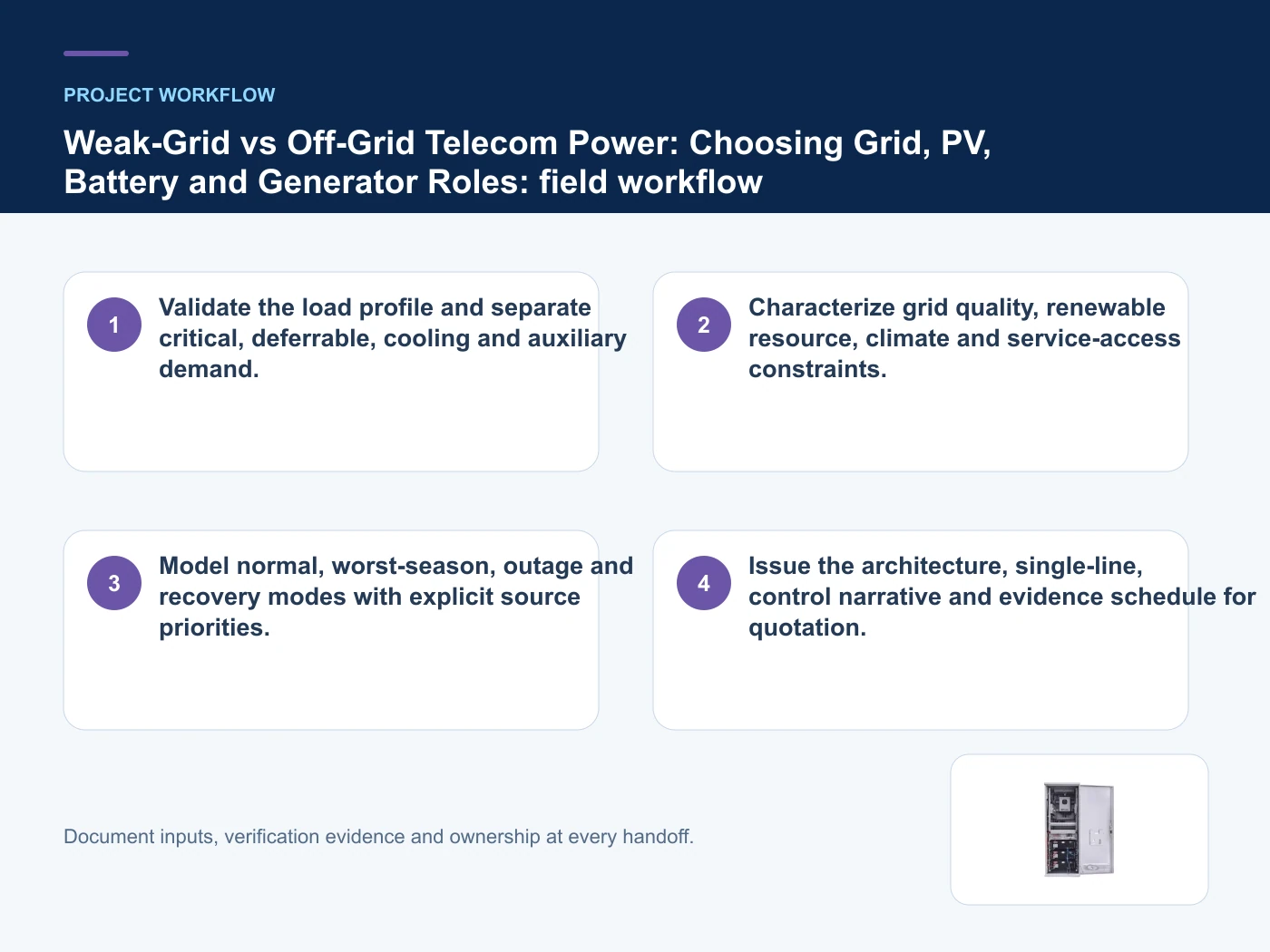
Relevant products from our communications portfolio
The products below connect the weak grid vs off grid telecom power decision to real catalogue families and verified site photography. They are starting points, not a claim that every configuration described here is a standard stock item; confirm model, interface, rating, drawing and testing scope with the project team.
- Indoor Hybrid Telecom Energy Cabinet — use this product page as a configuration reference when you classify the grid from measured availability and quality rather than a connected or disconnected label. Confirm the offered model, interfaces, drawings and available evidence before quotation.
- Multi-Environment Telecom Site Battery Cabinet — use this product page as a configuration reference when you build hourly and seasonal load cases for telecom, cooling and auxiliary equipment. Confirm the offered model, interfaces, drawings and available evidence before quotation.
- Off-Grid Satellite Communication Energy Cabinet — use this product page as a configuration reference when you assign normal, backup and recovery roles to PV, battery, grid and generator sources. Confirm the offered model, interfaces, drawings and available evidence before quotation.
- Outdoor Integrated Power Supply — use this product page as a configuration reference when you define low-energy, failed-source and communications-loss behavior before equipment selection. Confirm the offered model, interfaces, drawings and available evidence before quotation.
For adjacent configurations, browse Telecom Power & Site Energy and compare those options against the weak grid vs off grid telecom power inputs above, including hourly load profile.
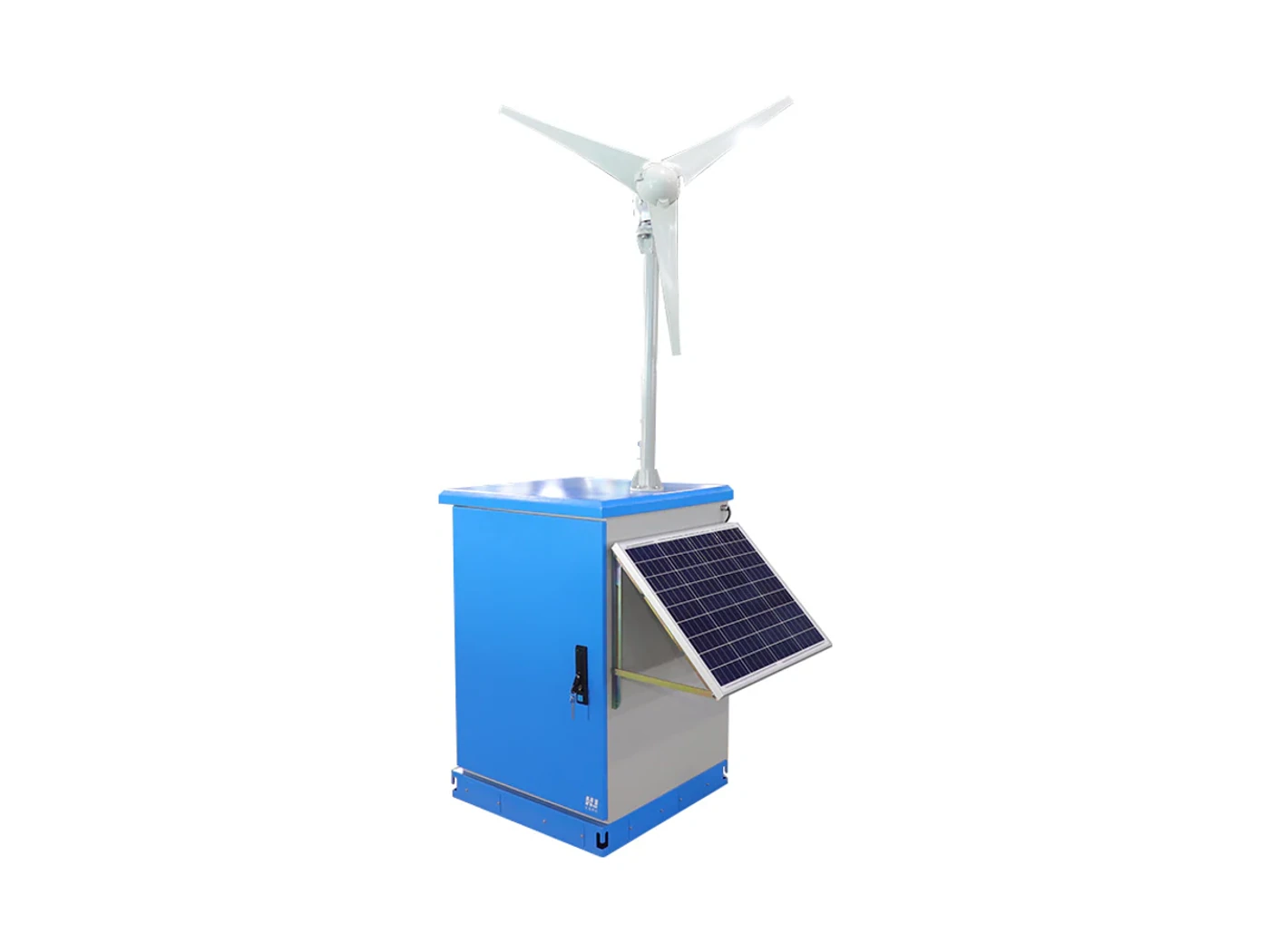
Common mistakes to avoid
- Calling a site weak-grid without quantified outage and voltage-quality data.
- Sizing PV and batteries from an annual average while ignoring the design season.
What to include in the RFQ or design input
For weak grid vs off grid telecom power, a complete request reduces back-and-forth and prevents a catalogue image from being mistaken for a verified configuration. Record the following fields, identify which values are mandatory or provisional and attach route, interface or layout drawings where relevant.
- Hourly load profile
- Grid outage and voltage-quality record
- Solar resource and shading data
- Autonomy objective
- Battery operating limits
- Generator data and fuel access
- Site temperature and altitude
Questions engineers and buyers ask
How should weak-grid hybrid be evaluated for weak grid vs off grid telecom power?
Use utility is useful but outages or quality problems are material as the operating context, record hourly load profile, and verify grid acceptance, source priority and battery cycling for the exact offered configuration.
Which project input can change the weak grid vs off grid telecom power decision?
Classify the grid from measured availability and quality rather than a connected or disconnected label. Recheck that decision when grid outage and voltage-quality record or solar resource and shading data changes.
Sources and standards
The references below define terminology, scope or test methods relevant to weak grid vs off grid telecom power. They do not certify an offered product; confirm the edition adopted by the contract and destination authority.
- ITU-T L.1210: Sustainable power-feeding solutions for 5G network (In force; reviewed 2026-10-16). Use it to verify the terminology and scope relevant to weak grid vs off grid telecom power; the source does not certify a specific offered product.
- IEC 60364-7-712: Solar photovoltaic power supply installations (2025, Ed.3). Use it to verify the terminology and scope relevant to weak grid vs off grid telecom power; the source does not certify a specific offered product.
- IEC 62619: Safety requirements for secondary lithium cells and batteries for industrial applications (2022, Ed. 2). Use it to verify the terminology and scope relevant to weak grid vs off grid telecom power; the source does not certify a specific offered product.
- IEC 61439-8: Low-voltage assemblies for photovoltaic installations (2026, Ed.1). Use it to verify the terminology and scope relevant to weak grid vs off grid telecom power; the source does not certify a specific offered product.
Source review: Links and cited editions for weak grid vs off grid telecom power were checked on 2026-10-16. Confirm the edition adopted by the project contract and the authority having jurisdiction.
Related guidance
LiFePO4 vs VRLA for Telecom Backup: Usable Energy, Temperature, BMS and Lifecycle Evidence • Telecom Battery Backup Runtime: Calculated Autonomy vs Site Verification • Multi-Vendor Telecom Site Monitoring: Alarms, Timestamps, Protocols and NOC Mapping
Prepare a weak grid vs off grid telecom power configuration for review
Send hourly load profile, grid outage and voltage-quality record, solar resource and shading data, autonomy objective, quantity and delivery destination. Huijue Group can review the configuration boundary and identify the drawings or evidence needed for a factory quotation.
——END——