
Direct answer
LiFePO4 and VRLA batteries for telecom backup should be compared on usable energy at the required discharge rate and temperature, compatible charging behavior, allowable depth of discharge, end-of-life reserve, fault current, physical mass, ventilation, monitoring and maintenance capability. Nominal Ah or kWh is not a complete comparison, and a lithium module should not be connected to a legacy rectifier until voltage limits, charge settings, BMS communications, parallel operation and protection have been reviewed. VRLA may fit an established maintenance and charging regime, while LiFePO4 can provide a different monitoring and packaging approach; the correct choice remains site-specific. Ask for model-level safety and performance evidence rather than inferring certification, life or runtime from the chemistry name.
Within the broader Integrated Telecom Site Energy workflow, this article focuses on lithium vs lead acid telecom battery: compare battery technologies against the site’s electrical, environmental, monitoring and maintenance requirements. Confirm required backup duration and the evidence for the offered product before final engineering approval.
Decisions that separate the options
Compare battery technologies against the site’s electrical, environmental, monitoring and maintenance requirements. Start with the operating requirement and installation boundary, then separate system requirements from product claims so each supplier knows which evidence must accompany the offered configuration.
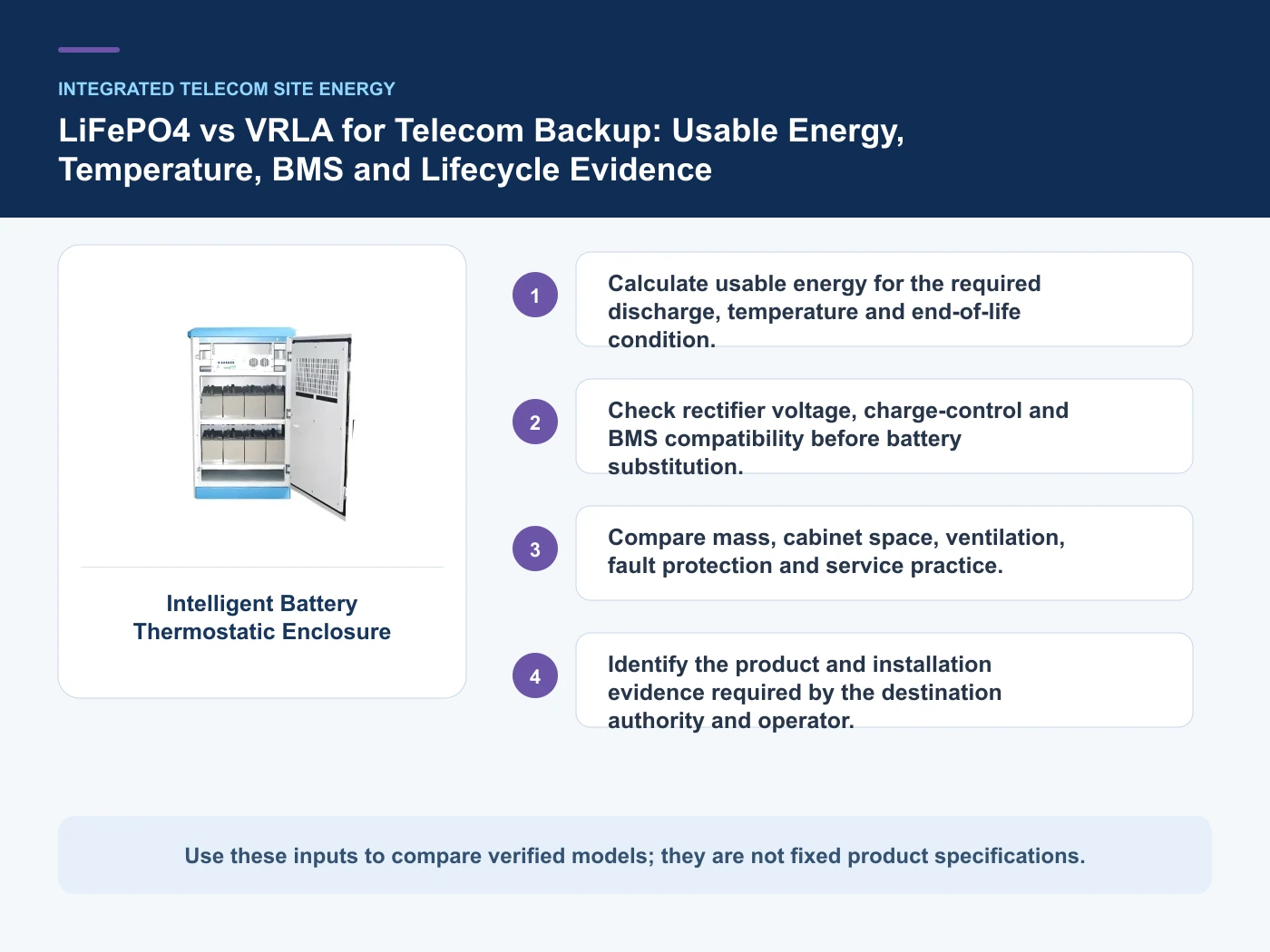
- Calculate usable energy for the required discharge, temperature and end-of-life condition.
- Check rectifier voltage, charge-control and BMS compatibility before battery substitution.
- Compare mass, cabinet space, ventilation, fault protection and service practice.
Calculate usable energy for the required discharge, temperature and end-of-life condition
Capture Required backup duration, then use VRLA battery string as a practical comparison point: Existing charging and maintenance practice is designed around VRLA. Before approval, verify this point: Temperature, ventilation, strings and replacement policy.
Check rectifier voltage, charge-control and BMS compatibility before battery substitution
Capture Load and discharge profile, then use LiFePO4 module as a practical comparison point: BMS integration and compatible charge control are available. Before approval, verify this point: Cell and pack evidence, protocol and protection.
Compare mass, cabinet space, ventilation, fault protection and service practice
Capture Temperature range, then use Phased technology migration as a practical comparison point: A fleet cannot change all sites at once. Before approval, verify this point: Site grouping, mixed-system restrictions and spares.
Where the options diverge
This table connects integrated site architecture, hybrid energy, batteries, BMS, monitoring, energy metrics and FAT/SAT handover to the decision on lithium vs lead acid telecom battery. It is a decision aid rather than a universal performance table: exact capacity, environmental class, electrical or optical limits and certifications must come from the selected model, applicable project documents and verifiable test evidence.
| Option or input | When it fits | What must be verified |
|---|---|---|
| VRLA battery string | Existing charging and maintenance practice is designed around VRLA | Temperature, ventilation, strings and replacement policy |
| LiFePO4 module | BMS integration and compatible charge control are available | Cell and pack evidence, protocol and protection |
Reference point: IEC 62619: Safety requirements for secondary lithium cells and batteries for industrial applications and IEC 60896-22: Stationary lead-acid batteries — Valve regulated types — Requirements frame the terminology or method used for this lithium vs lead acid telecom battery comparison. They do not approve a product configuration; apply the edition named by the contract and local authority.
Relevant products from our communications portfolio
The products below connect the lithium vs lead acid telecom battery decision to real catalogue families and verified site photography. They are starting points, not a claim that every configuration described here is a standard stock item; confirm model, interface, rating, drawing and testing scope with the project team.
- Intelligent Battery Thermostatic Enclosure — use this product page as a configuration reference when you calculate usable energy for the required discharge, temperature and end-of-life condition. Confirm the offered model, interfaces, drawings and available evidence before quotation.
- Multi-Environment Telecom Site Battery Cabinet — use this product page as a configuration reference when you check rectifier voltage, charge-control and BMS compatibility before battery substitution. Confirm the offered model, interfaces, drawings and available evidence before quotation.
- Standard Telecom LiFePO4 Backup Battery Module — use this product page as a configuration reference when you compare mass, cabinet space, ventilation, fault protection and service practice. Confirm the offered model, interfaces, drawings and available evidence before quotation.
- Smart Telecom LiFePO4 Backup Battery Module — use this product page as a configuration reference when you identify the product and installation evidence required by the destination authority and operator. Confirm the offered model, interfaces, drawings and available evidence before quotation.
For adjacent configurations, browse Telecom Power & Site Energy and compare those options against the lithium vs lead acid telecom battery inputs above, including required backup duration.
A comparison workflow that avoids label-based selection
- Step 1: Define the autonomy case, discharge profile, temperature and end-of-life reserve. Record Required backup duration as an explicit input. Temperature, ventilation, strings and replacement policy.
- Step 2: Compare usable energy and compatible operating limits using exact offered battery data. Record Load and discharge profile as an explicit input. Cell and pack evidence, protocol and protection.
- Step 3: Review charging, BMS, protection, cabinet and maintenance interfaces as one system. Record Temperature range as an explicit input. Site grouping, mixed-system restrictions and spares.
Common mistakes to avoid
- Comparing batteries only by nominal Ah or kWh.
- Assuming a 48 V lithium module is compatible with every existing rectifier controller.
What to include in the RFQ or design input
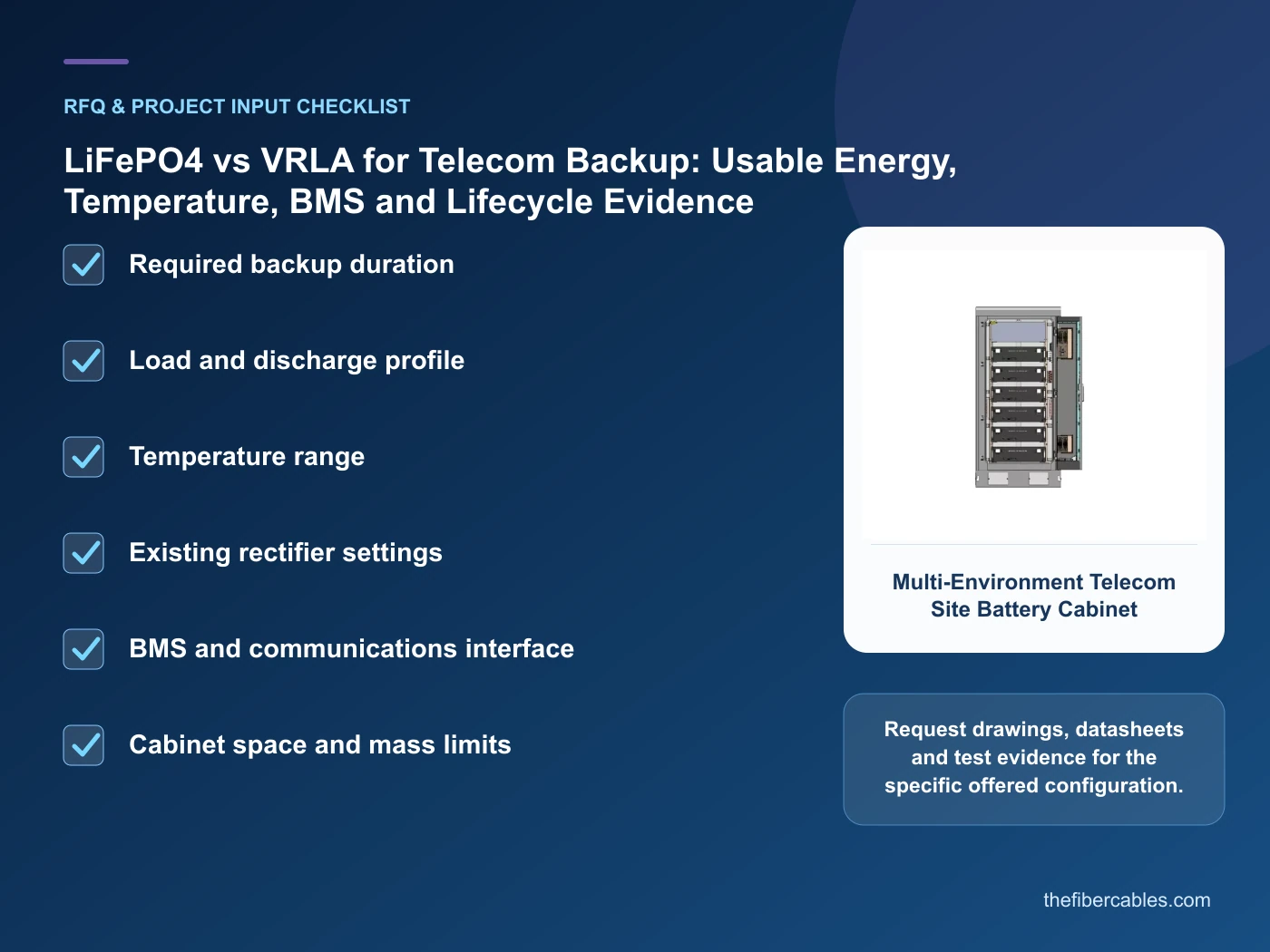
For lithium vs lead acid telecom battery, a complete request reduces back-and-forth and prevents a catalogue image from being mistaken for a verified configuration. Record the following fields, identify which values are mandatory or provisional and attach route, interface or layout drawings where relevant.
- Required backup duration
- Load and discharge profile
- Temperature range
- Existing rectifier settings
- BMS and communications interface
Questions engineers and buyers ask
How should vrla battery string be evaluated for lithium vs lead acid telecom battery?
Use existing charging and maintenance practice is designed around vrla as the operating context, record required backup duration, and verify temperature, ventilation, strings and replacement policy for the exact offered configuration.
Sources and standards
The references below define terminology, scope or test methods relevant to lithium vs lead acid telecom battery. They do not certify an offered product; confirm the edition adopted by the contract and destination authority.
- IEC 62619: Safety requirements for secondary lithium cells and batteries for industrial applications (2022, Ed. 2). Use it to verify the terminology and scope relevant to lithium vs lead acid telecom battery; the source does not certify a specific offered product.
- IEC 60896-22: Stationary lead-acid batteries — Valve regulated types — Requirements (2004, Ed. 1). Use it to verify the terminology and scope relevant to lithium vs lead acid telecom battery; the source does not certify a specific offered product.
- NFPA 855: Standard for the Installation of Stationary Energy Storage Systems (Current standard page reviewed 2026-10-16). Use it to verify the terminology and scope relevant to lithium vs lead acid telecom battery; the source does not certify a specific offered product.
- UL 9540 energy storage system testing and certification overview (Program overview reviewed 2026-10-16). Use it to verify the terminology and scope relevant to lithium vs lead acid telecom battery; the source does not certify a specific offered product.
- ITU-T L.1210: Sustainable power-feeding solutions for 5G network (In force; reviewed 2026-10-16). Use it to verify the terminology and scope relevant to lithium vs lead acid telecom battery; the source does not certify a specific offered product.
Source review: Links and cited editions for lithium vs lead acid telecom battery were checked on 2026-10-16. Confirm the edition adopted by the project contract and the authority having jurisdiction.
Related guidance
Weak-Grid vs Off-Grid Telecom Power: Choosing Grid, PV, Battery and Generator Roles • Telecom Battery Backup Runtime: Calculated Autonomy vs Site Verification • Multi-Vendor Telecom Site Monitoring: Alarms, Timestamps, Protocols and NOC Mapping
Prepare a lithium vs lead acid telecom battery configuration for review
Send required backup duration, load and discharge profile, temperature range, existing rectifier settings, quantity and delivery destination. Huijue Group can review the configuration boundary and identify the drawings or evidence needed for a factory quotation.
——END——