
Outdoor Infrastructure Solutions
Outdoor Cabinet & Edge Site Infrastructure
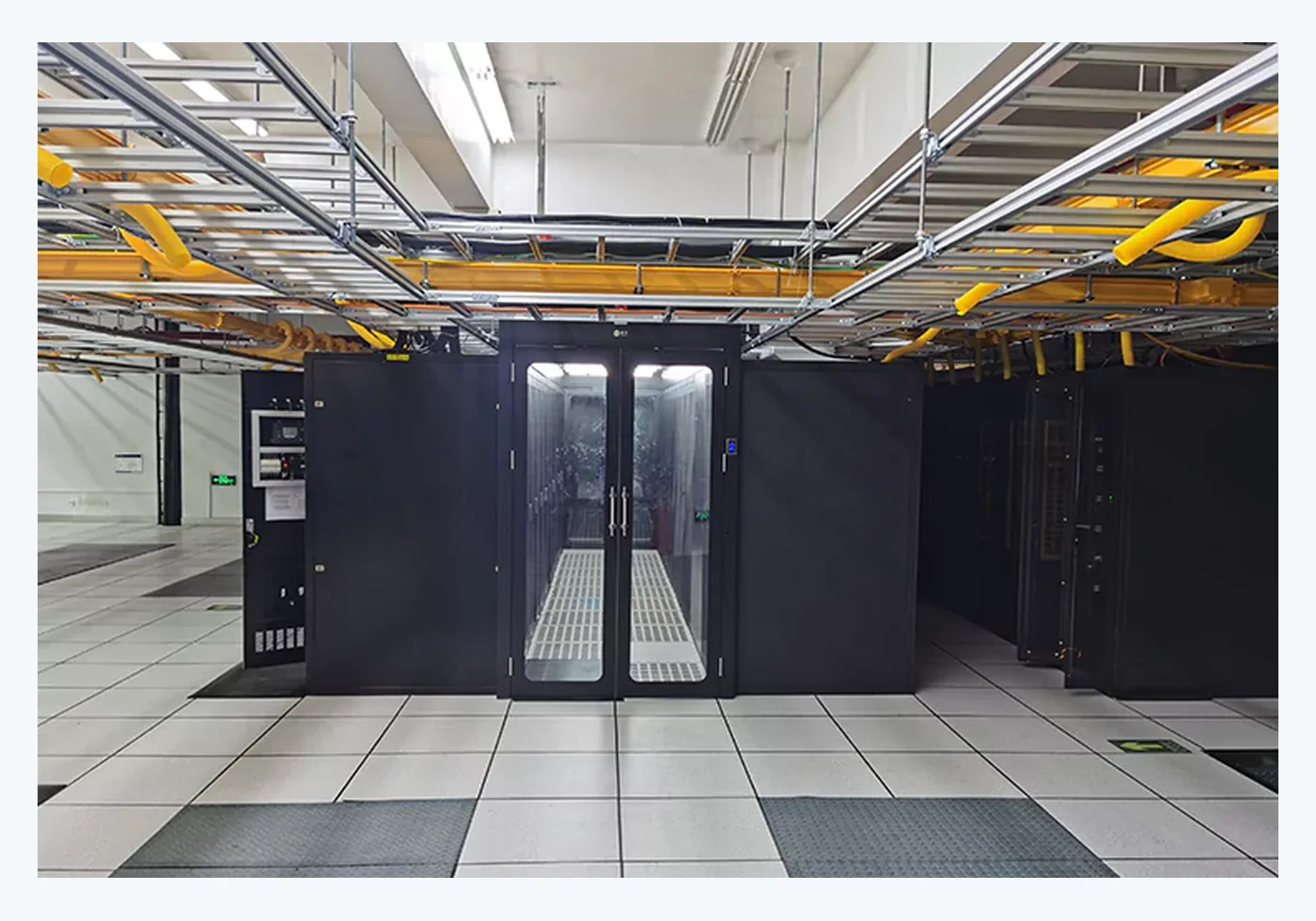
Protect telecom, network, power, battery and edge-computing equipment with an enclosure configured around environmental exposure, heat load, installation method and maintenance access.
Planning and configuration
Solution overview
An outdoor enclosure is the working environment for the equipment inside it. Its dimensions, seals, thermal system, cable entries and internal zones have to be selected from the installed load and the site exposure. A cabinet chosen only by rack height or a generic weatherproof label can create problems with overheating, condensation, maintenance access or field wiring.
Huijue Group manufactures and configures outdoor telecom cabinets, integrated equipment cabinets, battery enclosures and site-support structures for communications, monitoring, transport and edge applications. Projects may start from a standard cabinet family or from a dimensioned equipment schedule. Final material, protection level, thermal method and component interfaces are confirmed in the approved drawing and specification.
Translate the site into enclosure requirements
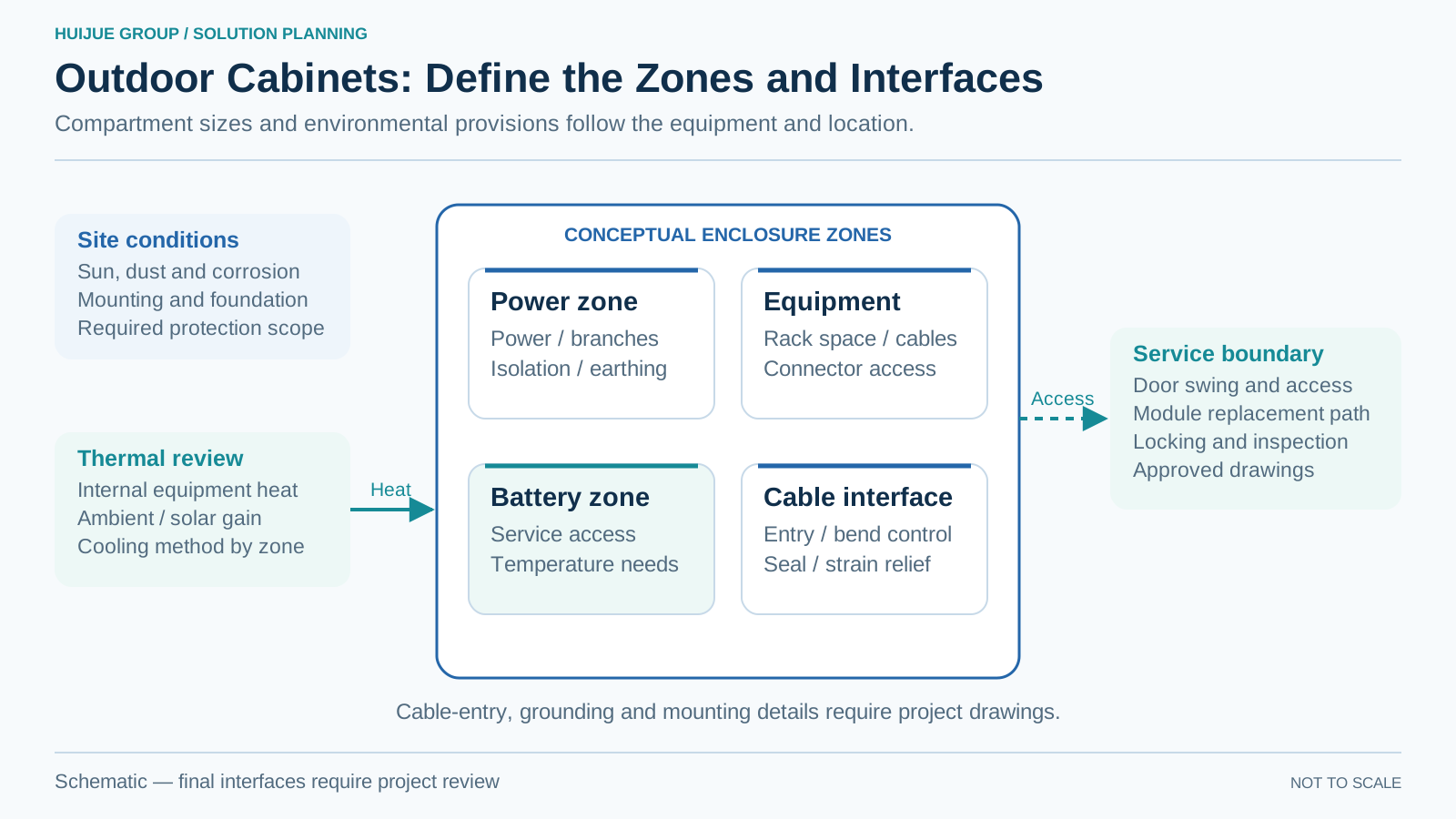
The project review begins with climate and placement. Record ambient temperature range, solar exposure, humidity, rainfall, dust, salt or industrial pollution, altitude, wind and flood risk as applicable. Then define whether the cabinet is pole-mounted, wall-mounted, plinth-mounted or floor-standing. Each method changes weight limits, door access, cable routing and the civil or structural interface.
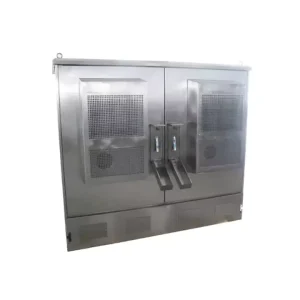
The outdoor telecom cabinet family provides a general starting point. Space-limited base stations may use a compact enclosure, while projects that need standard 19-inch equipment and larger service zones can review the 30U/40U sandwich-panel cabinet. The appropriate product is the one that accommodates equipment geometry, heat and service clearances—not simply the largest available shell.
Plan internal zones before external dimensions
Prepare a scaled equipment arrangement showing racks, batteries, rectifiers, distribution devices, fiber termination, monitoring and any customer equipment. Separate battery and electronics zones when required by the thermal and service strategy. Reserve conductor bend radius, door-mounted component depth, busbar clearance, grounding points and a safe working path to replace modules.
An outdoor integrated modular assembly cabinet can support project-specific combinations, while an outdoor telecom base-station cabinet focuses on protected field equipment. Integration does not remove the need to identify which devices are factory-installed, which are shipped separately and which are supplied by the site contractor.
Choose thermal management from a heat balance
- Convection or filtered fans
- Appropriate only where the equipment heat load and ambient conditions permit them.
- Heat exchange
- Transfers heat while maintaining separation between internal and external air.
- Compressor air conditioning
- Provides active cooling for higher loads or hotter environments, with additional electrical demand, condensate management and maintenance requirements.
Select an outdoor air-conditioned cabinet using internal dissipation, solar gain, cabinet insulation, target internal temperature and the expected ambient design point.
Heating, anti-condensation measures and emergency ventilation may also be needed. If batteries share the enclosure, their preferred temperature range may influence the compartment design. Final cooling capacity must be calculated for the actual assembly.
Interfaces that matter in the field
- Cable entry: specify entry direction, cable quantity and diameter, glands or feeder windows, bend control and sealing method.
- Grounding: identify cabinet bonding, equipment earth bar, door bonding and the site grounding interface.
- Access: define front, rear or side maintenance, door opening angle, locks and any remote access-control requirement.
- Monitoring: select required temperature, humidity, smoke, water-ingress and door points plus the communication protocol.
- Corrosion and finish: match the material and coating system to the confirmed environment; color and branding alone do not establish durability.
OEM, private label and drawing-based customization
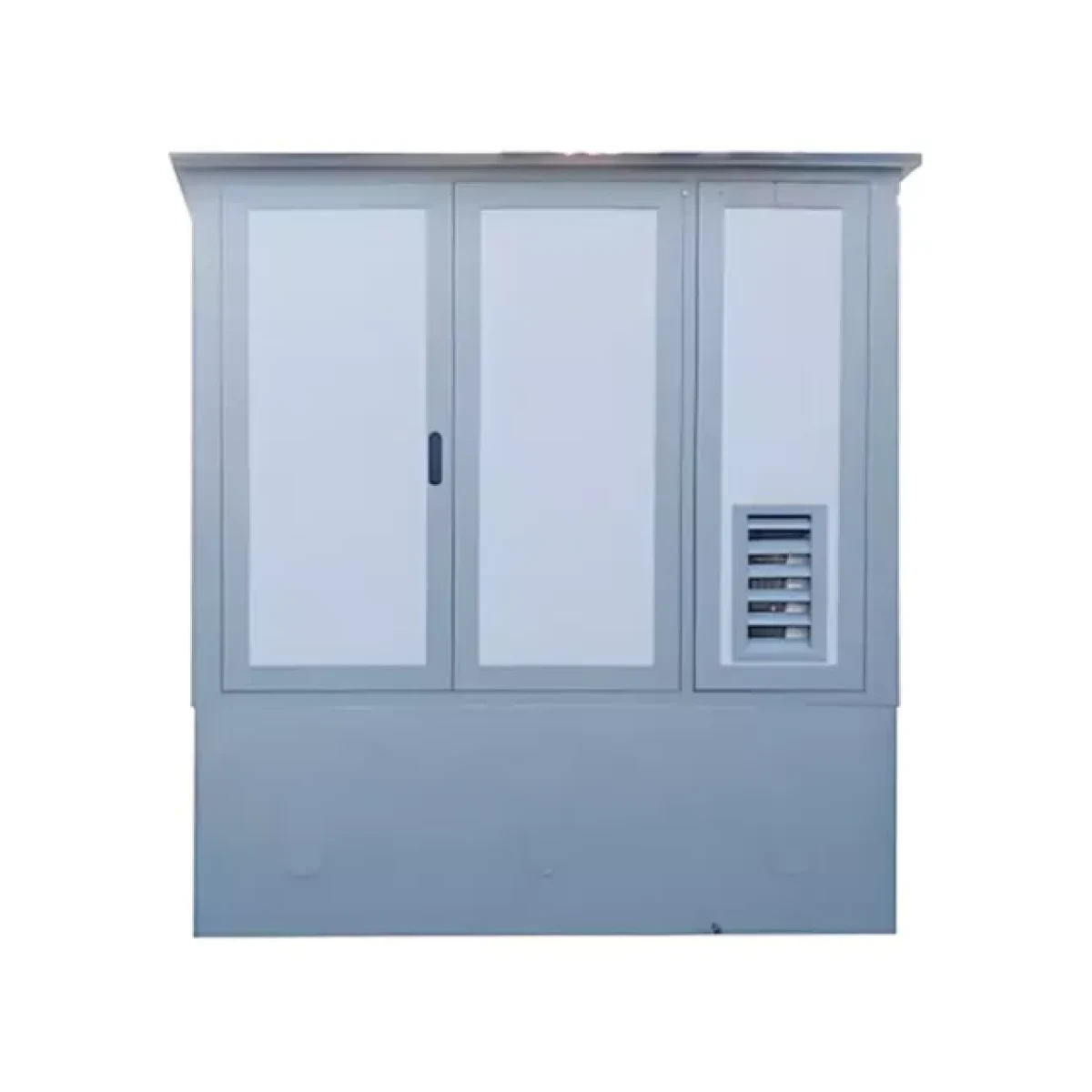
As a manufacturer, Huijue Group can review OEM and private-label cabinets, customer samples and dimensioned drawings. Custom work may cover size, compartment layout, mounting rails, doors, panels, cable openings, color, labels, thermal devices and pre-installed power or monitoring assemblies. Feasibility depends on structural design, material, tooling, production quantity, electrical scope and agreed enclosure tests. The approved manufacturing drawing should control the order so that marketing descriptions do not replace dimensional requirements. Where multiple site types are planned, a controlled cabinet matrix can identify common parts and the options unique to each environment.
For an unattended location, specify how cabinet measurements reach the maintenance team using the telecom energy and environmental monitoring brief. The Laos monitoring-station project provides a related example of coordinating an enclosure, remote communications and independent site power.
Information needed for configuration
- Equipment list, dimensions, weight and required rack units
- Internal heat dissipation and target internal temperature
- Ambient temperature, solar, dust, humidity and corrosion conditions
- Mounting method, foundation and lifting restrictions
- Required cabinet material, finish and confirmed protection target
- Power and battery zones
- Cable-entry direction, sizes and quantities
- Cooling, heating and condensate requirements
- Monitoring, locks, alarms and communication interface
- Quantity, customization level and inspection requirements
Send the equipment list and site conditions for an enclosure-layout review.
Product pathways
Related products
Use these products as configuration references. Final model selection depends on the approved project inputs.
Outdoor Telecom Cabinets
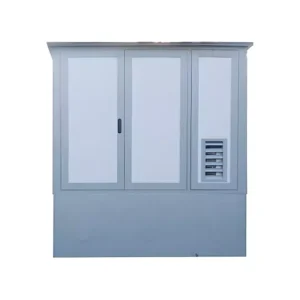
30U/40U Sandwich-Panel Outdoor Floor-Standing Integrated Cabinet
View product
Manufacturer support
Review the complete system before fixing the bill of materials
Huijue Group supports OEM, private-label and drawing-based customization subject to engineering review and the confirmed production scope.