
Case Study
Shanghai Qinhuo Telecom Rooftop Solar & Storage Retrofit
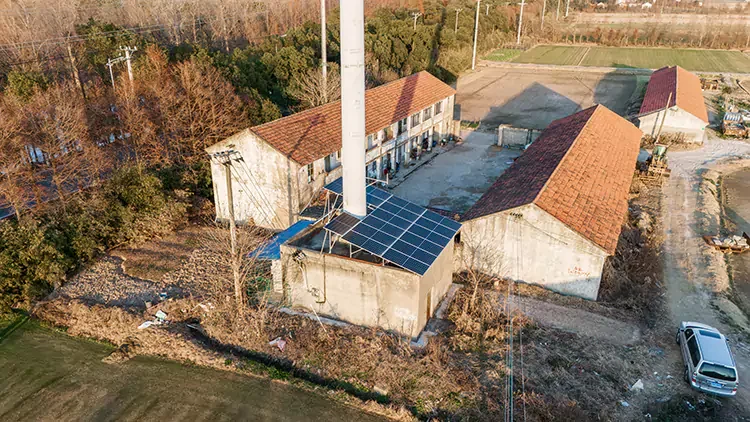
A rooftop retrofit at Qinhuo telecom station in Shanghai brought an 8.8 kW photovoltaic array and 204.8 kWh of battery storage into an existing site with supplementary diesel generation.
Documented project
Project overview
The Qinhuo station project in Shanghai’s Fengxian district added solar generation and battery storage to an existing telecommunications site. Its distinguishing constraint was physical: useful generation space had to be found around an operating equipment room rather than on an unrestricted greenfield plot. Huijue Group’s project used the equipment-room roof for the photovoltaic array and used diesel generation as a supplementary energy source.
Project at a glance
- Location
- Qinhuo telecom station, Fengxian, Shanghai, China
- Deployment
- Existing telecom-site photovoltaic and storage retrofit
- Roof area used for PV
- 41 m²
- Documented generation and storage
- 8.8 kW photovoltaic array; 204.8 kWh battery storage
- Supplementary source
- Diesel generation
A roof-led retrofit, not a replacement base station
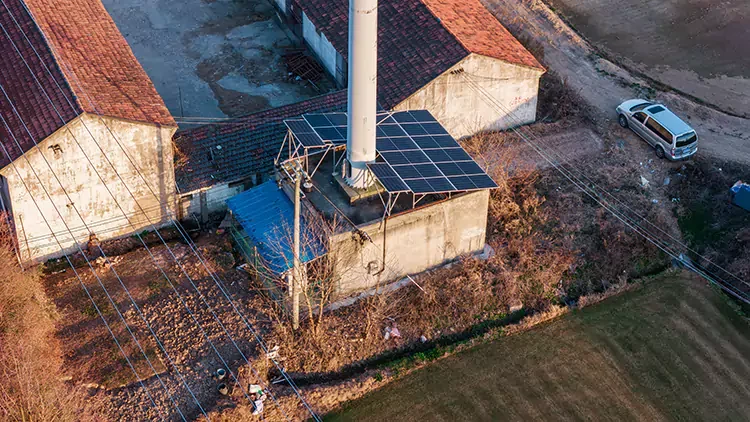
The configuration shows how available surfaces can become part of a telecom energy upgrade. The roof provides the generation footprint, while storage and the supplementary source address periods when sunlight and demand do not coincide. The project record identifies lower operating cost, energy security and a more renewable supply mix as objectives. It does not provide a monitored annual production total, a verified saving percentage or an independently established payback period.
For another existing station, the roof assessment must precede array selection. Shading from the tower, access paths, drainage, roof condition, fixing details and allowable loading can all constrain the usable layout. The 41 m² and 8.8 kW figures describe this project; they are not a universal conversion rule for other rooftops.
Inside the supporting cabinet
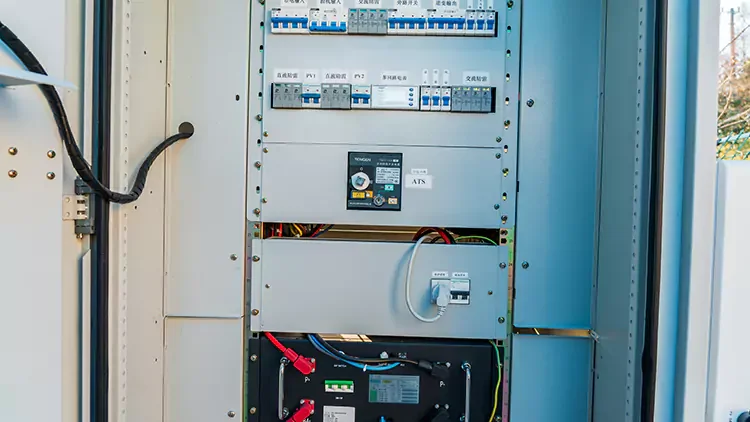
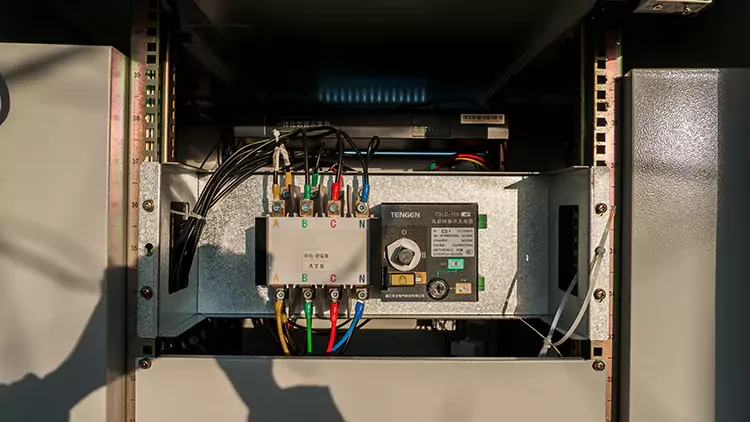
The photographs make the physical integration easier to understand than an equipment list alone. Distribution equipment, battery connections, door-mounted thermal hardware and internal controls occupy different working areas. These visible details are useful references for arrangement and service access; the photographs do not establish hidden conductor ratings, protection settings or battery performance.
| Interface | Review before release |
|---|---|
| Roof to array | Structural approval, waterproofing, shading, access and attachment details |
| Array to power system | String arrangement, controller operating range, isolation and surge protection |
| Storage to telecom load | Usable energy, current limits, voltage compatibility and reserve policy |
| Supplementary generator | Start interface, operating priority, recharge allowance and safe isolation |
Thermal control and cabinet supervision
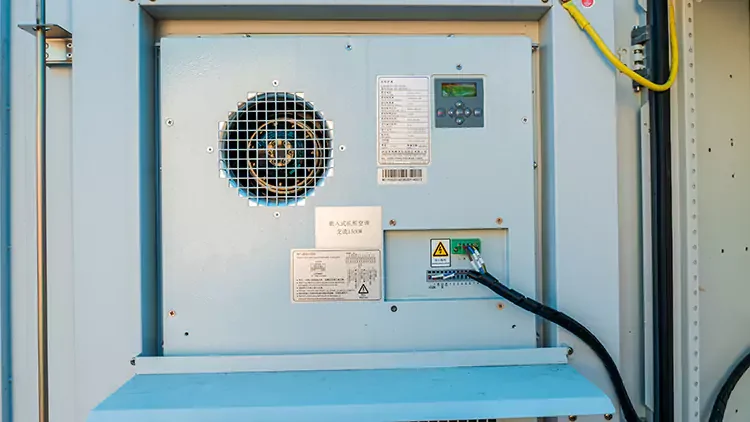
Battery and power equipment need a cabinet environment suited to their approved operating ranges. When adapting this architecture, account for solar gain on the enclosure, heat from power conversion and the service space required by the thermal unit. Thermal selection must follow the actual heat load; a photograph cannot justify a cooling rating.
Preparing a comparable upgrade
- Survey the live site: record the roof plan, equipment-room access, tower shading, existing source arrangement and permitted outage windows.
- Measure the demand: include radio, transmission, cooling and auxiliary loads across a representative operating period.
- Agree the energy policy: distinguish bill reduction, backup reserve and generator-use objectives before setting control priorities.
- Freeze the interfaces: approve array, cabinet, battery, generator, monitoring and grounding drawings as one coordinated package.
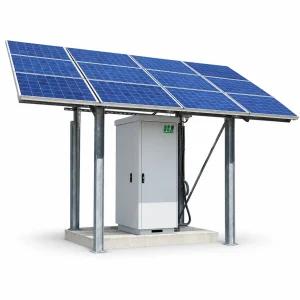
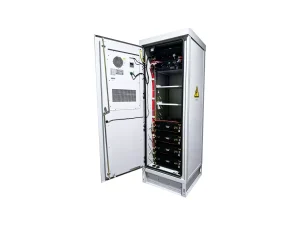
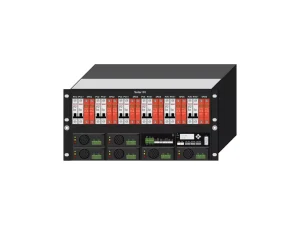
For current equipment options, review the outdoor photovoltaic energy cabinet and outdoor hybrid telecom energy cabinet. These are relevant product families for a new configuration, not a claim that their present catalogue specifications are the exact historical Qinhuo bill of materials. Send the roof drawing and site load profile for a retrofit review.
Product pathways
Relevant product families
Use these products as configuration references. Final model selection depends on the approved project inputs.
Manufacturer support
Review the complete system before fixing the bill of materials
Huijue Group supports OEM, private-label and drawing-based customization subject to engineering review and the confirmed production scope.