
Core equipment rooms
Coordinate DC power, distribution, batteries and monitoring around communications loads.
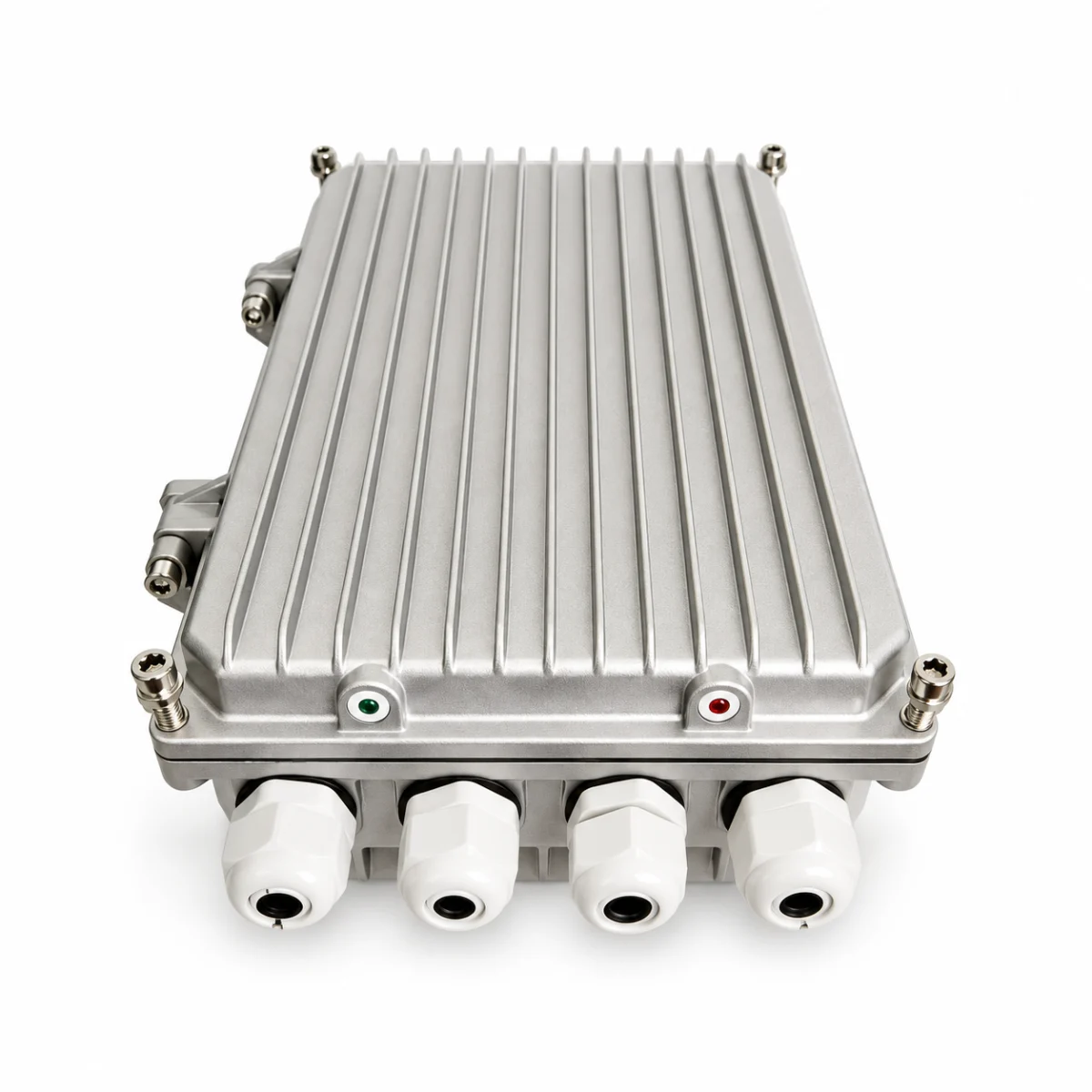
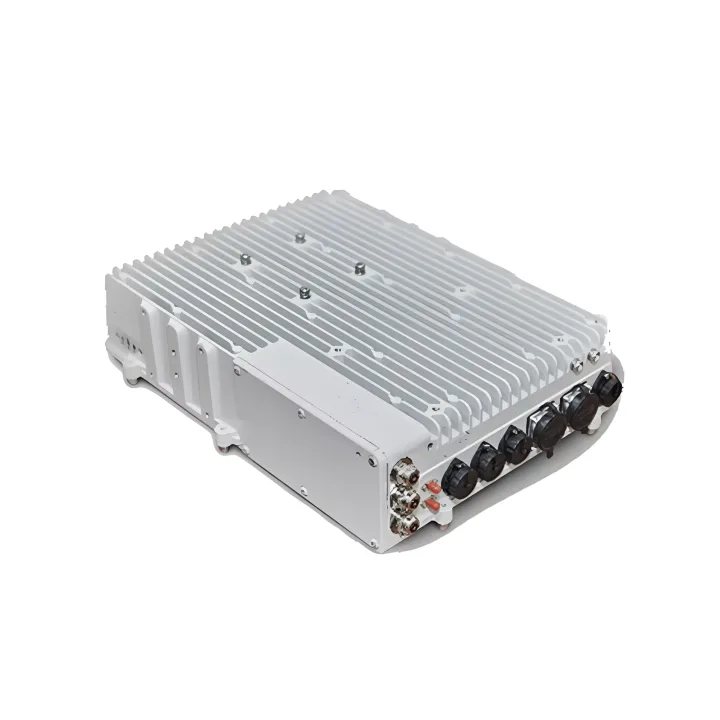
Naturally cooled 800 W, 1000 W and 1500 W conversion modules with default −53.5 V DC output, IP65 enclosure and wall/pole mounting.
The outdoor telecom AC/DC power supply module provides a compact conversion stage for distributed communications equipment. Three power versions share a naturally cooled enclosure and a default −53.5 V DC output, allowing the converter to be positioned near the load instead of inside a full-size power cabinet.
The documented full-power input window is narrower than the overall AC acceptance range. Selection should therefore consider site mains quality and the required load during low-voltage conditions, rather than relying only on the headline power rating.
Check output polarity, load voltage tolerance and the connector arrangement against the equipment. The source lists thermal shutdown at 65°C, whereas the operating ambient range is −25°C to 55°C; shutdown protection should not be used as a normal operating target.
Huijue Group can review OEM markings, private-label supply and bracket or connection adaptations from drawings or a sample. Enclosure sealing, heat dissipation, tooling, verification tests, order quantity and supplied installation hardware need engineering confirmation.
Identify output watts/current, input voltage extremes, equipment voltage tolerance, mounting surface or pole diameter, connector requirements and ambient conditions.
| Function Type | 800W | 1000W | 1500W |
|---|---|---|---|
| DC output | DC voltage | -53.5 Vdc (default) | |
| Output current | 16A | 19A | 28A |
| Current range | 0-16A | 0-19A | 0-28A |
| Maximum power | 800W (176-275 Vac or 176~396 Vdc input) | 1000W (176-275 Vac or 176~396 Vdc input) | 1500W (176-275 Vac or 176~396 Vdc input) |
| Voltage accuracy | ±1% | ||
| Efficiency | ≥94% (typical, 220 Vac input, 60% load) | ||
| Start-up time | 3S-10S soft start | ||
| AC input | Voltage range | 90-290 Vac | |
| Frequency range | 47-63 Hz | ||
| Power factor | 0.99 | ||
| Protection | Input overvoltage protection | ≥300 Vac | |
| Input undervoltage protection | ≤85 Vac | ||
| Output overvoltage protection | ≥58.5 V | ||
| Output undervoltage protection | ≤43.2 V | ||
| Output current limiting | 110% of output current range | ||
| Overtemperature protection | Shuts down at 65℃; auto-recovers when temperature returns | ||
| Short-circuit protection | Self-recovery after short-circuit protection | ||
| Environment | Operating temperature | -25℃~+55℃ | |
| Storage temperature | -40℃~+80℃ | ||
| Operating humidity | ≤95% non-condensing (40℃±2℃) | ||
| Storage humidity | ≤95% non-condensing (40℃±2℃) | ||
| Other | Dimensions | H×W×D = 280×210×95 mm | |
| Packaging | 1 unit/carton; gross weight ≈3.5 kg, net weight ≈2.9 kg | ||
| Mounting | Supports wall-mount and pole-clamp installation | ||
| Accessories | Pole clamps, wall-mount kit, certificate of conformity, hex wrench |
The module is listed as IP65, with −25°C to 55°C operating ambient and humidity up to 95% non-condensing. Maintain the required natural-convection clearance and weatherproof the complete cable connection arrangement.
Buyer Questions
Answers specific to Outdoor Telecom AC/DC Power Supply Module selection, configuration and purchasing.
The documented default is −53.5 V DC. Check that this voltage and polarity suit the intended 48 V-class equipment.
Full-power operation is documented for 176–275 V AC. Confirm the output available outside that window for the selected module.
The module uses natural convection. It still needs suitable orientation and clearance so the enclosure can dissipate heat at the project load and ambient temperature.
Use the deployment context to narrow the configuration before comparing dimensions, capacities and options.
Coordinate DC power, distribution, batteries and monitoring around communications loads.
Use integrated or wall-mounted systems where equipment space is limited.
Match generation, storage and power conversion to load and autonomy requirements.
Combine grid, solar, battery or generator inputs around a defined operating strategy.
Before quotation: confirm capacity, interfaces, installation environment, power conditions, quantity and required options.