
Campus and backbone routes
Select indoor, outdoor or armored constructions around fiber count, route length and installation method.
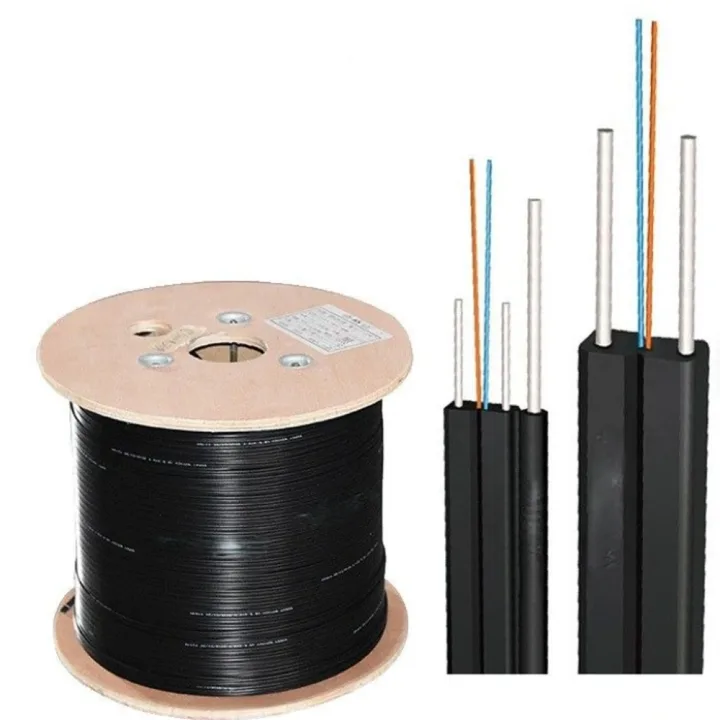
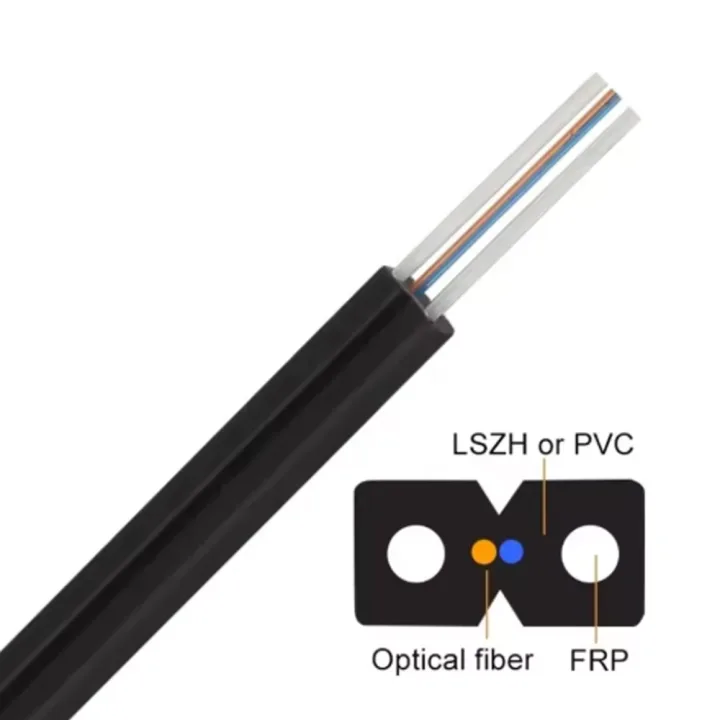
A butterfly drop cable combining FRP reinforcement beside the fibers with an independent steel messenger, using a 2.0 × 5.0 mm LSZH-sheathed construction for self-supporting access drops.
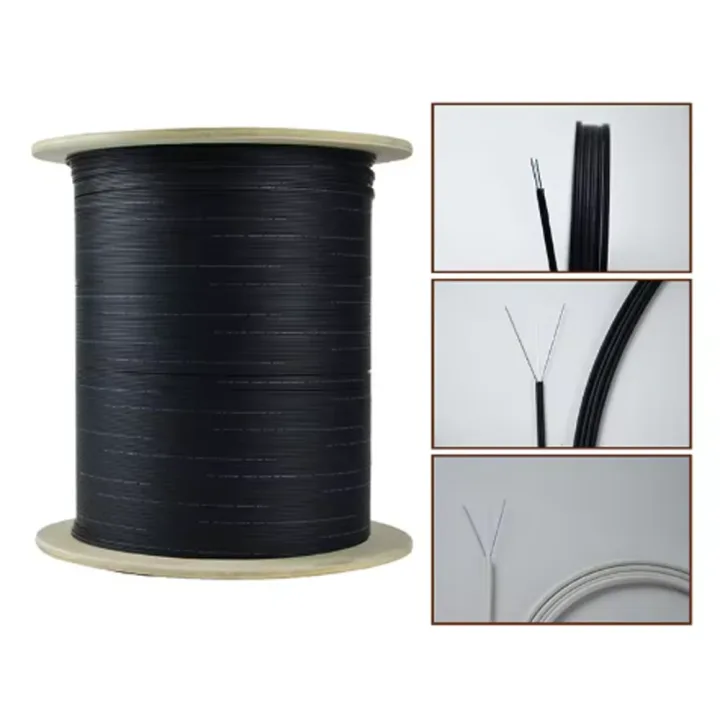
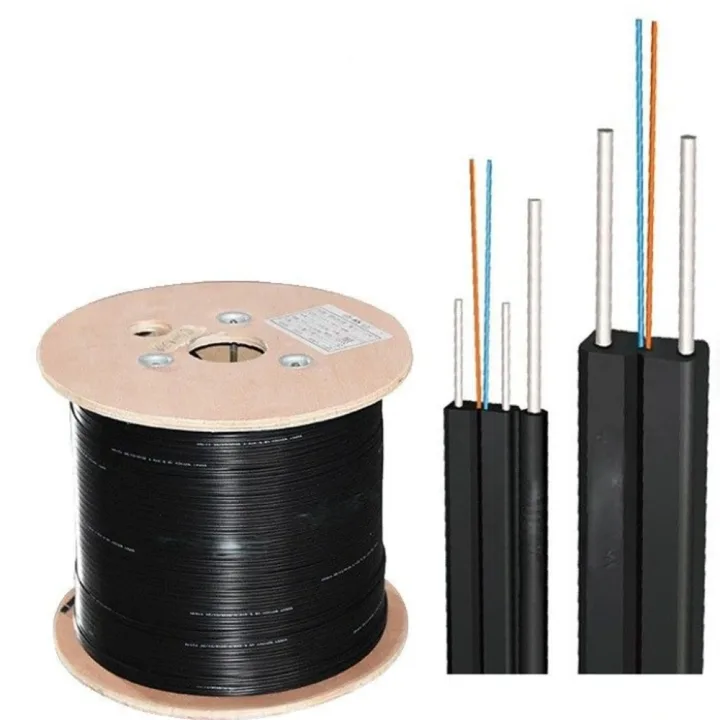
GJYXFCH uses two FRP members in the fiber section and an independent steel messenger for a self-supporting drop arrangement. It supports FTTH, FTTO and FTTB subscriber connections where a defined span and compact fiber-routing section are needed.
The non-metallic description applies to the primary members beside the fibers. Because the documented cable also includes a steel messenger, it should not be specified as an entirely dielectric cable.
Define span geometry and support hardware, then select fiber grade and subscriber-end routing. The table gives 1000/2200 N per 100 mm crush references and distinguishes 30/60 mm static/dynamic bending for B1.1/B1.3 from 15/30 mm for B6a. Confirm the complete limits for the ordered variant, especially where another fiber grade is requested.
For GJYXFCH manufacture, Huijue Group can review OEM marking, private-label supply and cable samples or drawings covering FRP and messenger details. Geometry, tooling, mechanical and optical validation, quantity and delivery scope require engineering agreement.
Include fiber count and grade, messenger/span requirements, attachment drawings, bend constraints, jacket color, mechanical acceptance criteria and drum or cut lengths.
| Product Model | GJYXFCH – 4 fibers or fewer | |||||||
|---|---|---|---|---|---|---|---|---|
| Product Type | Self-supporting butterfly drop cable with non-metallic strength members | |||||||
| Fiber Count | 4 fibers or fewer | |||||||
| Fiber Type | B1.1 / B1.3 / B6a / B6b | |||||||
| Primary Strength Members | Two parallel FRP non-metallic strength members | |||||||
| Self-Supporting Member | Single steel messenger wire | |||||||
| Jacket Type | Low-smoke zero-halogen (LSZH) flame-retardant jacket | |||||||
| Jacket Color | White / Black | |||||||
| Dimensions | 2.0mm × 5.0mm | |||||||
| Applicable Networks | FTTH / FTTO / FTTB | |||||||
| Operating Wavelength | B1.1, B1.3 (G.652) | B6a (G.657A) | B6b (G.657B) | |||||
| 1310nm | ≤0.45dB/km | ≤0.40dB/km | ≤0.60dB/km | |||||
| 1550nm | ≤0.30dB/km | ≤0.30dB/km | ≤0.50dB/km | |||||
| Cable Model | Fiber Count | Fiber Type | Allowable Tensile Load (N) | Allowable Crush Load (N/100mm) | Bend Radius (mm) | |||
| Long-term | Short-term | Long-term | Short-term | Static | Dynamic | |||
| GJYXFCH | 4 fibers or fewer | B1.1, B1.3 | 300 | 600 | 1000 | 2200 | 30 | 60 |
| B6a | 300 | 600 | 1000 | 2200 | 15 | 30 |
For subscriber aerial drops with an approved steel-messenger support design and FRP-reinforced fiber section, followed by the specified premises-entry route.
Provide span weather loads and building-entry conditions. The LSZH material description does not establish every required fire classification or environmental limit.
Buyer Questions
Answers specific to Drop Cable – GJYXFCH Self-Supporting Non-Metallic Strength Member selection, configuration and purchasing.
No. Its two primary fiber-section members are FRP, but the source explicitly includes a steel messenger.
No. Confirm the complete mechanical specification for the selected grade. The local mechanical rows explicitly show B1.1/B1.3 and B6a values.
Not alone. Messenger geometry, sag, support hardware and wind/ice conditions must be evaluated for the intended span.
Use the deployment context to narrow the configuration before comparing dimensions, capacities and options.
Select indoor, outdoor or armored constructions around fiber count, route length and installation method.
Coordinate feeder, distribution and drop cables with the building-entry and subscriber topology.
Match tensile, crush, moisture and armor requirements to poles, ducts or direct-buried routes.
Use FTTA or hybrid constructions where optical transmission and site power share a route.
Before quotation: confirm capacity, interfaces, installation environment, power conditions, quantity and required options.