
Direct answer
Select a fiber optic cable by defining the route before comparing product names. The useful sequence is application, installation method, environmental exposure, fibre type and count, mechanical load, fire or electrical constraints, termination, test evidence and delivery format. A cable that fits a duct route may be wrong for aerial, direct-buried, indoor or tight-bend access sections even when the fibre count is identical.
This pillar guide connects cable construction, route conditions, fibre type, installation method and procurement inputs. Use it to define project inputs before narrowing to a product family.
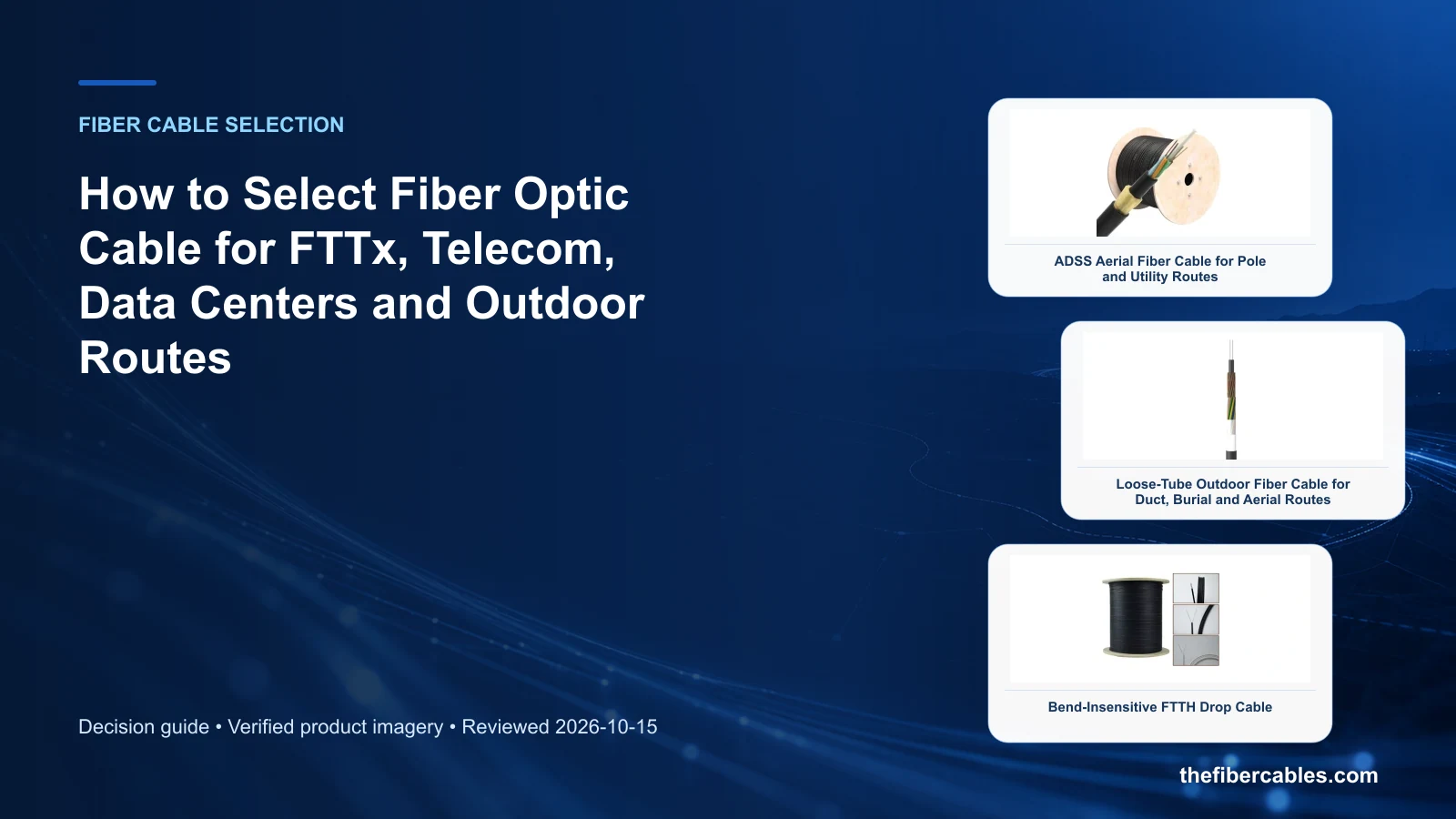
System boundaries to define before product selection
Plan cable type from route, environment, termination and service requirements. Start with the operating requirement and installation boundary, then separate system requirements from product claims so each supplier knows which evidence must accompany the offered configuration.
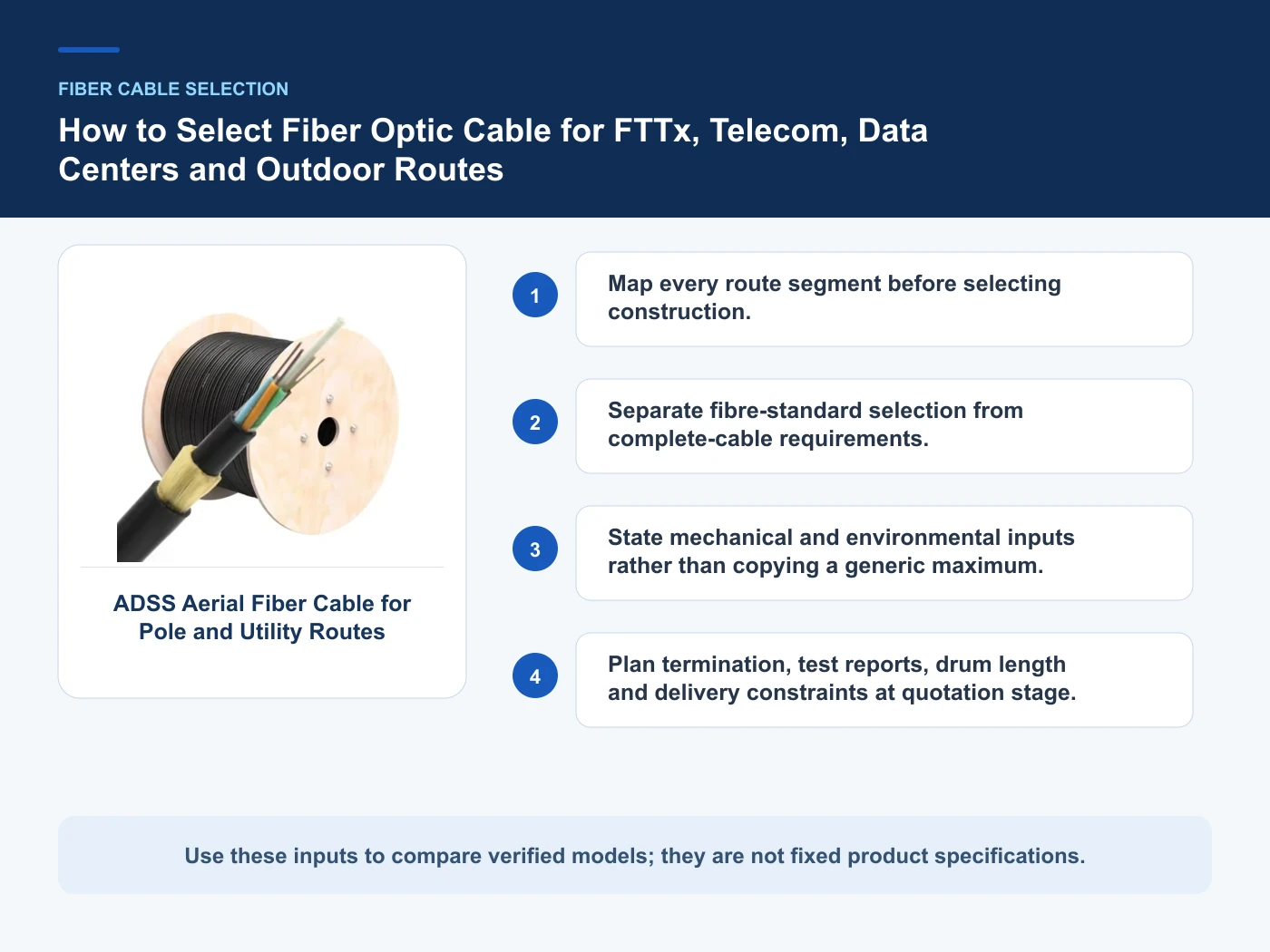
- Map every route segment before selecting construction.
- Separate fibre-standard selection from complete-cable requirements.
- State mechanical and environmental inputs rather than copying a generic maximum.
- Plan termination, test reports, drum length and delivery constraints at quotation stage.
Map every route segment before selecting construction
Capture Route and installation method, then use Indoor pathway as a practical comparison point: Tight-buffered or indoor-rated design. Before approval, verify this point: Check route, bend control and applicable fire requirements.
Separate fibre-standard selection from complete-cable requirements
Capture Fibre type and count, then use Duct or tunnel as a practical comparison point: Outdoor cable designed for pulling. Before approval, verify this point: Confirm water blocking, pulling method and duct condition.
State mechanical and environmental inputs rather than copying a generic maximum
Capture Mechanical and environmental conditions, then use Direct burial as a practical comparison point: Purpose-designed buried cable. Before approval, verify this point: Armour alone does not prove suitability for every soil condition.
Plan termination, test reports, drum length and delivery constraints at quotation stage
Capture Jacket, armour and fire requirements, then use Aerial route as a practical comparison point: ADSS, self-supporting or lashed construction. Before approval, verify this point: Span, loading, support hardware and electrical environment differ.
Architecture choices and verification boundaries
This table connects cable construction, route conditions, fibre type, installation method and procurement inputs to the decision on fiber optic cable selection guide. It is a decision aid rather than a universal performance table: exact capacity, environmental class, electrical or optical limits and certifications must come from the selected model, applicable project documents and verifiable test evidence.
| Option or input | When it fits | What must be verified |
|---|---|---|
| Indoor pathway | Tight-buffered or indoor-rated design | Check route, bend control and applicable fire requirements |
| Duct or tunnel | Outdoor cable designed for pulling | Confirm water blocking, pulling method and duct condition |
| Direct burial | Purpose-designed buried cable | Armour alone does not prove suitability for every soil condition |
| Aerial route | ADSS, self-supporting or lashed construction | Span, loading, support hardware and electrical environment differ |
Reference point: ITU-T G.652: Characteristics of a single-mode optical fibre and cable and ITU-T G.657: Bend-insensitive single-mode optical fibre and cable frame the terminology or method used for this fiber optic cable selection guide comparison. They do not approve a product configuration; apply the edition named by the contract and local authority.
Define the cable boundary from the route drawing
Treat the route drawing as the first cable specification. Mark building entrances, risers, ducts, handholes, buried sections, pole spans, drop sections and termination rooms, because a construction suitable for one segment may not be suitable for the next. ITU-T G.652 and G.657 describe optical-fiber characteristics; they do not by themselves establish the jacket, water blocking, tensile behavior, installation method or fire performance of the finished cable. IEC 60794 provides cable-level requirements and test frameworks, while the applicable project specification and local rules still have to define the actual operating and installation conditions. Where one route crosses several environments, either define a justified transition point or require evidence that the selected construction covers every stated segment.
Ask for evidence tied to the offered construction
A useful submittal identifies the exact offered cable construction and connects each requested characteristic to verifiable evidence. Review the cross-sectional drawing, material description, manufacturer data sheet and applicable type-test information together; a report for another jacket, armour arrangement or fibre count should not automatically be treated as evidence for the quoted item. Before shipment, agree which reel or drum records will be supplied, how length and fibre identification will be shown, and whether attenuation or continuity results are required for each delivery unit. The acceptance plan should also distinguish factory evidence, incoming inspection and measurements made before and after installation. Record approved deviations so that the as-built cable can later be traced to the quotation and test package.
Compare bids by installed risk, not price per metre
Build the RFQ around route-specific inputs: installation method, expected pulling or span conditions, bend-sensitive sections, water and UV exposure, temperature range, electrical environment, cable-entry interfaces, termination method, fibre count, growth allowance, delivery length and site logistics. Ask each supplier to identify included accessories, installation limitations and responsibilities rather than assuming that clamps, glands, grounding items or termination hardware are part of the cable price. Commercial comparison should include joint locations, waste from delivery lengths, required transition hardware, installation labour and the cost of retesting or replacement if evidence is incomplete. If the route, installation method or environment changes after award, review the cable selection again instead of applying the original approval to materially different conditions.
From requirements to an auditable project decision
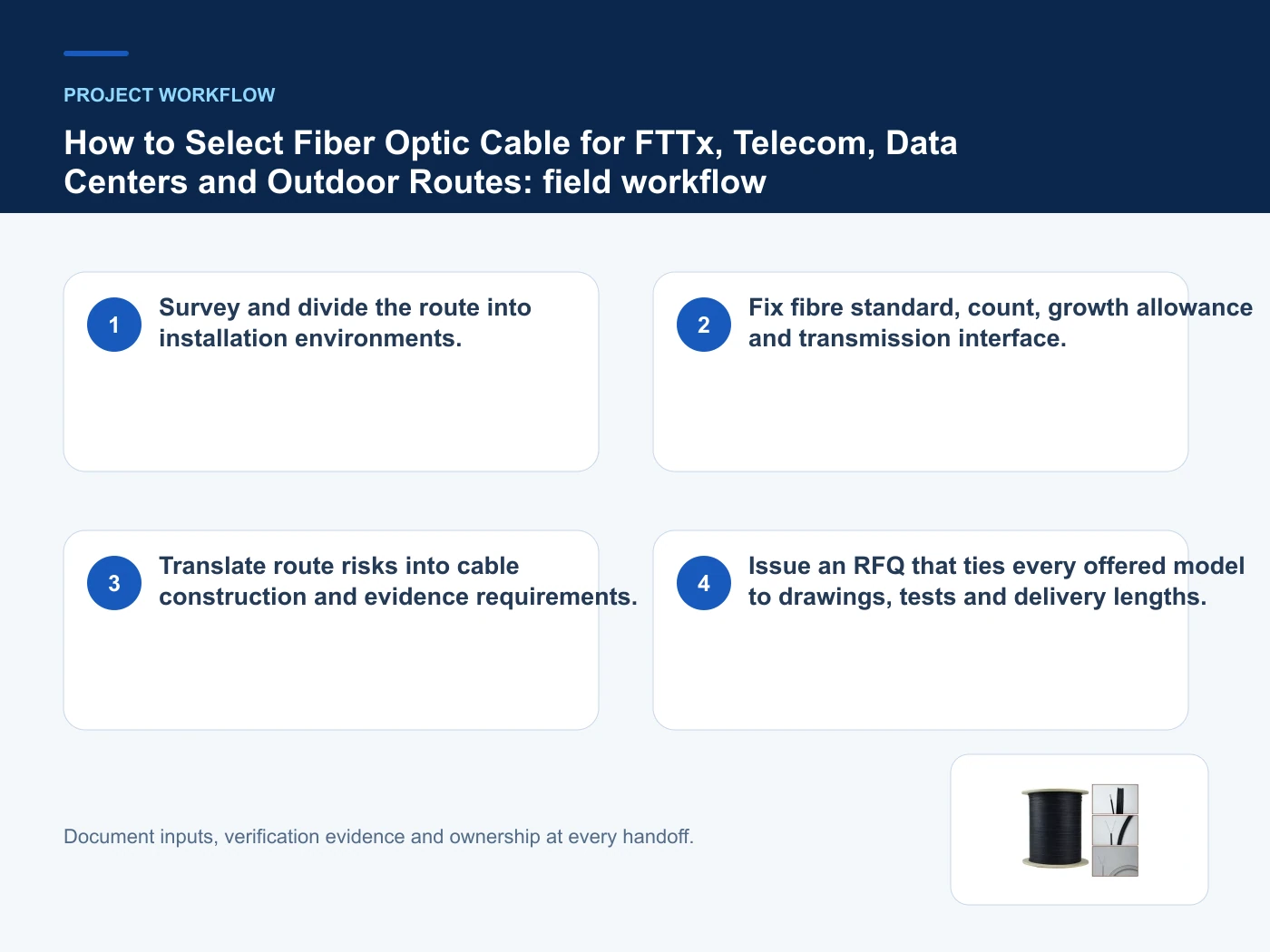
- Step 1: Survey and divide the route into installation environments. Record Route and installation method as an explicit input. Check route, bend control and applicable fire requirements.
- Step 2: Fix fibre standard, count, growth allowance and transmission interface. Record Fibre type and count as an explicit input. Confirm water blocking, pulling method and duct condition.
- Step 3: Translate route risks into cable construction and evidence requirements. Record Mechanical and environmental conditions as an explicit input. Armour alone does not prove suitability for every soil condition.
- Step 4: Issue an RFQ that ties every offered model to drawings, tests and delivery lengths. Record Jacket, armour and fire requirements as an explicit input. Span, loading, support hardware and electrical environment differ.
Relevant products from our communications portfolio
The products below connect the fiber optic cable selection guide decision to real catalogue families and verified site photography. They are starting points, not a claim that every configuration described here is a standard stock item; confirm model, interface, rating, drawing and testing scope with the project team.
- ADSS Aerial Fiber Cable for Pole and Utility Routes — use this product page as a configuration reference when you map every route segment before selecting construction. Confirm the offered model, interfaces, drawings and available evidence before quotation.
- Loose-Tube Outdoor Fiber Cable for Duct, Burial and Aerial Routes — use this product page as a configuration reference when you separate fibre-standard selection from complete-cable requirements. Confirm the offered model, interfaces, drawings and available evidence before quotation.
- Bend-Insensitive FTTH Drop Cable — use this product page as a configuration reference when you state mechanical and environmental inputs rather than copying a generic maximum. Confirm the offered model, interfaces, drawings and available evidence before quotation.
For adjacent configurations, browse Fiber Optic Cables and compare those options against the fiber optic cable selection guide inputs above, including route and installation method.
Common mistakes to avoid
- Selecting by fibre count alone.
- Treating G.652 or G.657 compliance as proof of the entire cable design.
- Using one bend, tensile or temperature number for every installation stage.
What to include in the RFQ or design input
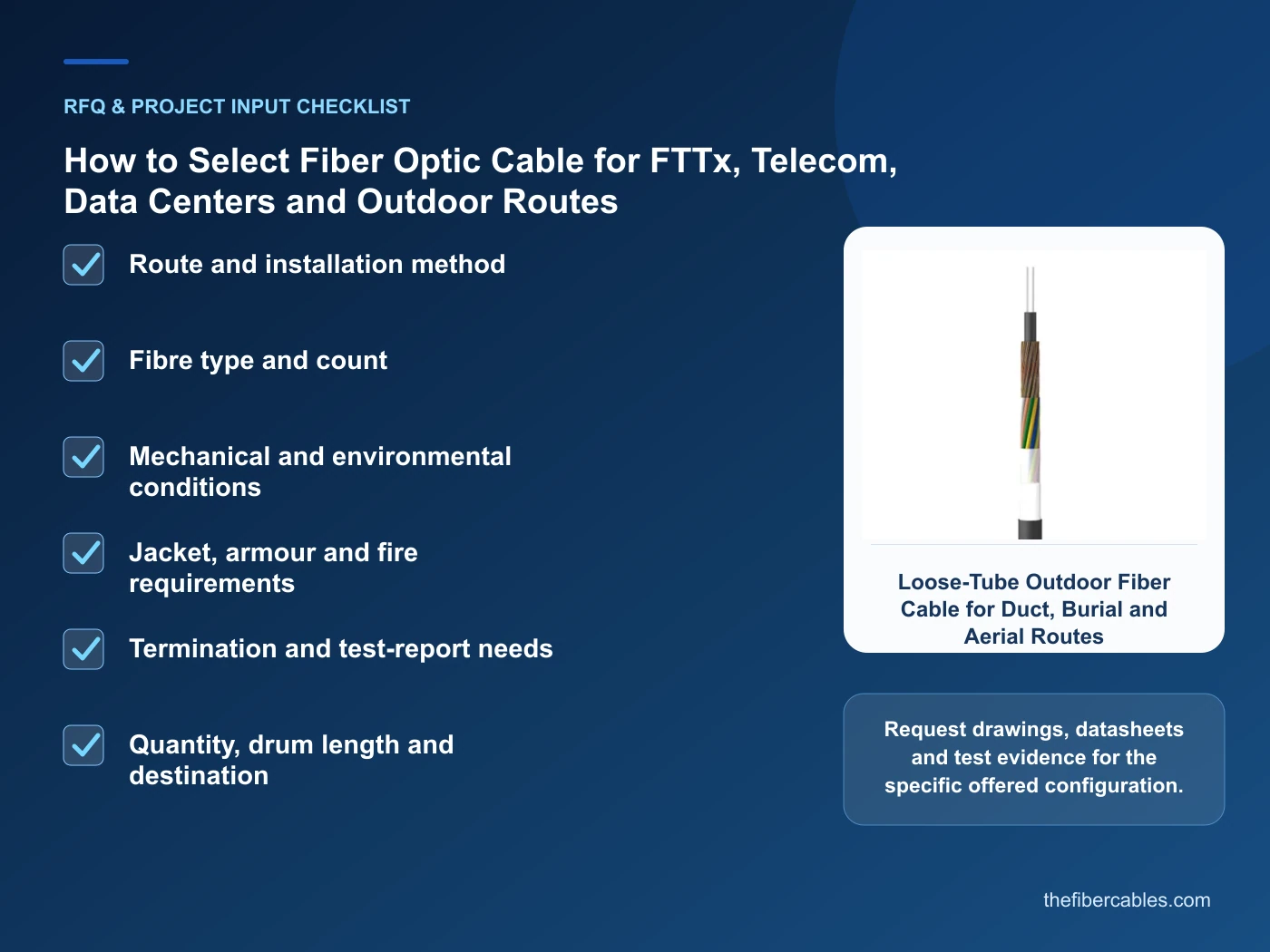
For fiber optic cable selection guide, a complete request reduces back-and-forth and prevents a catalogue image from being mistaken for a verified configuration. Record the following fields, identify which values are mandatory or provisional and attach route, interface or layout drawings where relevant.
- Route and installation method
- Fibre type and count
- Mechanical and environmental conditions
- Jacket, armour and fire requirements
- Termination and test-report needs
- Quantity, drum length and destination
Questions engineers and buyers ask
What should be fixed before selecting products for fiber optic cable selection guide?
Define route and installation method, fibre type and count, mechanical and environmental conditions first, then compare product evidence against the complete system boundary rather than one catalogue value.
How should a fiber optic cable selection guide decision be documented?
Keep the route or architecture drawing, decision assumptions, selected configuration, verification evidence and acceptance records under the same revision process.
Sources and standards
For fiber optic cable selection guide, the references below define relevant terminology, scope or test methods. ITU-T G.652: Characteristics of a single-mode optical fibre and cable is one documented boundary for this topic; neither a standards catalogue page nor a category page proves certification of the offered product. Apply the edition adopted by the contract, destination market and authority having jurisdiction.
- ITU-T G.652: Characteristics of a single-mode optical fibre and cable (08/2024). Use it to verify the terminology and scope relevant to fiber optic cable selection guide; the source does not certify a specific offered product.
- ITU-T G.657: Bend-insensitive single-mode optical fibre and cable (08/2024). Use it to verify the terminology and scope relevant to fiber optic cable selection guide; the source does not certify a specific offered product.
- IEC 60794-1-1: Optical fibre cables — Generic specification (2023, Ed.5). Use it to verify the terminology and scope relevant to fiber optic cable selection guide; the source does not certify a specific offered product.
- ITU-T L.100: Optical fibre cables for duct and tunnel application (01/2024). Use it to verify the terminology and scope relevant to fiber optic cable selection guide; the source does not certify a specific offered product.
Source review: Links and cited editions for fiber optic cable selection guide were checked on 2026-10-15. Confirm the edition adopted by the project contract and the authority having jurisdiction.
Related guidance
ADSS vs Figure-8 Aerial Fiber Cable: Which Route Conditions Decide? • Loose-Tube vs Tight-Buffered Fiber Cable: Environment, Termination and Installation • G.652.D vs G.657.A1 vs G.657.A2: Selecting Fiber for Access and Tight Bends
Prepare a fiber optic cable selection guide configuration for review
Send route and installation method, fibre type and count, mechanical and environmental conditions, jacket, armour and fire requirements, together with quantity and delivery destination. We will help narrow the relevant product family and identify the drawings or test evidence needed for quotation.
——END——