
Campus and backbone routes
Select indoor, outdoor or armored constructions around fiber count, route length and installation method.
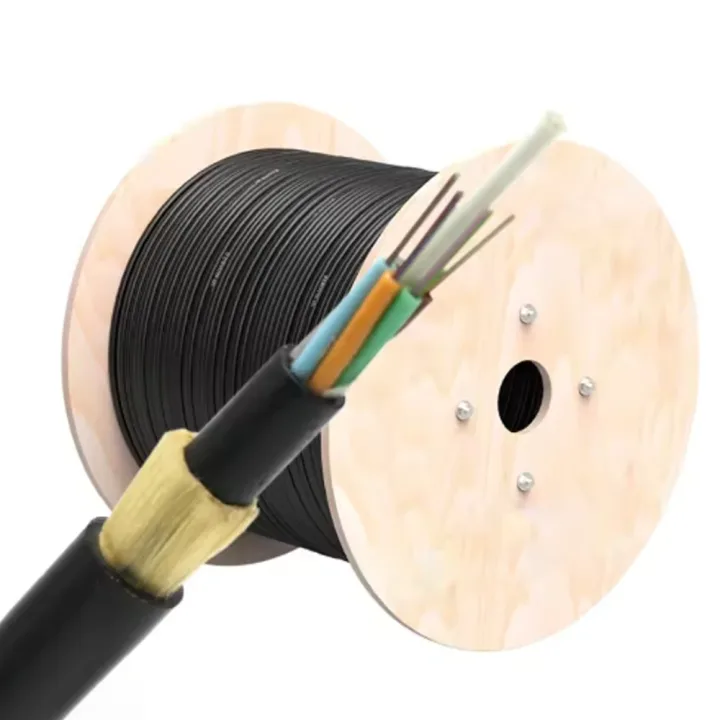
An all-dielectric, self-supporting aerial cable with aramid reinforcement and PE or anti-tracking sheath options for engineered pole-line and utility-corridor optical routes.
ADSS Aerial Fiber Cable for Pole and Utility Routes combines the optical path and tensile support within one non-metallic cable. It is suspended between supports without a separate metallic messenger in the designed aerial arrangement.
On a utility route, span length is only one design input. Sag, support geometry, weather loads and electrical-field exposure influence the cable and hardware choice. The construction should be selected from a route assessment rather than from a single maximum-span figure.
Provide each span, elevation change, required sag, wind and ice conditions, support details and proximity to electrical conductors. Confirm the required sheath and tensile design with the route engineer. Suspension and termination hardware must match the final cable diameter and mechanical requirements.
Huijue Group can assess OEM ADSS production and private-label drum identification from route schedules, cable drawings or reference samples. Reinforcement and sheath variations require engineering agreement on tooling, type and routine tests, quantity and delivery scope.
Send fiber standard and count, span schedule, sag criteria, wind/ice data, pole or tower drawings, electrical exposure, hardware details, jacket preference and drum lengths.
| Fiber type | OS2 / G.652D / G.657A single-mode |
| Fiber count | 2–288 fibers; custom configurations available |
| Cable structure | Loose tube / central tube |
| Strength member | Dielectric aramid yarn |
| Installation | Self-supporting aerial |
| Reference span classes | 50 m / 100 m / 200 m / 300 m+; project design required |
| Outer jacket | PE / AT anti-tracking sheath |
| Operating temperature | -40°C to +70°C |
For engineered utility communication corridors, telecom pole lines, rural aerial access routes and transport or campus overhead networks.
The current operating range is -40°C to 70°C. Confirm environmental loading and electrical-field conditions for the selected span design and installation procedure.
Buyer Questions
Answers specific to ADSS Aerial Fiber Cable for Pole and Utility Routes selection, configuration and purchasing.
No. Span suitability depends on wind, ice, sag and tensile conditions as well as cable construction and support hardware.
Provide the electrical-field exposure for engineering review. The need for anti-tracking material must be assessed for the actual installation position.
It describes the cable materials. The utility and responsible site team must establish the permitted installation method and working conditions.
Use the deployment context to narrow the configuration before comparing dimensions, capacities and options.
Select indoor, outdoor or armored constructions around fiber count, route length and installation method.
Coordinate feeder, distribution and drop cables with the building-entry and subscriber topology.
Match tensile, crush, moisture and armor requirements to poles, ducts or direct-buried routes.
Use FTTA or hybrid constructions where optical transmission and site power share a route.
Before quotation: confirm capacity, interfaces, installation environment, power conditions, quantity and required options.