
Campus and backbone routes
Select indoor, outdoor or armored constructions around fiber count, route length and installation method.
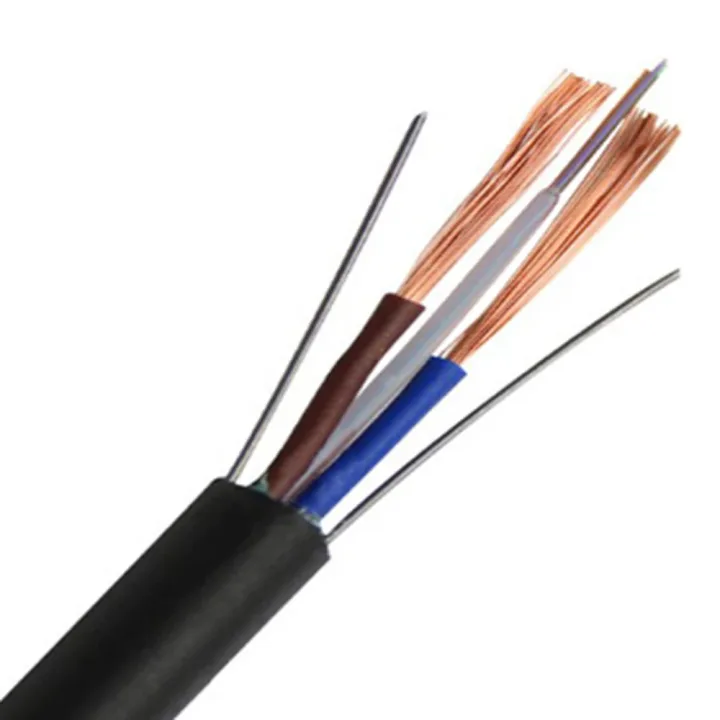
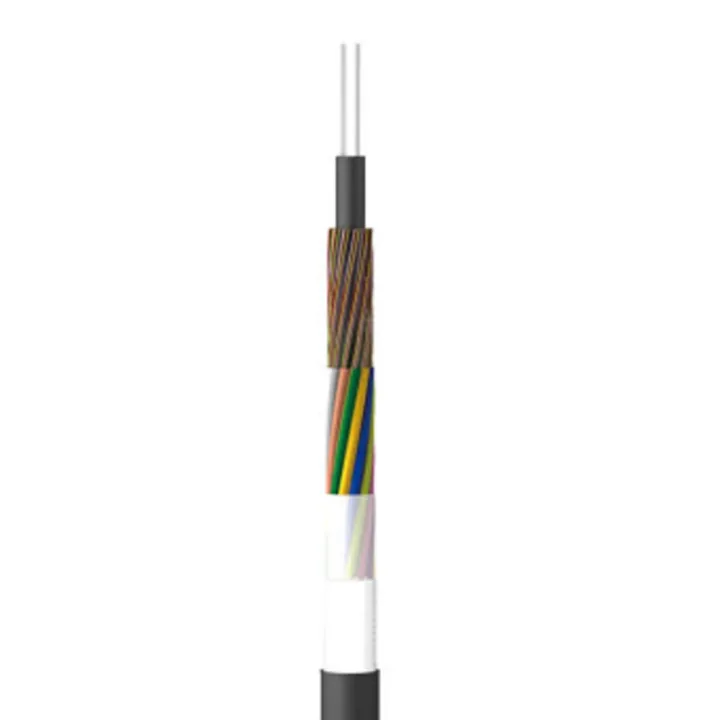
A GYXS/GYXTW central loose-tube cable with coated steel-tape protection, parallel steel wires and a polyethylene sheath, with documented low-count fiber and tensile variants.
Central-tube Light-armored Optical Cable places the optical fibers in one central loose tube rather than a ring of stranded tubes. Water-blocking materials and coated steel tape surround the tube, with two parallel steel wires supporting the finished construction.
The source model table includes different weight and tensile arrangements under the GYXS/GYXTW family. Specify the exact mechanical variant along with fiber count to avoid treating a family designation as a complete cable specification.
Identify fiber grade, required core count and mechanical duty. The table includes static/dynamic bend references of 10D/20D and a 300/1000 N per 100 mm crush reference on the initial configuration row. Confirm their applicability and the finished cable diameter for the selected model, particularly where repeated cells are blank.
Huijue Group can evaluate an OEM central-tube cable and private-label identification from a construction drawing or reference sample. Wire sizing, sheath tooling, optical/mechanical validation, quantity and delivery scope require engineering agreement.
Send count, fiber standard, required tensile variant, diameter/weight constraints, pulling and bend conditions, sheath details, route length and drum quantities.
| Fiber Type | Attenuation (+20℃) | Bandwidth | Numerical Aperture | Cable Cut-off Wavelength | ||||
|---|---|---|---|---|---|---|---|---|
| @850nm | @1300nm | @1310nm | @1550nm | @850nm | @1300nm | |||
| G.652 | — | — | ≤0.36dB/km | ≤0.22dB/km | — | — | — | ≤1260nm |
| G.655 | — | — | ≤0.40dB/km | ≤0.23dB/km | — | — | — | ≤1450nm |
| 50/125μm | ≤3.3dB/km | ≤1.2dB/km | — | — | ≥500MHz·km | ≥500MHz·km | 0.200±0.015 NA | — |
| 62.5/125μm | ≤3.5dB/km | ≤1.2dB/km | — | — | ≥200MHz·km | ≥500MHz·km | 0.275±0.015 NA | — |
| Cable Model (increments of 2 fibers) | Fiber Count | Reference Cable Weight (kg/km) | Allowable Tensile Load Long/Short Term (N) | Allowable Crush Load Long/Short Term (N/100mm) | Bend Radius Static/Dynamic (mm) | |||
| GYXS/GYXTW-2~12Xn | 2~12 | 82 | 600/1500 | 300/1000 | 10D/20D | |||
| GYXS/GYXTW-14~24Xn | 14~24 | 127 | ||||||
| GYXS/GYXTW-2~12Xn | 2~12 | 124 | 1000/3000 | |||||
| GYXS/GYXTW-14~24Xn | 14~24 | 147 |
For optical routes where a central-tube, low-fiber-count cable and defined light-armored construction meet the installation requirements.
Provide outdoor exposure, moisture conditions and installation method. Confirm route protection and metallic-layer treatment; the family name does not establish every environmental rating.
Buyer Questions
Answers specific to Central-tube Light-armored Optical Cable selection, configuration and purchasing.
No. The table lists different mass and tensile references. Confirm the selected construction and its complete mechanical limits.
The described construction uses two parallel steel wires alongside the central tube. Their sizing and the completed cable variant determine the applicable mechanical specification.
The local table groups models into 2–12 and 14–24 fibers. Any other requirement needs a separate construction review.
Use the deployment context to narrow the configuration before comparing dimensions, capacities and options.
Select indoor, outdoor or armored constructions around fiber count, route length and installation method.
Coordinate feeder, distribution and drop cables with the building-entry and subscriber topology.
Match tensile, crush, moisture and armor requirements to poles, ducts or direct-buried routes.
Use FTTA or hybrid constructions where optical transmission and site power share a route.
Before quotation: confirm capacity, interfaces, installation environment, power conditions, quantity and required options.