
Direct answer
Fan cooling, heat exchangers and air conditioners solve different combinations of heat load and environmental isolation. Fans exchange cabinet air with ambient air and are efficient when contamination and humidity permit. Air-to-air heat exchangers keep the internal and external air paths separated but can only move heat toward the ambient. Air conditioners can cool below ambient within their design envelope, with higher power and maintenance requirements. Selection requires a heat balance, not a cabinet-size rule.
Within the broader Outdoor Telecom & Edge Sites workflow, this article focuses on outdoor cabinet cooling: select a cabinet thermal method from heat load and environment. Confirm equipment heat load and the evidence for the offered product before final engineering approval.
Decisions that separate the options
Select a cabinet thermal method from heat load and environment. Start with the operating requirement and installation boundary, then separate system requirements from product claims so each supplier knows which evidence must accompany the offered configuration.
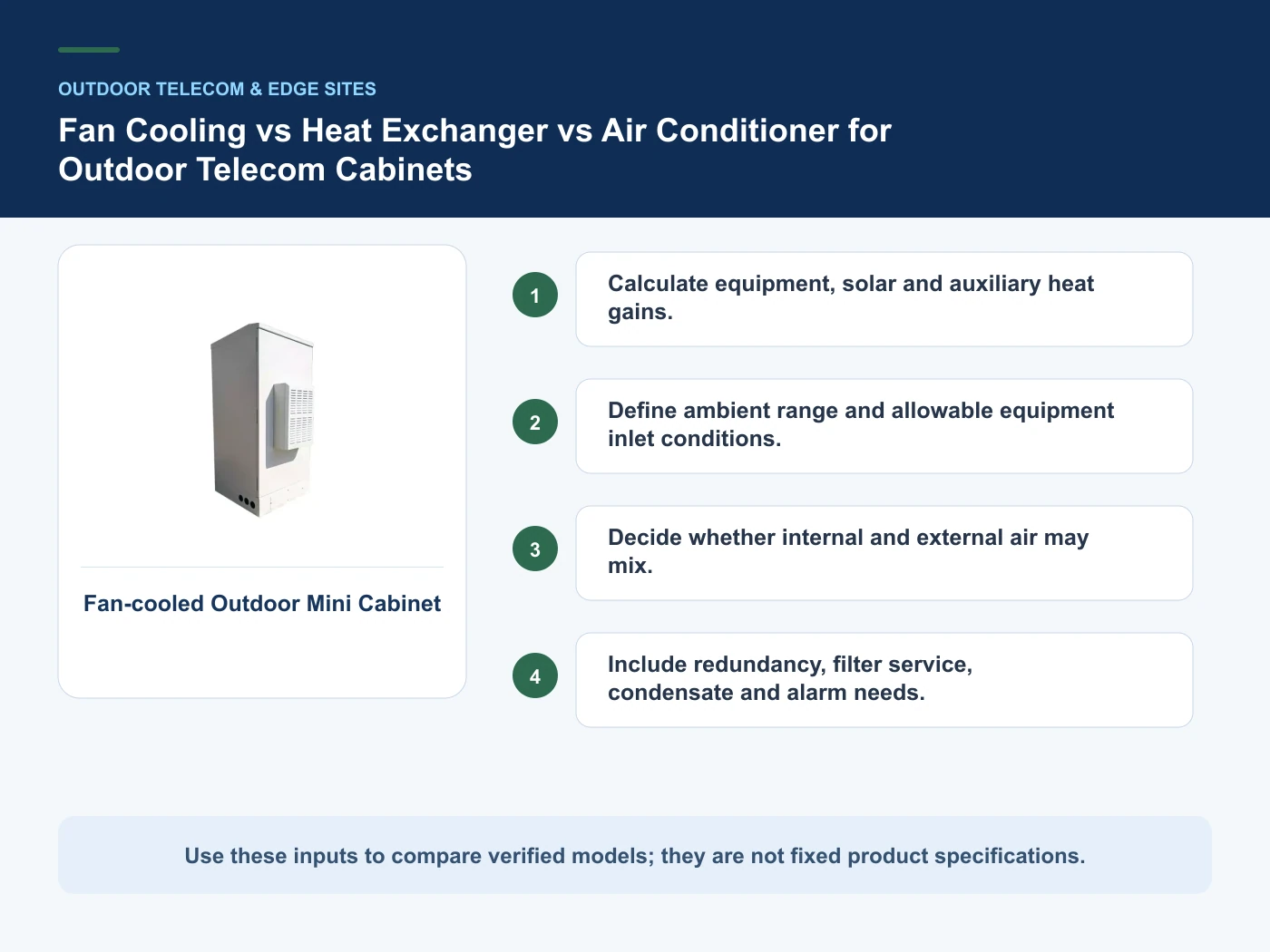
- Calculate equipment, solar and auxiliary heat gains.
- Define ambient range and allowable equipment inlet conditions.
- Decide whether internal and external air may mix.
- Include redundancy, filter service, condensate and alarm needs.
Calculate equipment, solar and auxiliary heat gains
Capture Equipment heat load, then use Fan as a practical comparison point: Ambient air is suitable and internal temperature may track above ambient. Before approval, verify this point: Check dust, humidity, filters and airflow path.
Define ambient range and allowable equipment inlet conditions
Capture Ambient temperature and solar exposure, then use Heat exchanger as a practical comparison point: Air paths must remain separated. Before approval, verify this point: Cannot cool internal air below ambient.
Decide whether internal and external air may mix
Capture Dust and humidity, then use Air conditioner as a practical comparison point: Below-ambient control or higher heat load is required. Before approval, verify this point: Check power, condensate, maintenance and low-temperature behavior.
Include redundancy, filter service, condensate and alarm needs
Capture Allowed internal conditions, then use Fan as a practical comparison point: Ambient air is suitable and internal temperature may track above ambient. Before approval, verify this point: Check dust, humidity, filters and airflow path.
Where the options diverge
This table connects enclosures, thermal management, environmental exposure, site integration and maintenance access to the decision on outdoor cabinet cooling. It is a decision aid rather than a universal performance table: exact capacity, environmental class, electrical or optical limits and certifications must come from the selected model, applicable project documents and verifiable test evidence.
| Option or input | When it fits | What must be verified |
|---|---|---|
| Fan | Ambient air is suitable and internal temperature may track above ambient | Check dust, humidity, filters and airflow path |
| Heat exchanger | Air paths must remain separated | Cannot cool internal air below ambient |
| Air conditioner | Below-ambient control or higher heat load is required | Check power, condensate, maintenance and low-temperature behavior |
Reference point: ISO/IEC 22237-4: Data centre facilities and infrastructures — Environmental control and ETSI EN 300 019-1-4 environmental conditions for non-weatherprotected locations frame the terminology or method used for this outdoor cabinet cooling comparison. They do not approve a product configuration; apply the edition named by the contract and local authority.
Relevant products from our communications portfolio
The products below connect the outdoor cabinet cooling decision to real catalogue families and verified site photography. They are starting points, not a claim that every configuration described here is a standard stock item; confirm model, interface, rating, drawing and testing scope with the project team.
- Fan-cooled Outdoor Mini Cabinet — use this product page as a configuration reference when you calculate equipment, solar and auxiliary heat gains. Confirm the offered model, interfaces, drawings and available evidence before quotation.
- Outdoor Air-Conditioned Cabinet — use this product page as a configuration reference when you define ambient range and allowable equipment inlet conditions. Confirm the offered model, interfaces, drawings and available evidence before quotation.
- Outdoor Integrated Cabinet — use this product page as a configuration reference when you decide whether internal and external air may mix. Confirm the offered model, interfaces, drawings and available evidence before quotation.
For adjacent configurations, browse Outdoor Cabinets & Site Infrastructure and compare those options against the outdoor cabinet cooling inputs above, including equipment heat load.
A comparison workflow that avoids label-based selection
- Step 1: Build the heat-load and ambient profile. Record Equipment heat load as an explicit input. Check dust, humidity, filters and airflow path.
- Step 2: Set equipment inlet and contamination limits. Record Ambient temperature and solar exposure as an explicit input. Cannot cool internal air below ambient.
- Step 3: Compare thermal capacity and isolation needs. Record Dust and humidity as an explicit input. Check power, condensate, maintenance and low-temperature behavior.
- Step 4: Specify alarms, maintenance access and acceptance tests. Record Allowed internal conditions as an explicit input. Check dust, humidity, filters and airflow path.
Common mistakes to avoid
- Choosing cooling from enclosure dimensions alone.
- Treating IP rating as a thermal-performance rating.
- Ignoring solar load, filter loading or loss of cooling.
What to include in the RFQ or design input
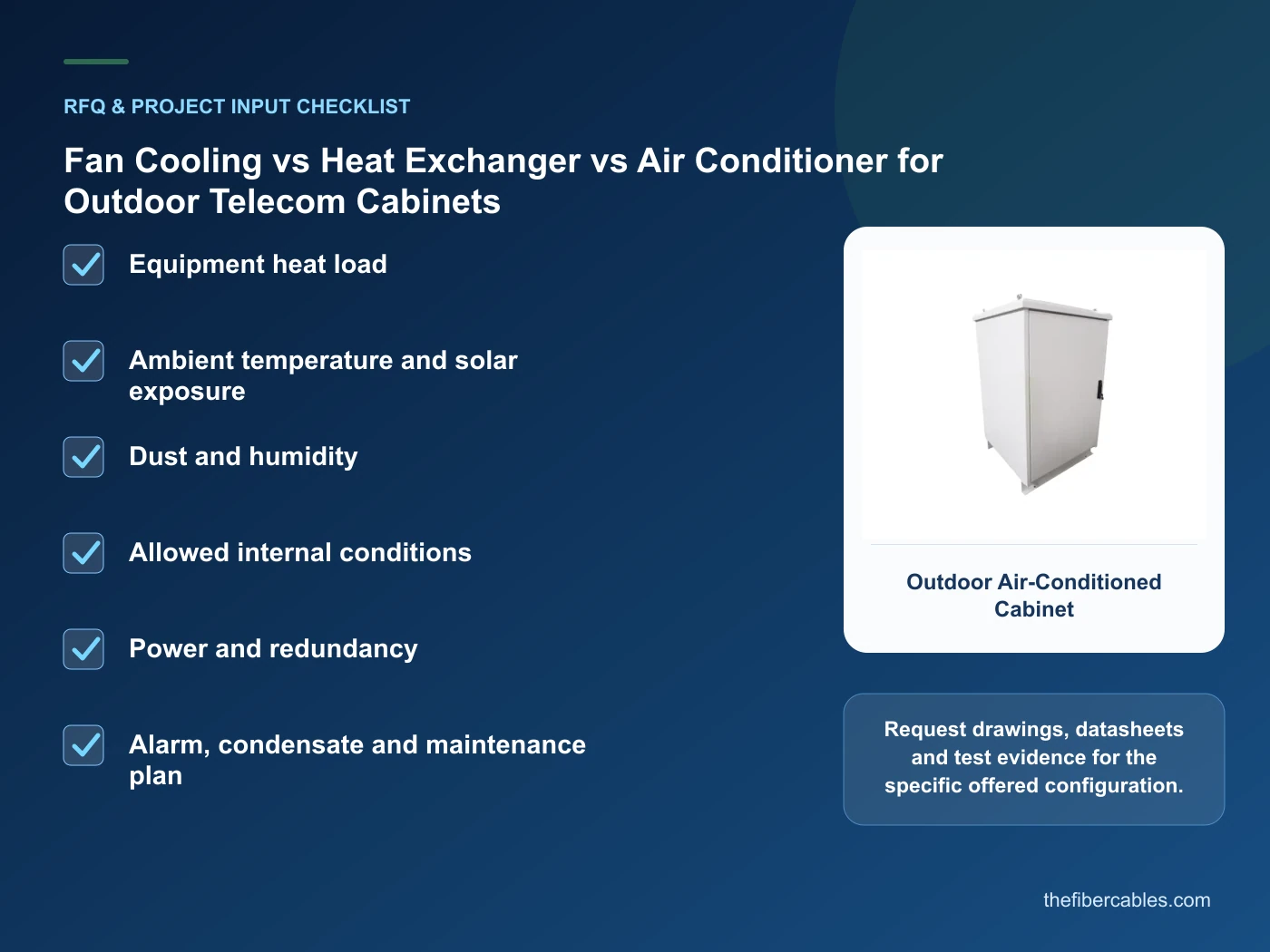
For outdoor cabinet cooling, a complete request reduces back-and-forth and prevents a catalogue image from being mistaken for a verified configuration. Record the following fields, identify which values are mandatory or provisional and attach route, interface or layout drawings where relevant.
- Equipment heat load
- Ambient temperature and solar exposure
- Dust and humidity
- Allowed internal conditions
- Power and redundancy
- Alarm, condensate and maintenance plan
Questions engineers and buyers ask
Which option is better for outdoor cabinet cooling?
There is no universal winner. Choose the option that satisfies calculate equipment, solar and auxiliary heat gains. and define ambient range and allowable equipment inlet conditions., then verify the offered model and project conditions.
Can price alone decide this comparison?
No. Compare installed interfaces, protection, testing, maintenance and expansion obligations as well as unit price.
Sources and standards
For outdoor cabinet cooling, the references below define relevant terminology, scope or test methods. ISO/IEC 22237-4: Data centre facilities and infrastructures — Environmental control is one documented boundary for this topic; neither a standards catalogue page nor a category page proves certification of the offered product. Apply the edition adopted by the contract, destination market and authority having jurisdiction.
- ISO/IEC 22237-4: Data centre facilities and infrastructures — Environmental control (2021). Use it to verify the terminology and scope relevant to outdoor cabinet cooling; the source does not certify a specific offered product.
- ETSI EN 300 019-1-4 environmental conditions for non-weatherprotected locations (V3.1.1, 05/2026; current edition). Use it to verify the terminology and scope relevant to outdoor cabinet cooling; the source does not certify a specific offered product.
- ITU-T L.1350: Energy efficiency metrics of a base station site (10/2016). Use it to verify the terminology and scope relevant to outdoor cabinet cooling; the source does not certify a specific offered product.
Source review: Links and cited editions for outdoor cabinet cooling were checked on 2026-10-15. Confirm the edition adopted by the project contract and the authority having jurisdiction.
Related guidance
Outdoor Telecom Site Design: Cabinets, Cooling, Power and Equipment Shelters • How to Select an Outdoor Cabinet IP Rating and Cable-Entry Strategy • Single-Compartment vs Multi-Compartment Outdoor Telecom Cabinets
Prepare a outdoor cabinet cooling configuration for review
Send equipment heat load, ambient temperature and solar exposure, dust and humidity, allowed internal conditions, together with quantity and delivery destination. We will help narrow the relevant product family and identify the drawings or test evidence needed for quotation.
——END——