
Direct answer
Hot-aisle and cold-aisle containment both reduce supply and return-air mixing, but they place the controlled boundary in different locations. Selection depends on cooling architecture, ceiling or return path, room use, fire and life-safety coordination, rack layout, maintenance practice and equipment inlet conditions. Neither option compensates for missing blanking, unmanaged cable openings or excessive bypass air.
Within the broader Data Center Physical Infrastructure workflow, this article focuses on hot aisle vs cold aisle containment: select containment around airflow, room interfaces and maintenance. Confirm rack layout and airflow direction and the evidence for the offered product before final engineering approval.
Decisions that separate the options
Select containment around airflow, room interfaces and maintenance. Start with the operating requirement and installation boundary, then separate system requirements from product claims so each supplier knows which evidence must accompany the offered configuration.
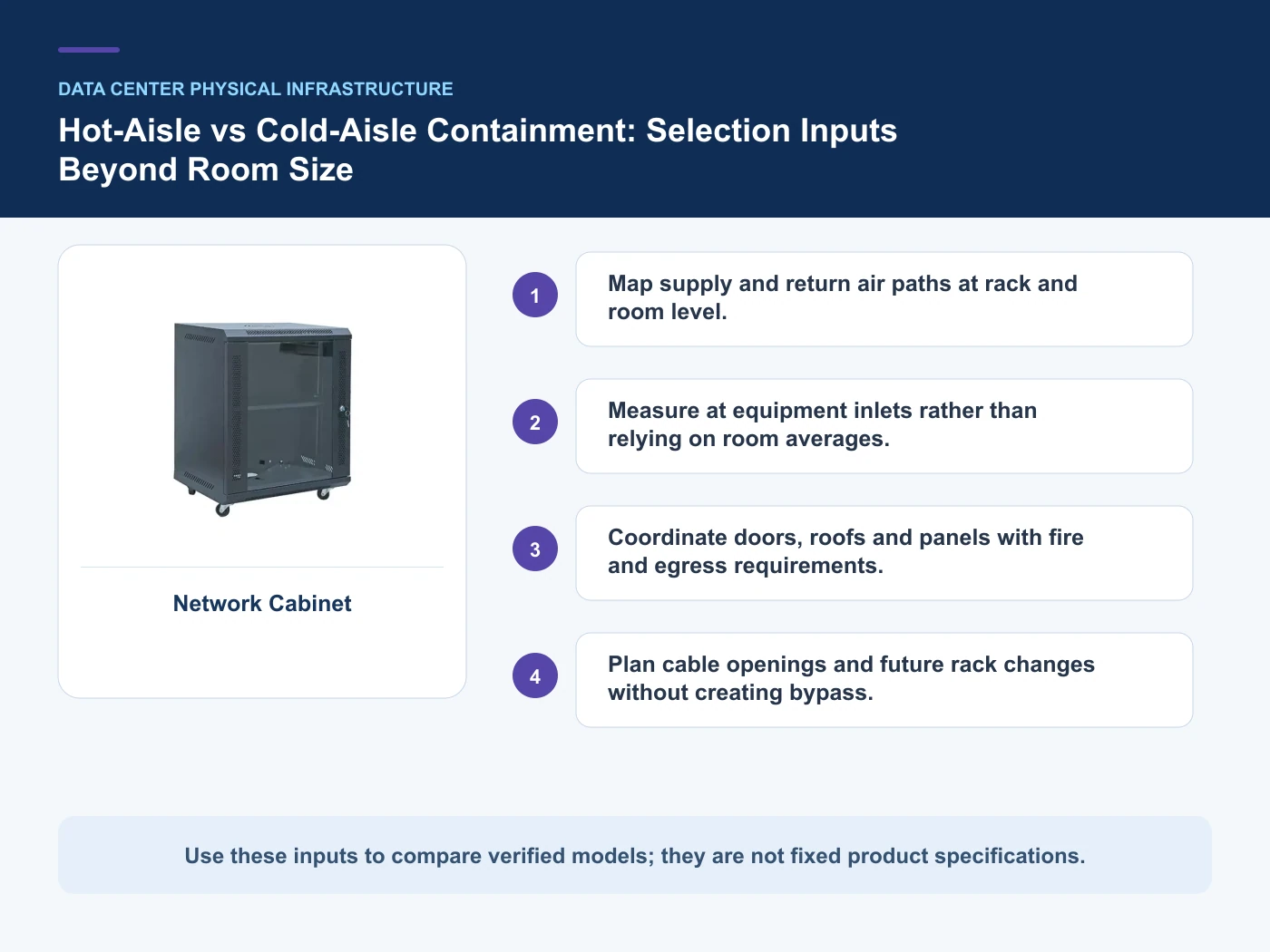
- Map supply and return air paths at rack and room level.
- Measure at equipment inlets rather than relying on room averages.
- Coordinate doors, roofs and panels with fire and egress requirements.
- Plan cable openings and future rack changes without creating bypass.
Map supply and return air paths at rack and room level
Capture Rack layout and airflow direction, then use Cold-aisle containment as a practical comparison point: Encloses supply-air zone. Before approval, verify this point: Room becomes the return-air volume.
Measure at equipment inlets rather than relying on room averages
Capture Heat load profile, then use Hot-aisle containment as a practical comparison point: Encloses hot exhaust. Before approval, verify this point: Requires a defined return path.
Coordinate doors, roofs and panels with fire and egress requirements
Capture Cooling supply/return path, then use Uncontained as a practical comparison point: Lower complexity at low density. Before approval, verify this point: Mixing risk grows with load and layout changes.
Plan cable openings and future rack changes without creating bypass
Capture Containment dimensions, then use Cold-aisle containment as a practical comparison point: Encloses supply-air zone. Before approval, verify this point: Room becomes the return-air volume.
Where the options diverge
This table connects racks, containment, pathways, modular rooms, service access and future expansion to the decision on hot aisle vs cold aisle containment. It is a decision aid rather than a universal performance table: exact capacity, environmental class, electrical or optical limits and certifications must come from the selected model, applicable project documents and verifiable test evidence.
| Option or input | When it fits | What must be verified |
|---|---|---|
| Cold-aisle containment | Encloses supply-air zone | Room becomes the return-air volume |
| Hot-aisle containment | Encloses hot exhaust | Requires a defined return path |
| Uncontained | Lower complexity at low density | Mixing risk grows with load and layout changes |
Reference point: ISO/IEC 22237-4: Data centre facilities and infrastructures — Environmental control and ASHRAE thermal guidance for data processing environments frame the terminology or method used for this hot aisle vs cold aisle containment comparison. They do not approve a product configuration; apply the edition named by the contract and local authority.
Relevant products from our communications portfolio
The products below connect the hot aisle vs cold aisle containment decision to real catalogue families and verified site photography. They are starting points, not a claim that every configuration described here is a standard stock item; confirm model, interface, rating, drawing and testing scope with the project team.
- Network Cabinet — use this product page as a configuration reference when you map supply and return air paths at rack and room level. Confirm the offered model, interfaces, drawings and available evidence before quotation.
- Server Rack Cabinet — use this product page as a configuration reference when you measure at equipment inlets rather than relying on room averages. Confirm the offered model, interfaces, drawings and available evidence before quotation.
- HR1000 Rack-Based Micro Data Center — use this product page as a configuration reference when you coordinate doors, roofs and panels with fire and egress requirements. Confirm the offered model, interfaces, drawings and available evidence before quotation.
For adjacent configurations, browse Data Center & Network Infrastructure and compare those options against the hot aisle vs cold aisle containment inputs above, including rack layout and airflow direction.
A comparison workflow that avoids label-based selection
- Step 1: Record cooling delivery and return architecture. Record Rack layout and airflow direction as an explicit input. Room becomes the return-air volume.
- Step 2: Map rack airflow direction and heat load. Record Heat load profile as an explicit input. Requires a defined return path.
- Step 3: Review containment interfaces with fire, lighting and egress. Record Cooling supply/return path as an explicit input. Mixing risk grows with load and layout changes.
- Step 4: Commission with inlet and pressure observations under operating load. Record Containment dimensions as an explicit input. Room becomes the return-air volume.
Common mistakes to avoid
- Selecting from room dimensions alone.
- Quoting a universal temperature without equipment class and measurement point.
- Leaving rack gaps and cable openings unmanaged.
What to include in the RFQ or design input
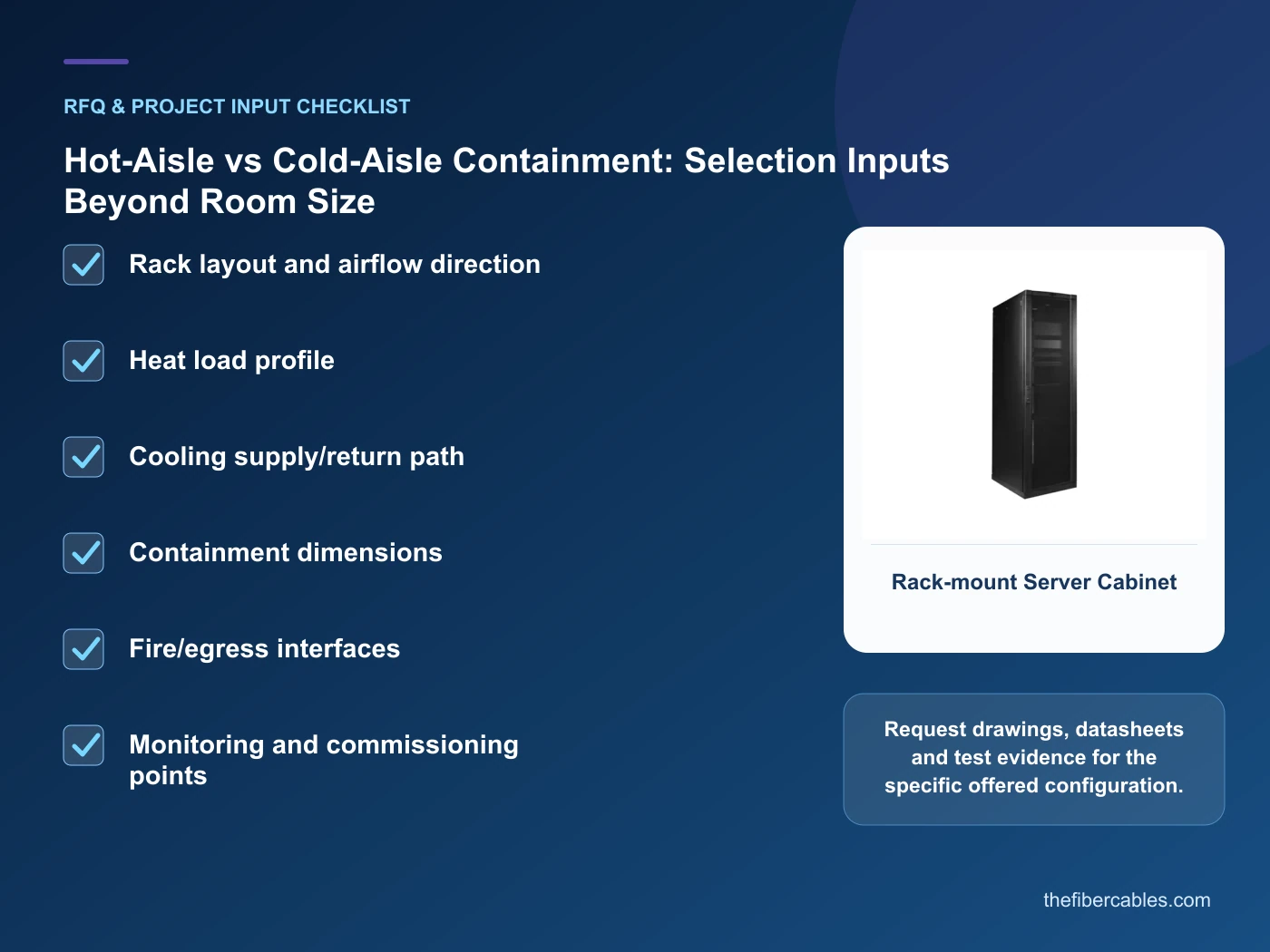
For hot aisle vs cold aisle containment, a complete request reduces back-and-forth and prevents a catalogue image from being mistaken for a verified configuration. Record the following fields, identify which values are mandatory or provisional and attach route, interface or layout drawings where relevant.
- Rack layout and airflow direction
- Heat load profile
- Cooling supply/return path
- Containment dimensions
- Fire/egress interfaces
- Monitoring and commissioning points
Questions engineers and buyers ask
Which option is better for hot aisle vs cold aisle containment?
There is no universal winner. Choose the option that satisfies map supply and return air paths at rack and room level. and measure at equipment inlets rather than relying on room averages., then verify the offered model and project conditions.
Can price alone decide this comparison?
No. Compare installed interfaces, protection, testing, maintenance and expansion obligations as well as unit price.
Sources and standards
For hot aisle vs cold aisle containment, the references below define relevant terminology, scope or test methods. ISO/IEC 22237-4: Data centre facilities and infrastructures — Environmental control is one documented boundary for this topic; neither a standards catalogue page nor a category page proves certification of the offered product. Apply the edition adopted by the contract, destination market and authority having jurisdiction.
- ISO/IEC 22237-4: Data centre facilities and infrastructures — Environmental control (2021). Use it to verify the terminology and scope relevant to hot aisle vs cold aisle containment; the source does not certify a specific offered product.
- ASHRAE thermal guidance for data processing environments (5th ed. 2021; revised 2022). Use it to verify the terminology and scope relevant to hot aisle vs cold aisle containment; the source does not certify a specific offered product.
- NFPA 75: Fire protection of information technology equipment (2024 edition). Use it to verify the terminology and scope relevant to hot aisle vs cold aisle containment; the source does not certify a specific offered product.
Source review: Links and cited editions for hot aisle vs cold aisle containment were checked on 2026-10-15. Confirm the edition adopted by the project contract and the authority having jurisdiction.
Related guidance
Data Center Physical Infrastructure Planning: Racks, Aisles, Fiber Pathways and Expansion • Micro-Modular Data Center vs Conventional Equipment Room: What Changes in Deployment? • Fiber Raceway vs Metal Cable Tray for Data-Center Cabling
Prepare a hot aisle vs cold aisle containment configuration for review
Send rack layout and airflow direction, heat load profile, cooling supply/return path, containment dimensions, together with quantity and delivery destination. We will help narrow the relevant product family and identify the drawings or test evidence needed for quotation.
——END——