
Direct answer
An FTTA cable should be selected from the complete BBU-to-radio connection path. Confirm equipment-side and radio-side connector families, fibre type and count, duplex or multi-fibre mapping, route length, breakout and pulling arrangement, outdoor exposure, bend and tensile limits, sealing accessories, grounding boundaries and test method. A cable diameter label or connector photo is not enough to prove compatibility with an RRU, RRH or AAU.
Within the broader Fiber Cable Selection workflow, this article focuses on FTTA cable selection: specify the remote-radio fibre route and interfaces. Confirm equipment at both ends and the evidence for the offered product before final engineering approval.
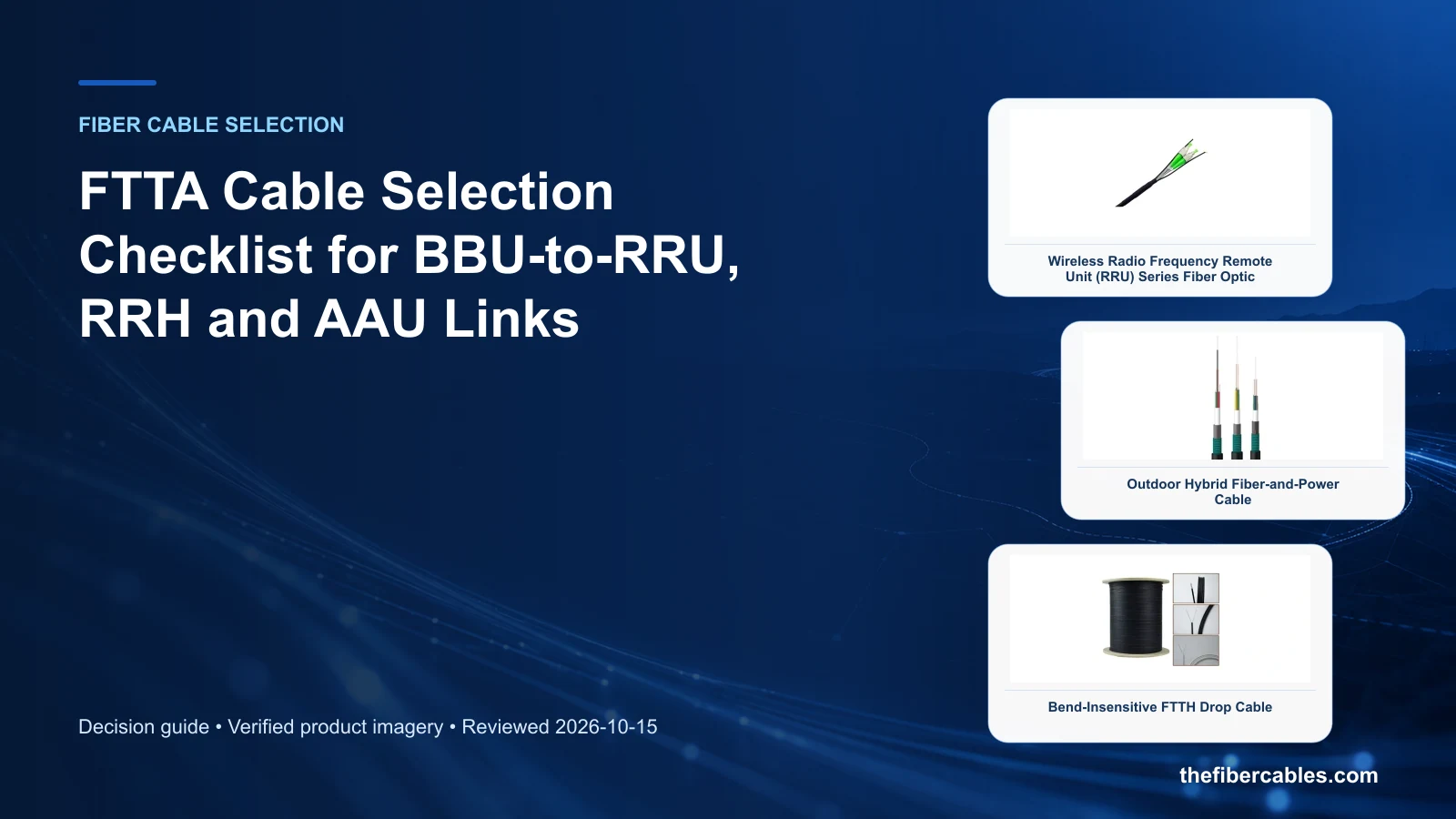
Project inputs that narrow the product family
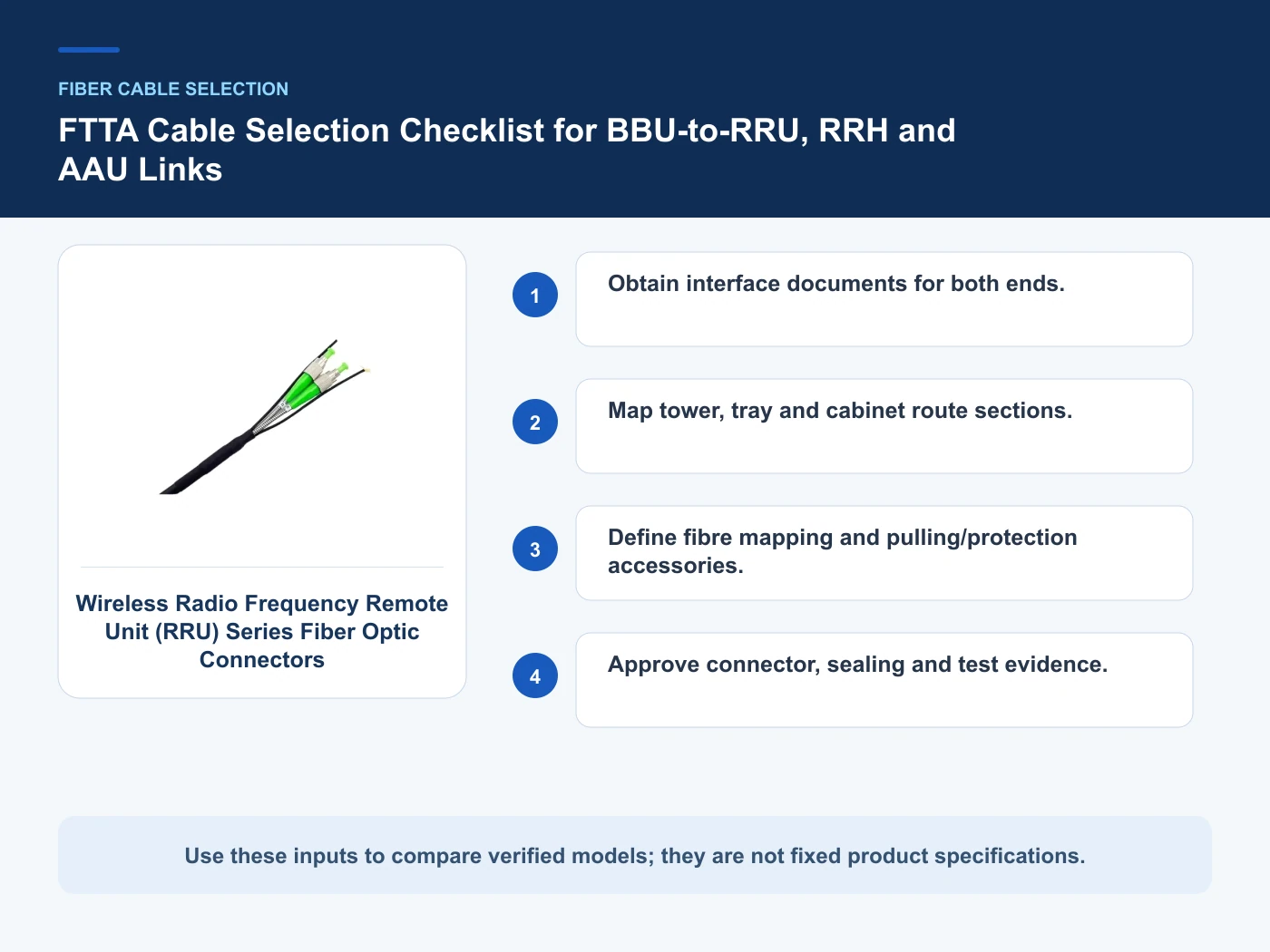
Specify the remote-radio fibre route and interfaces. Start with the operating requirement and installation boundary, then separate system requirements from product claims so each supplier knows which evidence must accompany the offered configuration.
- Obtain interface documents for both ends.
- Map tower, tray and cabinet route sections.
- Define fibre mapping and pulling/protection accessories.
- Approve connector, sealing and test evidence.
Obtain interface documents for both ends
Capture Equipment at both ends, then use Interface as a practical comparison point: Connector family, polish, keying and pin/fibre map. Before approval, verify this point: Visual similarity does not prove compatibility.
Map tower, tray and cabinet route sections
Capture Connector and fibre map, then use Route as a practical comparison point: Length, bends, pulling and outdoor exposure. Before approval, verify this point: Use complete-cable limits.
Define fibre mapping and pulling/protection accessories
Capture Route length, then use Installation set as a practical comparison point: Breakout, clamps, seals and labels. Before approval, verify this point: Treat as a coordinated assembly.
Approve connector, sealing and test evidence
Capture Cable diameter/construction, then use Interface as a practical comparison point: Connector family, polish, keying and pin/fibre map. Before approval, verify this point: Visual similarity does not prove compatibility.
Relevant products from our communications portfolio
The products below connect the FTTA cable selection decision to real catalogue families and verified site photography. They are starting points, not a claim that every configuration described here is a standard stock item; confirm model, interface, rating, drawing and testing scope with the project team.
- RRU Fiber Optic Cable Assemblies — use this product page as a configuration reference when you obtain interface documents for both ends. Confirm the offered model, interfaces, drawings and available evidence before quotation.
- Outdoor Hybrid Fiber-and-Power Cable — use this product page as a configuration reference when you map tower, tray and cabinet route sections. Confirm the offered model, interfaces, drawings and available evidence before quotation.
- Bend-Insensitive FTTH Drop Cable — use this product page as a configuration reference when you define fibre mapping and pulling/protection accessories. Confirm the offered model, interfaces, drawings and available evidence before quotation.
For adjacent configurations, browse Fiber Optic Cables and compare those options against the FTTA cable selection inputs above, including equipment at both ends.
Selection boundaries to verify
This table connects cable construction, route conditions, fibre type, installation method and procurement inputs to the decision on FTTA cable selection. It is a decision aid rather than a universal performance table: exact capacity, environmental class, electrical or optical limits and certifications must come from the selected model, applicable project documents and verifiable test evidence.
| Option or input | When it fits | What must be verified |
|---|---|---|
| Interface | Connector family, polish, keying and pin/fibre map | Visual similarity does not prove compatibility |
| Route | Length, bends, pulling and outdoor exposure | Use complete-cable limits |
| Installation set | Breakout, clamps, seals and labels | Treat as a coordinated assembly |
Reference point: IEC 60794-1-1: Optical fibre cables — Generic specification and ITU-T G.657: Bend-insensitive single-mode optical fibre and cable frame the terminology or method used for this FTTA cable selection comparison. They do not approve a product configuration; apply the edition named by the contract and local authority.
A practical product-selection workflow
- Step 1: Collect equipment interface data. Record Equipment at both ends as an explicit input. Visual similarity does not prove compatibility.
- Step 2: Survey and measure the route. Record Connector and fibre map as an explicit input. Use complete-cable limits.
- Step 3: Specify cable/assembly and accessories. Record Route length as an explicit input. Treat as a coordinated assembly.
- Step 4: Test continuity, mapping and loss before activation. Record Cable diameter/construction as an explicit input. Visual similarity does not prove compatibility.
Common mistakes to avoid
- Ordering from equipment brand shorthand only.
- Ignoring installed connector passage size.
- Assuming a waterproof connector proves the entire route seal.
What to include in the RFQ or design input
For FTTA cable selection, a complete request reduces back-and-forth and prevents a catalogue image from being mistaken for a verified configuration. Record the following fields, identify which values are mandatory or provisional and attach route, interface or layout drawings where relevant.
- Equipment at both ends
- Connector and fibre map
- Route length
- Cable diameter/construction
- Accessories
- Test and label requirements
Questions engineers and buyers ask
What should a buyer specify first for FTTA cable selection?
Begin with equipment at both ends, connector and fibre map, route length; these inputs narrow the product family before optional features are compared.
Does a product photo confirm the final configuration?
No. Treat the image as a visual reference and confirm the model, drawing, interfaces, ratings and test evidence for the offered unit.
Sources and standards
For FTTA cable selection, the references below define relevant terminology, scope or test methods. IEC 60794-1-1: Optical fibre cables — Generic specification is one documented boundary for this topic; neither a standards catalogue page nor a category page proves certification of the offered product. Apply the edition adopted by the contract, destination market and authority having jurisdiction.
- IEC 60794-1-1: Optical fibre cables — Generic specification (2023, Ed.5). Use it to verify the terminology and scope relevant to FTTA cable selection; the source does not certify a specific offered product.
- ITU-T G.657: Bend-insensitive single-mode optical fibre and cable (08/2024). Use it to verify the terminology and scope relevant to FTTA cable selection; the source does not certify a specific offered product.
Source review: Links and cited editions for FTTA cable selection were checked on 2026-10-15. Confirm the edition adopted by the project contract and the authority having jurisdiction.
Related guidance
How to Select Fiber Optic Cable for FTTx, Telecom, Data Centers and Outdoor Routes • How to Specify a Hybrid Fiber-and-Power Cable Without Undersizing the Conductors • ADSS vs Figure-8 Aerial Fiber Cable: Which Route Conditions Decide?
Prepare a FTTA cable selection configuration for review
Send equipment at both ends, connector and fibre map, route length, cable diameter/construction, together with quantity and delivery destination. We will help narrow the relevant product family and identify the drawings or test evidence needed for quotation.
——END——