
Equipment rooms
Organize racks, pathways and service access around active network equipment.
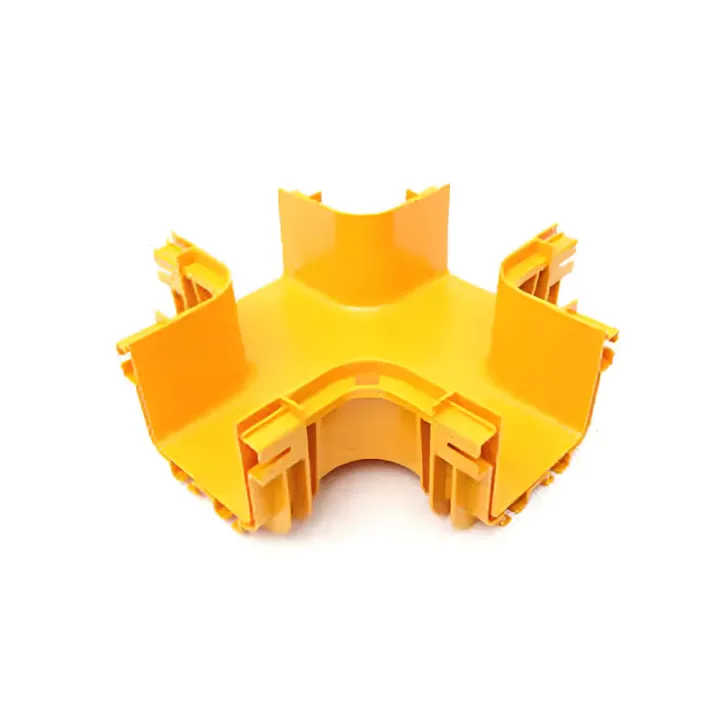
An indoor ABS/PVC fiber-routing system with straight channels, bends, branches and equipment outlets for managing optical connections through communications rooms and rack areas.
Fiber Raceway establishes a dedicated path for optical fibers and patching routes in a communications room. Straight sections connect with elbows, tees, outlets and transition parts so fibers can travel from distribution frames to equipment without relying on general cable supports at every point.
The source describes extruded and molded components. Route continuity matters as much as channel width: outlet geometry, support locations and transitions should preserve the bend requirements of the actual fibers.
Count the fibers, cords and planned additions, then choose channel size with space for exits and maintenance. Identify every ODF and equipment drop. The source refers to a 40 mm minimum bend dimension; verify the required bend radius against the actual cable specification and the selected fittings before finalizing the route.
Huijue Group can assess an OEM fiber raceway or private-label package from route drawings and component samples. Nonstandard molded fittings, tooling, material and fit tests, quantities and delivery scope require engineering review.
Provide the route plan, channel widths and heights, fiber/cord counts, cable bend requirements, outlet locations, transitions, support heights and accessory quantities.
| S/N | Model | NAME | Material | Application scenarios | Width (mm) | Height (mm) |
|---|---|---|---|---|---|---|
| 1 | HJ GXCD1-120A | Fiber Raceway Channel | ABS/PVC | (indoor) | 120 | 50 |
| 2 | HJ GXCD1-240A | Fiber Raceway Channel | ABS/PVC | (indoor) | 240 | 50 |
| 3 | HJ GXCD1-360A | Fiber Raceway Channel | ABS/PVC | (indoor) | 360 | 50 |
| 4 | HJ GXCD1-120B | Fiber Raceway Channel | ABS/PVC | (indoor) | 120 | 70 |
| 5 | HJ GXCD1-240B | Fiber Raceway Channel | ABS/PVC | (indoor) | 240 | 70 |
| 6 | HJ GXCD1-360B | Fiber Raceway Channel | ABS/PVC | (indoor) | 360 | 70 |
| 7 | HJ GXCD1-120C | Fiber Raceway Channel | ABS/PVC | (indoor) | 120 | 100 |
| 8 | HJ GXCD1-240C | Fiber Raceway Channel | ABS/PVC | (indoor) | 240 | 100 |
| 9 | HJ GXCD1-360C | Fiber Raceway Channel | ABS/PVC | (indoor) | 360 | 100 |
| S/N | Product Name | unit | quantity | REMARK | ||
| 1 | Straight groove | m | 1 | 1 m length | ||
| 2 | Connector | pcs | 0.67 | |||
| 3 | Three-way | pcs | 0.33 | |||
| 4 | Four-way | pcs | 0.33 | |||
| 5 | ODF side outlet (including plastic bellows) | pcs | 1.67 | |||
| 6 | Equipment side outlet (including plastic bellows) | pcs | 1.67 | |||
| 7 | supporting item | Sleeve | 0.5 | Meet the height requirements of the machine room | ||
| 8 | Hanging pendant | Sleeve | 0.5 | Length meets machine room height | ||
| 9 | Bending Groove | Sleeve | 1 | |||
| 10 | Conversion head (240mm-120mm) | Sleeve | 1 | |||
| 11 | 240mm-120mm 4-way | Sleeve | 1 | |||
| 12 | 240mm-120mm Tee | Sleeve | 1 |
Suitable project contexts include indoor optical distribution areas, equipment-room patching routes and dedicated fiber paths between ODFs and racks.
The documented variants are indoor channels. Any required flame, smoke or material-compliance evidence must be agreed for the exact supplied material and components.
Buyer Questions
Answers specific to Fiber Raceway selection, configuration and purchasing.
The table lists 120, 240 and 360 mm widths with 50, 70 and 100 mm heights. Confirm the selected combination and fittings on the bill of materials.
The source includes 240-to-120 mm transition components. Check fiber count, bend requirements and outlet routing at the reduction.
The fiber or cable specification remains a controlling input. Check every bend and outlet against it, including any source-stated raceway bend dimension.
Use the deployment context to narrow the configuration before comparing dimensions, capacities and options.
Organize racks, pathways and service access around active network equipment.
Coordinate cabinet capacity, cable routes, airflow and planned expansion.
Package network equipment within compact distributed infrastructure sites.
Add capacity while accounting for existing racks, routes and maintenance space.
Before quotation: confirm capacity, interfaces, installation environment, power conditions, quantity and required options.