
Passive optical distribution
Match splitter or WDM architecture to wavelength plan, ratio, package and insertion-loss targets.
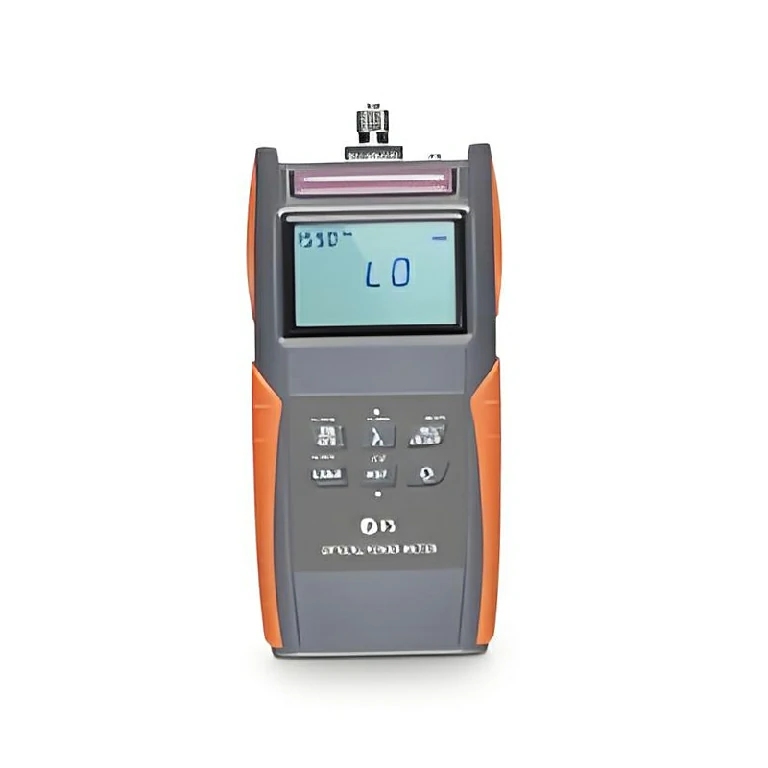
The OLP-85 handheld optical power meter covers 800–1700 nm, absolute and reference power measurement, and a -75 to +26 dBm range.
The OLP-85 Handheld Optical Power Meter is intended for field measurement of optical power and link loss across common single-mode and multimode wavelengths. It provides standard wavelength selections at 850, 980, 1300, 1310, 1490, 1550 and 1625 nm, while the wavelength setting can be adjusted from 800 to 1700 nm in 1 nm steps.
Absolute and reference power modes allow the technician to record received power or calculate loss against an established reference. When paired with a compatible light source, automatic wavelength functions can reduce manual setting errors; the complete measurement method and reference cord condition still determine whether results are useful.
Confirm the wavelengths, expected power range, connector interface and whether automatic wavelength recognition must work with an existing source. Also define the reporting and calibration requirements for the project. The listed operating range is -10°C to 55°C; storage and transport are -40°C to 70°C.
Huijue Group can review an OEM instrument kit with selected adapters, reference cords, case layout and private-label artwork. A customer sample or measurement workflow can be used to check accessory compatibility, while calibration documents, acceptance criteria, quantity and delivery contents require written confirmation.
| Serial No. | Performance Item | OLP-85 |
| 1 | Standard Wavelengths | 850, 980, 1300, 1310, 1490, 1550, 1625nm |
| 2 | Wavelength Range | 800 to 1700 nm, continuously adjustable in 1nm steps |
| 3 | Port Type | FC/PC |
| 4 | Fiber Type | 9/125, 62.5/125 |
| 5 | Test Power Range | -75~+26dBm |
| 6 | Uncertainty | ±0.13 dB (±3%) |
| 7 | Auto Zero | Yes |
| 8 | Power Measurement Functions | Absolute Power, Reference Power |
| 9 | Automatic Functions | Auto Wavelength Function: Automatic single-wavelength detection; Multi-wavelength Function: Automatic multi-wavelength detection |
Operating Temperature: -10~+55℃
Storage and Transportation Temperature: -40~+70℃
Allow the instrument to stabilize after a large temperature change, keep the port and reference cords clean, and establish a fresh reference before loss testing. Do not exceed the stated input range.
Buyer Questions
Answers specific to Handheld Optical Power Meter selection, configuration and purchasing.
Yes. It lists absolute and reference power modes; link loss is obtained after establishing a proper reference with a compatible source and clean reference cords.
Both wavelengths are included in the listed standard wavelength set.
They can be reviewed as part of a project kit after the connector interfaces and test method are confirmed.
Use the deployment context to narrow the configuration before comparing dimensions, capacities and options.
Match splitter or WDM architecture to wavelength plan, ratio, package and insertion-loss targets.
Coordinate connector, polish, fiber grade, polarity and cable length across patching points.
Plan MPO/MTP trunks and harnesses around port mapping, breakout format and rack density.
Select splicing, cleaning and test tools for the connector types and measurements used on site.
Before quotation: confirm capacity, interfaces, installation environment, power conditions, quantity and required options.