
Direct answer
An intelligent ODN system should connect physical ports and passive-node assets to controlled inventory records and field workflows. Define the identification method, data model, commissioning process, offline behavior, permissions and reconciliation procedure before selecting hardware; automated tags improve visibility only when moves, adds and changes remain auditable.
This pillar guide connects ODN inventory, automated identification, optical cross-connect governance, ODF capacity and auditable change control. Use it to define project inputs before narrowing to a product family.
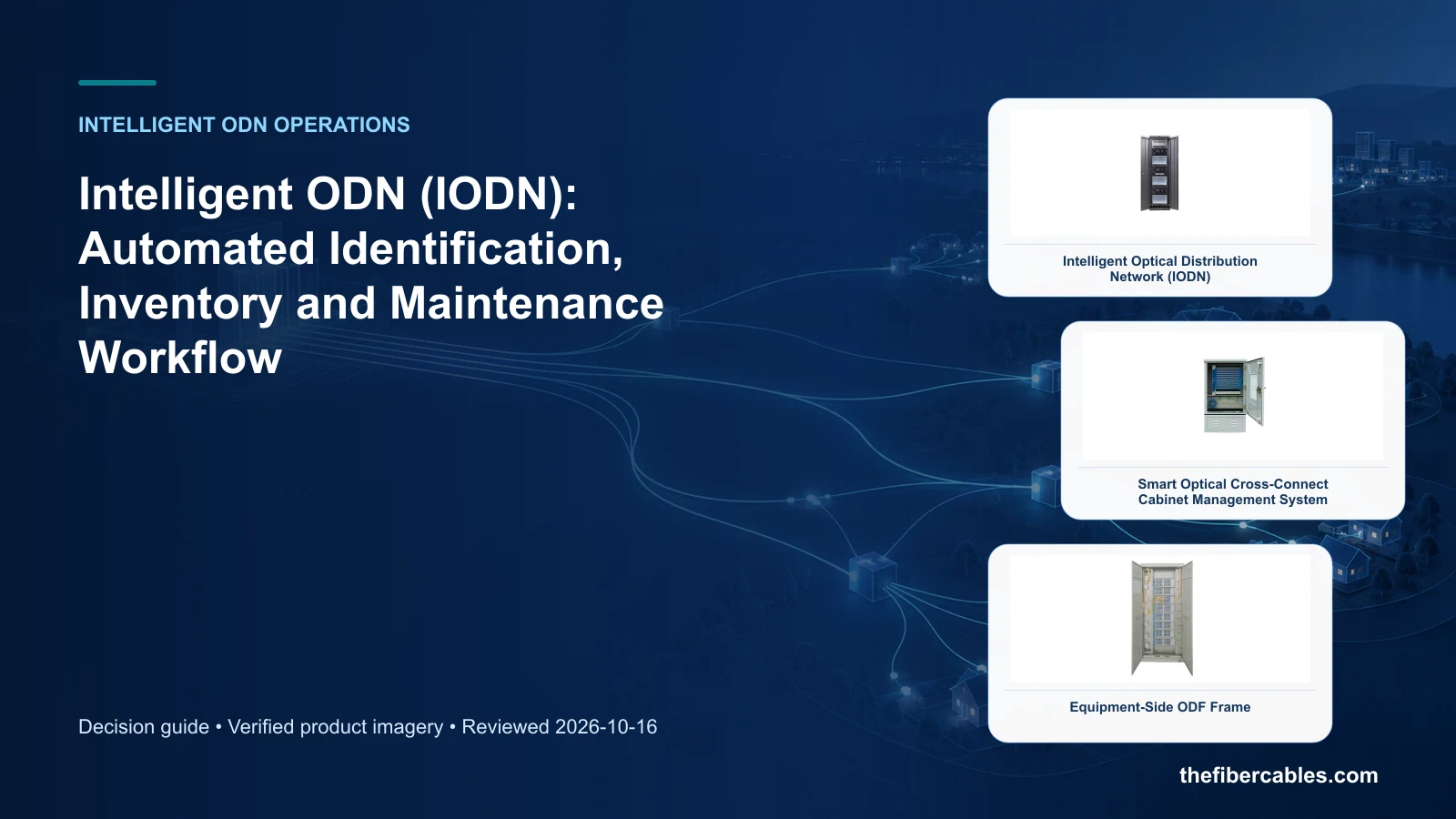
System boundaries to define before product selection
Define what an intelligent ODN system must identify, record and maintain. Start with the operating requirement and installation boundary, then separate system requirements from product claims so each supplier knows which evidence must accompany the offered configuration.
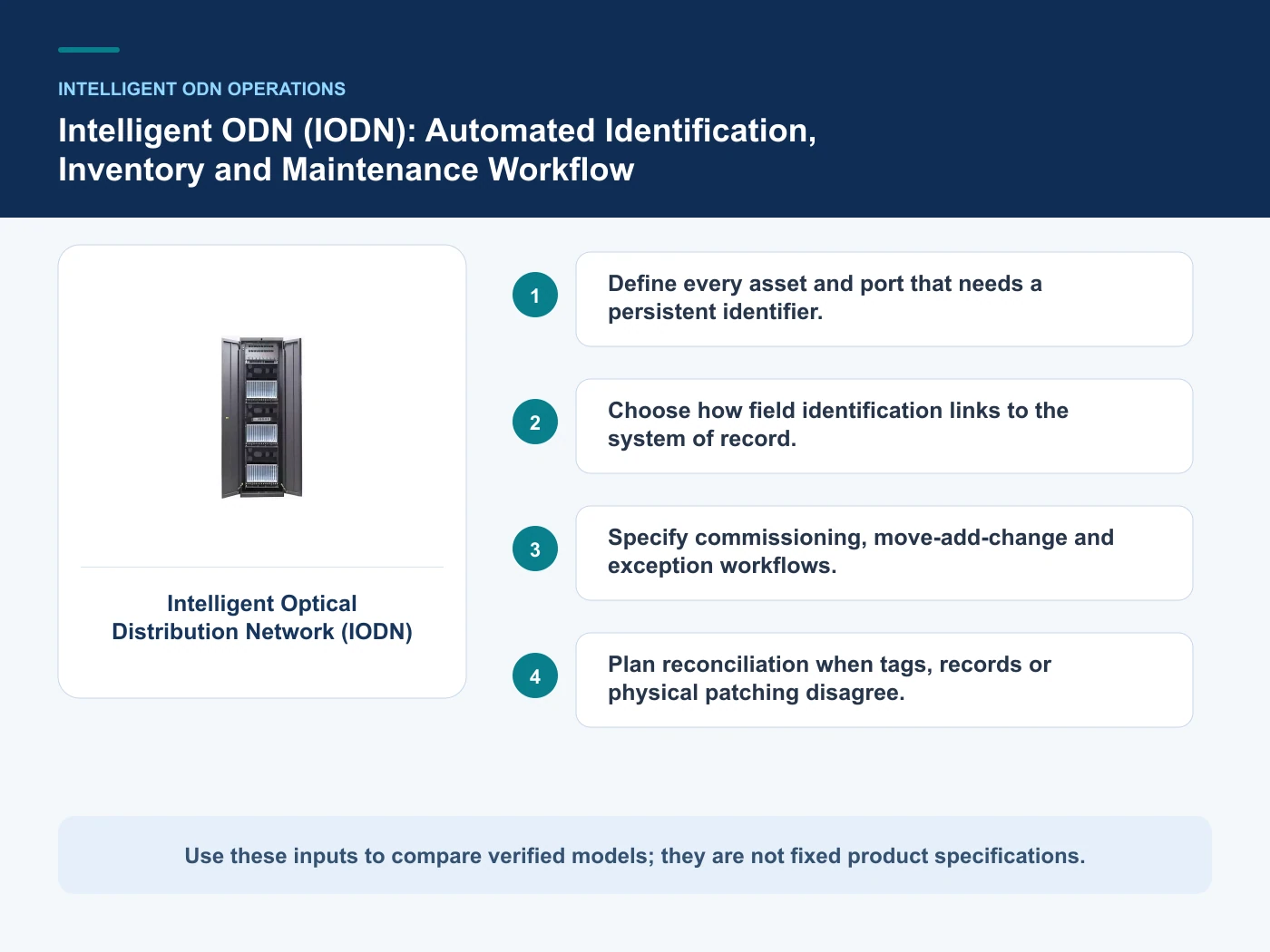
- Define every asset and port that needs a persistent identifier.
- Choose how field identification links to the system of record.
- Specify commissioning, move-add-change and exception workflows.
- Plan reconciliation when tags, records or physical patching disagree.
Define every asset and port that needs a persistent identifier
Capture Assets and ports in scope, then use Automated ID node as a practical comparison point: Port-level identification is required. Before approval, verify this point: Tag technology, reader and failure behavior.
Choose how field identification links to the system of record
Capture Identification technology, then use Managed cross-connect as a practical comparison point: Cabinet operations need guided records. Before approval, verify this point: Port map, permissions and audit trail.
Specify commissioning, move-add-change and exception workflows
Capture System-of-record integration, then use Inventory integration as a practical comparison point: Existing OSS/GIS remains authoritative. Before approval, verify this point: Data ownership, API and synchronization rules.
Plan reconciliation when tags, records or physical patching disagree
Capture Offline field workflow, then use Automated ID node as a practical comparison point: Port-level identification is required. Before approval, verify this point: Tag technology, reader and failure behavior.
Architecture choices and verification boundaries
This table connects ODN inventory, automated identification, optical cross-connect governance, ODF capacity and auditable change control to the decision on intelligent ODN. It is a decision aid rather than a universal performance table: exact capacity, environmental class, electrical or optical limits and certifications must come from the selected model, applicable project documents and verifiable test evidence.
| Option or input | When it fits | What must be verified |
|---|---|---|
| Automated ID node | Port-level identification is required | Tag technology, reader and failure behavior |
| Managed cross-connect | Cabinet operations need guided records | Port map, permissions and audit trail |
| Inventory integration | Existing OSS/GIS remains authoritative | Data ownership, API and synchronization rules |
Reference point: ITU-T L.207: Passive node elements with automated ID tag detection and ITU-T L.250: Topologies for optical access networks frame the terminology or method used for this intelligent ODN comparison. They do not approve a product configuration; apply the edition named by the contract and local authority.
From requirements to an auditable project decision
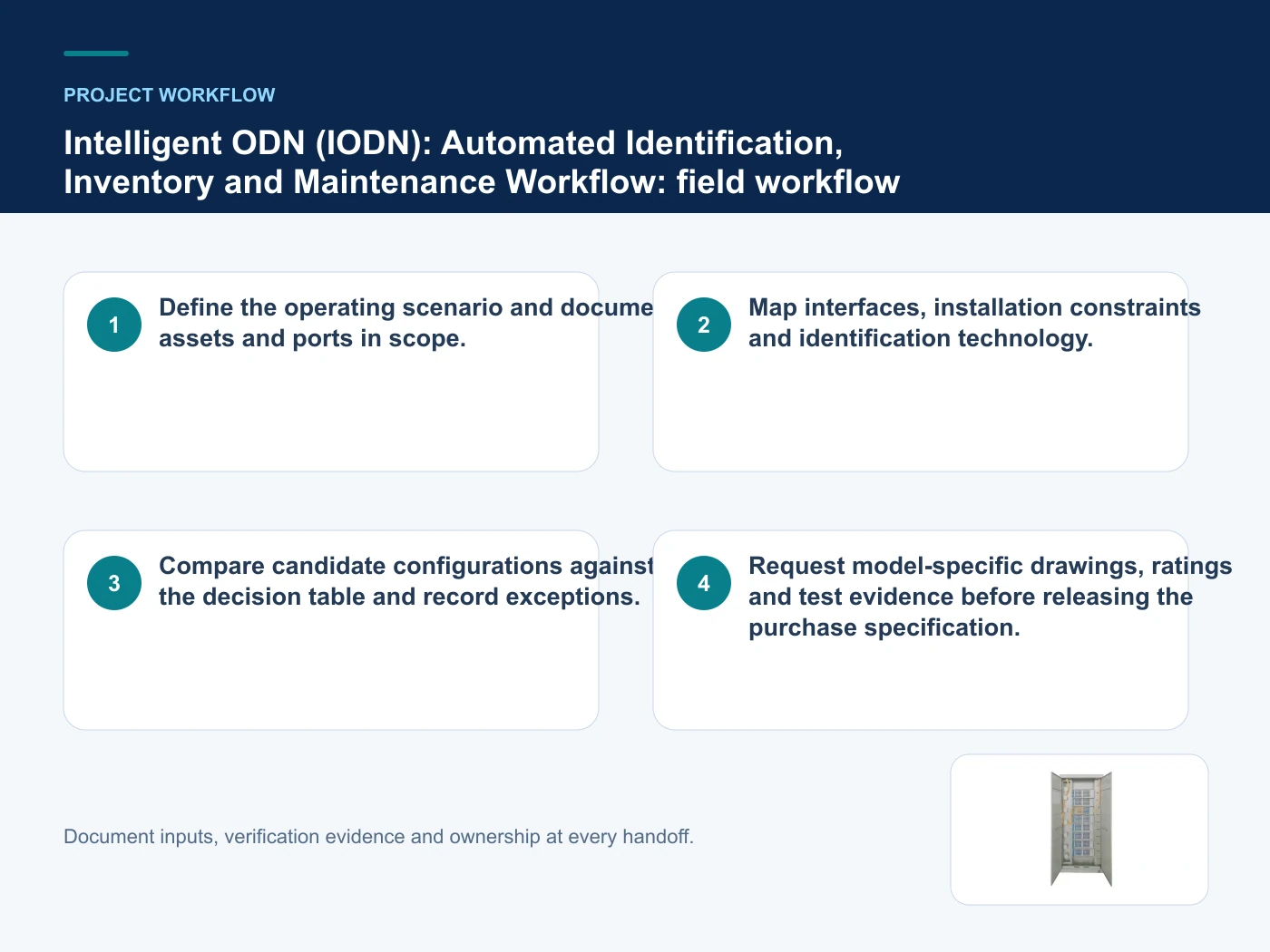
- Step 1: Define the operating scenario and document assets and ports in scope. Record Assets and ports in scope as an explicit input. Tag technology, reader and failure behavior.
- Step 2: Map interfaces, installation constraints and identification technology. Record Identification technology as an explicit input. Port map, permissions and audit trail.
- Step 3: Compare candidate configurations against the decision table and record exceptions. Record System-of-record integration as an explicit input. Data ownership, API and synchronization rules.
- Step 4: Request model-specific drawings, ratings and test evidence before releasing the purchase specification. Record Offline field workflow as an explicit input. Tag technology, reader and failure behavior.
Relevant products from our communications portfolio
The products below connect the intelligent ODN decision to real catalogue families and verified site photography. They are starting points, not a claim that every configuration described here is a standard stock item; confirm model, interface, rating, drawing and testing scope with the project team.
- Intelligent Optical Distribution Network (IODN) — use this product page as a configuration reference when you define every asset and port that needs a persistent identifier. Confirm the offered model, interfaces, drawings and available evidence before quotation.
- Smart Optical Cross-Connect Cabinet Management System — use this product page as a configuration reference when you choose how field identification links to the system of record. Confirm the offered model, interfaces, drawings and available evidence before quotation.
- Equipment-Side ODF Frame — use this product page as a configuration reference when you specify commissioning, move-add-change and exception workflows. Confirm the offered model, interfaces, drawings and available evidence before quotation.
For adjacent configurations, browse ODN & Fiber Distribution and compare those options against the intelligent ODN inputs above, including assets and ports in scope.
Common mistakes to avoid
- Selecting from a catalogue image before assets and ports in scope is fixed.
- Treating a category-page description as model-specific compliance evidence.
- Leaving reconciliation report undefined until after quotation.
What to include in the RFQ or design input
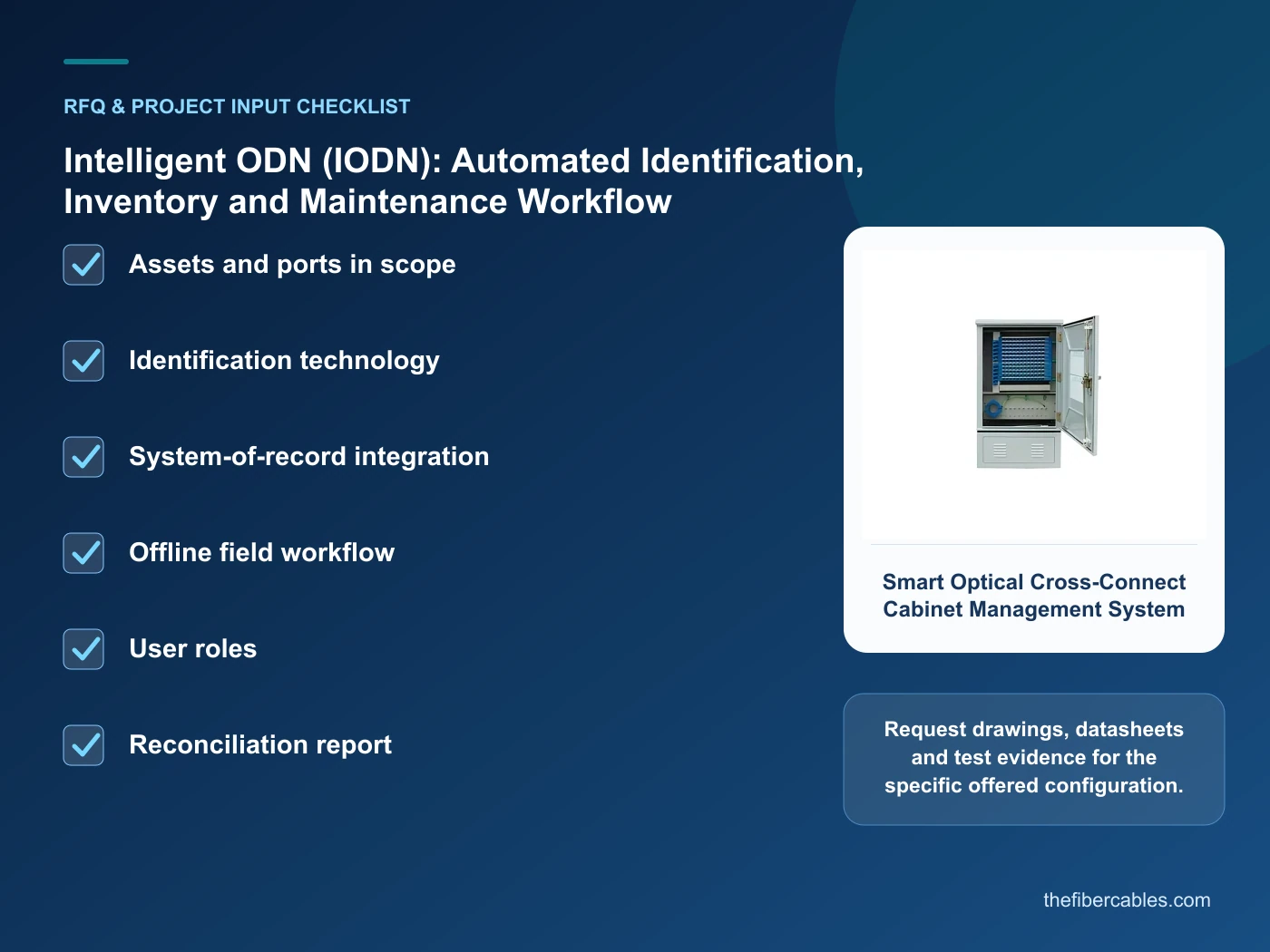
For intelligent ODN, a complete request reduces back-and-forth and prevents a catalogue image from being mistaken for a verified configuration. Record the following fields, identify which values are mandatory or provisional and attach route, interface or layout drawings where relevant.
- Assets and ports in scope
- Identification technology
- System-of-record integration
- Offline field workflow
- User roles
- Reconciliation report
Questions engineers and buyers ask
How should automated id node be evaluated for intelligent ODN?
Use port-level identification is required as the operating context, record assets and ports in scope, and verify tag technology, reader and failure behavior for the exact offered configuration.
Which project input can change the intelligent ODN decision?
Define every asset and port that needs a persistent identifier. Recheck that decision when identification technology or system-of-record integration changes.
Sources and standards
The references below define terminology, scope or test methods relevant to intelligent ODN. They do not certify an offered product; confirm the edition adopted by the contract and destination authority.
- ITU-T L.207: Passive node elements with automated ID tag detection (03/2018; in force and reviewed 2026-10-16). Use it to verify the terminology and scope relevant to intelligent ODN; the source does not certify a specific offered product.
- ITU-T L.250: Topologies for optical access networks (01/2024). Use it to verify the terminology and scope relevant to intelligent ODN; the source does not certify a specific offered product.
- ITU-T G.9807.1: 10-Gigabit-capable symmetric passive optical network (02/2023 with 05/2025 amendment). Use it to verify the terminology and scope relevant to intelligent ODN; the source does not certify a specific offered product.
Source review: Links and cited editions for intelligent ODN were checked on 2026-10-16. Confirm the edition adopted by the project contract and the authority having jurisdiction.
Related guidance
Smart Optical Cross-Connect Cabinet Management: Port Records, Alarms and Work Orders • 24-, 48- or 72-Core ODF Unit: Working Fibres, Reserve and Patch Access • ODN As-Built Records: Feeder, Distribution, Drop and Splice Data Model
Prepare a intelligent ODN configuration for review
Send assets and ports in scope, identification technology, system-of-record integration, offline field workflow, quantity and delivery destination. Huijue Group can review the configuration boundary and identify the drawings or evidence needed for a factory quotation.
——END——