
Direct answer
N+1 rectifier redundancy and battery runtime answer different failure scenarios. N+1 means the remaining rectifier modules can support the defined load and charging duty after one module is unavailable. Runtime describes how long the load can be supported from stored energy under stated load, efficiency, temperature, ageing and discharge assumptions. A quotation must define both, plus recharge objectives, monitoring and maintenance isolation.
Within the broader Telecom Power & Distribution workflow, this article focuses on N+1 rectifier redundancy: separate conversion redundancy from stored-energy autonomy. Confirm n load definition and the evidence for the offered product before final engineering approval.

Project inputs that narrow the product family
Separate conversion redundancy from stored-energy autonomy. Start with the operating requirement and installation boundary, then separate system requirements from product claims so each supplier knows which evidence must accompany the offered configuration.
- Define the load state used for N capacity.
- State whether charging must continue during module failure.
- Calculate runtime with battery and environmental assumptions.
- Plan alarms, bypass and safe module/battery maintenance.
Define the load state used for N capacity
Capture N load definition, then use Rectifier redundancy as a practical comparison point: Module failure during AC availability. Before approval, verify this point: Does not create battery energy.
State whether charging must continue during module failure
Capture Module capacity/count, then use Battery autonomy as a practical comparison point: Loss of AC or source. Before approval, verify this point: Depends on load, temperature, ageing and cutoff.
Calculate runtime with battery and environmental assumptions
Capture Recharge duty, then use Recharge as a practical comparison point: Recovery after discharge. Before approval, verify this point: Affects rectifier capacity and restoration time.
Plan alarms, bypass and safe module/battery maintenance
Capture Battery technology/capacity, then use Rectifier redundancy as a practical comparison point: Module failure during AC availability. Before approval, verify this point: Does not create battery energy.
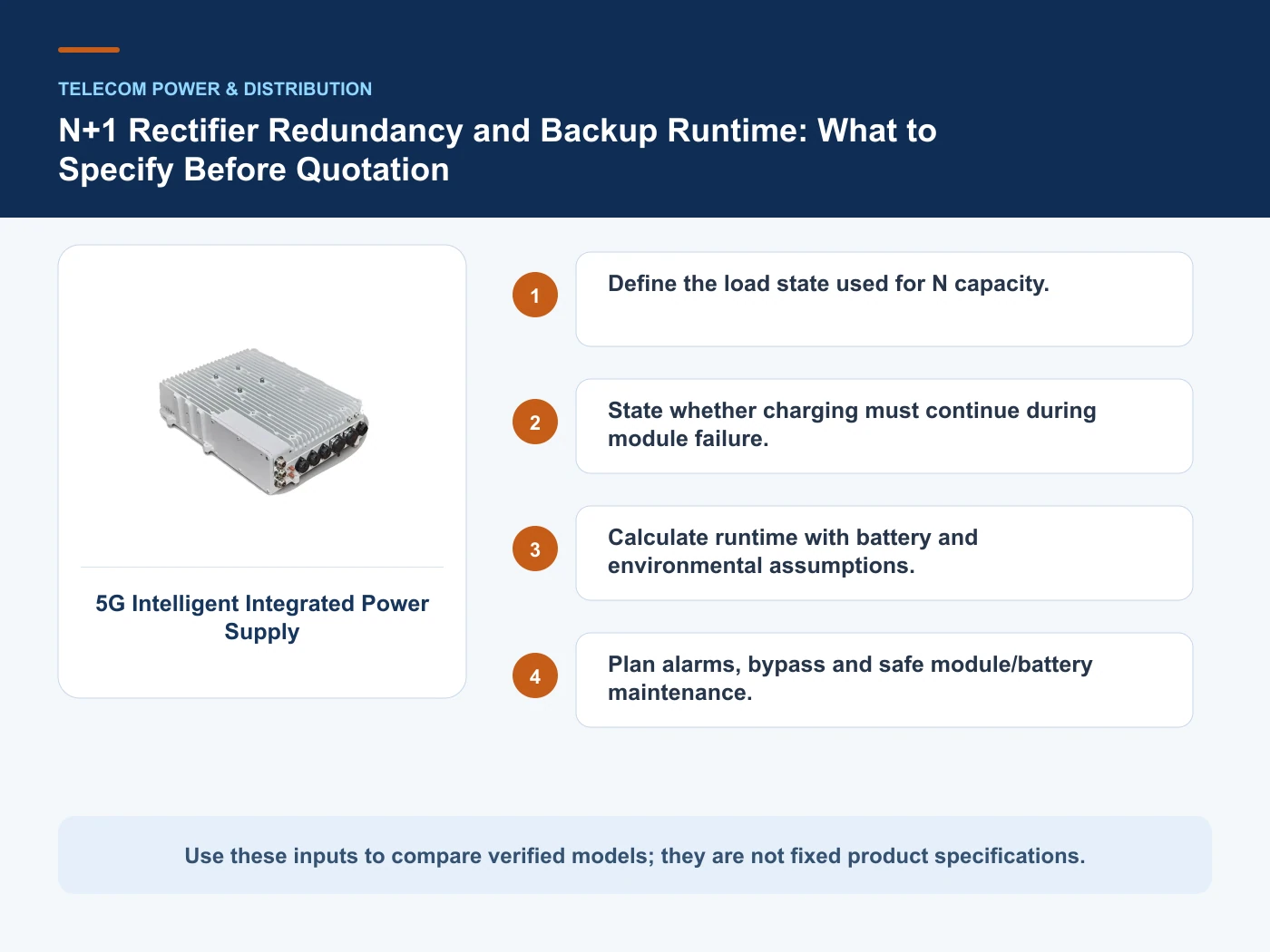
Relevant products from our communications portfolio
The products below connect the N+1 rectifier redundancy decision to real catalogue families and verified site photography. They are starting points, not a claim that every configuration described here is a standard stock item; confirm model, interface, rating, drawing and testing scope with the project team.
- 5G Intelligent Integrated Power Supply — use this product page as a configuration reference when you define the load state used for N capacity. Confirm the offered model, interfaces, drawings and available evidence before quotation.
- Micro-Site Integrated Power Supply — use this product page as a configuration reference when you state whether charging must continue during module failure. Confirm the offered model, interfaces, drawings and available evidence before quotation.
- Outdoor AC/DC Power Supply — use this product page as a configuration reference when you calculate runtime with battery and environmental assumptions. Confirm the offered model, interfaces, drawings and available evidence before quotation.
For adjacent configurations, browse Telecom Power & Site Energy and compare those options against the N+1 rectifier redundancy inputs above, including n load definition.
Selection boundaries to verify
This table connects AC input, DC interfaces, rectifier capacity, branch protection, redundancy and backup to the decision on N+1 rectifier redundancy. It is a decision aid rather than a universal performance table: exact capacity, environmental class, electrical or optical limits and certifications must come from the selected model, applicable project documents and verifiable test evidence.
| Option or input | When it fits | What must be verified |
|---|---|---|
| Rectifier redundancy | Module failure during AC availability | Does not create battery energy |
| Battery autonomy | Loss of AC or source | Depends on load, temperature, ageing and cutoff |
| Recharge | Recovery after discharge | Affects rectifier capacity and restoration time |
Reference point: ETSI EN 300 132-2: -48 V DC input interface at telecommunications equipment and ITU-T L.1221: Evaluation and selection of stationary batteries frame the terminology or method used for this N+1 rectifier redundancy comparison. They do not approve a product configuration; apply the edition named by the contract and local authority.
A practical product-selection workflow
- Step 1: Fix load and failure scenarios. Record N load definition as an explicit input. Does not create battery energy.
- Step 2: Calculate N capacity and module count. Record Module capacity/count as an explicit input. Depends on load, temperature, ageing and cutoff.
- Step 3: Model battery autonomy and ageing. Record Recharge duty as an explicit input. Affects rectifier capacity and restoration time.
- Step 4: Verify recharge, alarm and maintenance behavior. Record Battery technology/capacity as an explicit input. Does not create battery energy.
Common mistakes to avoid
- Calling spare rectifier capacity backup runtime.
- Quoting hours without temperature and end-of-life assumptions.
- Using N+1 without defining N load.
What to include in the RFQ or design input
For N+1 rectifier redundancy, a complete request reduces back-and-forth and prevents a catalogue image from being mistaken for a verified configuration. Record the following fields, identify which values are mandatory or provisional and attach route, interface or layout drawings where relevant.
- N load definition
- Module capacity/count
- Recharge duty
- Battery technology/capacity
- Runtime assumptions
- Monitoring and maintenance
Questions engineers and buyers ask
What should a buyer specify first for N+1 rectifier redundancy?
Begin with n load definition, module capacity/count, recharge duty; these inputs narrow the product family before optional features are compared.
Does a product photo confirm the final configuration?
No. Treat the image as a visual reference and confirm the model, drawing, interfaces, ratings and test evidence for the offered unit.
Sources and standards
For N+1 rectifier redundancy, the references below define relevant terminology, scope or test methods. ETSI EN 300 132-2: -48 V DC input interface at telecommunications equipment is one documented boundary for this topic; neither a standards catalogue page nor a category page proves certification of the offered product. Apply the edition adopted by the contract, destination market and authority having jurisdiction.
- ETSI EN 300 132-2: -48 V DC input interface at telecommunications equipment (V2.8.1, 10/2024). Use it to verify the terminology and scope relevant to N+1 rectifier redundancy; the source does not certify a specific offered product.
- ITU-T L.1221: Evaluation and selection of stationary batteries (11/2018). Use it to verify the terminology and scope relevant to N+1 rectifier redundancy; the source does not certify a specific offered product.
- IEEE 1188: Maintenance and testing of stationary VRLA batteries (2025 edition; reviewed 2026-10-15). Use it to verify the terminology and scope relevant to N+1 rectifier redundancy; the source does not certify a specific offered product.
- IEC 62619: Safety requirements for industrial secondary lithium cells and batteries (2022, Ed.2). Use it to verify the terminology and scope relevant to N+1 rectifier redundancy; the source does not certify a specific offered product.
Source review: Links and cited editions for N+1 rectifier redundancy were checked on 2026-10-15. Confirm the edition adopted by the project contract and the authority having jurisdiction.
Related guidance
Telecom Power and Distribution Design: From AC Input to -48 V DC Loads • How to Size a -48 V Telecom Power System: Load, Rectifier and Growth Inputs • AC vs DC Distribution in Telecom Sites: Architecture and Protection Boundaries
Prepare a N+1 rectifier redundancy configuration for review
Send n load definition, module capacity/count, recharge duty, battery technology/capacity, together with quantity and delivery destination. We will help narrow the relevant product family and identify the drawings or test evidence needed for quotation.
——END——