
Passive optical distribution
Match splitter or WDM architecture to wavelength plan, ratio, package and insertion-loss targets.
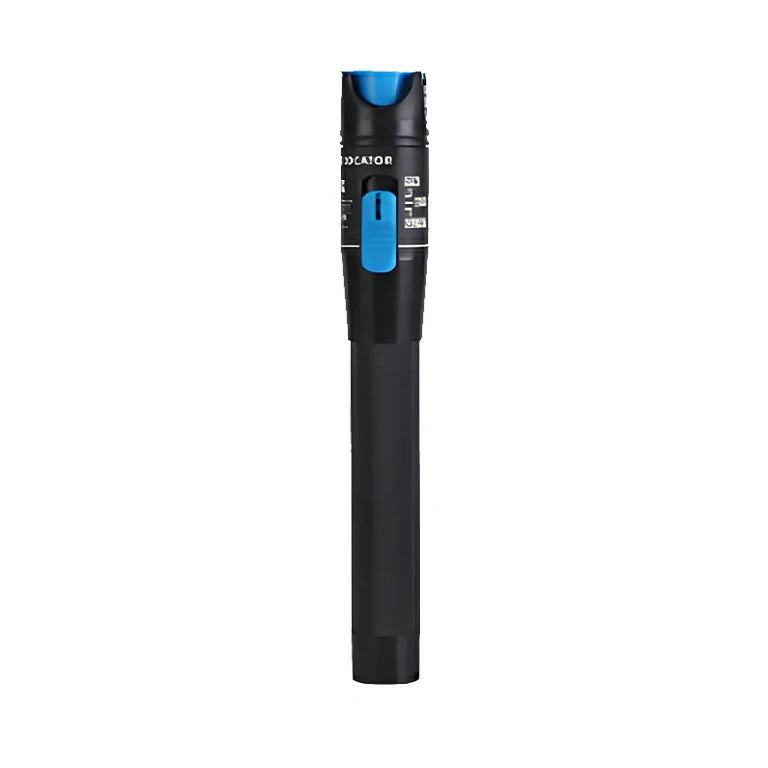
A 650 nm visual fault locator with continuous or blinking output, 1.25 and 2.5 mm interface options, and up to 5 dBm output.
The Pen-Style Visual Fault Locator (VFL) is a handheld tool for continuity checks and visible fault tracing on single-mode or multimode links. Its 650 nm source can be operated continuously or in blinking mode, helping a technician identify fiber routing, breaks or severe bends where visible light can escape.
The listed VFL series uses AAA batteries, offers up to 5 dBm output and provides 1.25 mm and 2.5 mm interface options. The published identification distance is 5 km, but visibility in an installed link depends on route construction, loss, ambient light and how the fiber is enclosed.
Select the ferrule adapter around the connector inventory and confirm whether the job requires only continuity indication or measured loss and distance. A VFL does not replace an optical power meter or OTDR. The listed operating range is -5°C to 45°C, with storage and transport at -25°C to 55°C.
Huijue Group can review OEM labeling, private-label packaging and kits containing the required ferrule adapter. Customer connector samples can be checked when interface access is uncertain; artwork, accessory fit, test scope and order quantity remain subject to approval.
| Serial No. | Item | VFL Series Pen-Style Visual Fault Locator |
| 1 | Visible Light Test Wavelength | 650nm |
| 2 | Battery Type | AAA Dry Battery |
| 3 | Continuous Working Time | ≥8h |
| 4 | Interface | 2.5 mm /1.25 mm |
| 5 | Maximum Output Power | 5 dBm |
| 6 | Identification Distance | 5Km |
| 7 | Output Light Mode | Continuous Light or Blinking Light |
Operating Temperature: -5~45℃
Storage and Transportation Temperature: -25~55℃
Use the correct adapter and keep the optical interface clean. Follow site laser-safety procedures and do not view an energized fiber or connector directly. Check whether active transmission equipment is disconnected before injecting visible light.
Buyer Questions
Answers specific to Pen-Style Visual Fault Locator (VFL) selection, configuration and purchasing.
No. It provides visible light for identification and fault tracing; quantitative loss testing requires a calibrated source and power meter.
No. LC normally uses the listed 1.25 mm interface, while SC uses 2.5 mm. Specify the required interface when ordering.
Use the deployment context to narrow the configuration before comparing dimensions, capacities and options.
Match splitter or WDM architecture to wavelength plan, ratio, package and insertion-loss targets.
Coordinate connector, polish, fiber grade, polarity and cable length across patching points.
Plan MPO/MTP trunks and harnesses around port mapping, breakout format and rack density.
Select splicing, cleaning and test tools for the connector types and measurements used on site.
Before quotation: confirm capacity, interfaces, installation environment, power conditions, quantity and required options.