
Direct answer
A PON loss budget is the sum of fibre attenuation, splice loss, connector loss, splitter or coexistence-element loss and an agreed engineering margin, compared with the applicable equipment optical path class. The splitter ratio and nominal reach cannot be evaluated separately. Use specified or measured values for the actual wavelength and components, document assumptions, and recalculate when migrating from GPON to XGS-PON or adding coexistence elements.
Within the broader ODN & FTTx Design workflow, this article focuses on GPON optical loss budget: calculate passive-path loss and margin without promising unsupported reach. Confirm pon generation and optical class and the evidence for the offered product before final engineering approval.
Inputs required before any calculation
Calculate passive-path loss and margin without promising unsupported reach. Start with the operating requirement and installation boundary, then separate system requirements from product claims so each supplier knows which evidence must accompany the offered configuration.
- Identify the equipment optical path class and wavelengths.
- Count every connector, splice and passive element.
- Use component data rather than a generic splitter table where available.
- Reserve margin for construction and lifecycle change.
Identify the equipment optical path class and wavelengths
Capture PON generation and optical class, then use Fibre as a practical comparison point: Length × wavelength-specific attenuation. Before approval, verify this point: Use project length and cable/fibre evidence.
Count every connector, splice and passive element
Capture Route length, then use Splices/connectors as a practical comparison point: Count × allowed or measured value. Before approval, verify this point: Include patch fields and test interfaces.
Use component data rather than a generic splitter table where available
Capture Splitter stages, then use Splitter/CEx/WDM as a practical comparison point: Specified loss at wavelength. Before approval, verify this point: Theoretical split is not the complete device loss.
Reserve margin for construction and lifecycle change
Capture Connector/splice count, then use Engineering margin as a practical comparison point: Project-defined allowance. Before approval, verify this point: State purpose and avoid hiding missing data.
A traceable sizing and verification workflow
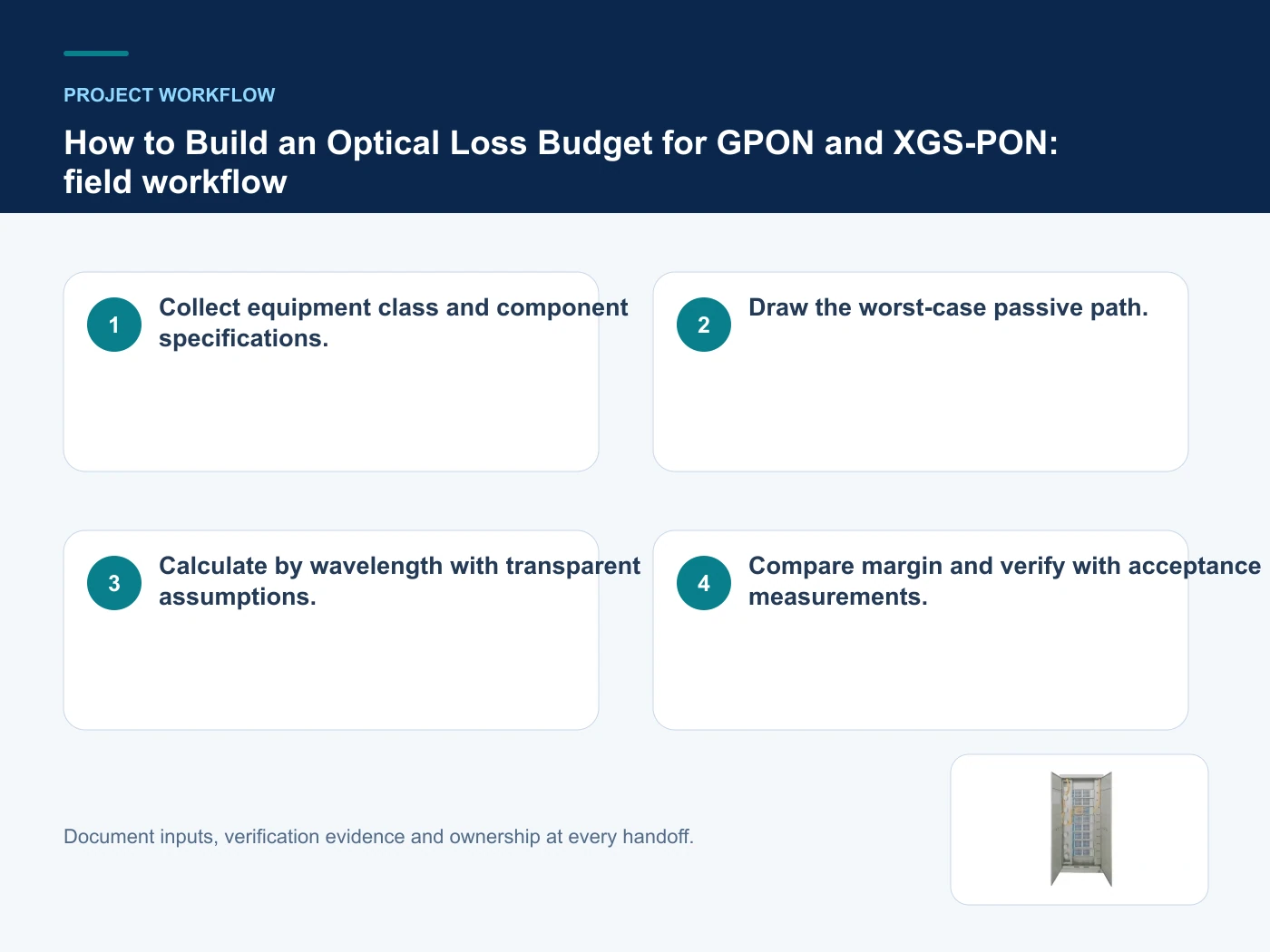
- Step 1: Collect equipment class and component specifications. Record PON generation and optical class as an explicit input. Use project length and cable/fibre evidence.
- Step 2: Draw the worst-case passive path. Record Route length as an explicit input. Include patch fields and test interfaces.
- Step 3: Calculate by wavelength with transparent assumptions. Record Splitter stages as an explicit input. Theoretical split is not the complete device loss.
- Step 4: Compare margin and verify with acceptance measurements. Record Connector/splice count as an explicit input. State purpose and avoid hiding missing data.
Calculation boundaries and acceptance limits
This table connects splitting, distribution, splicing, termination, capacity planning and optical-loss control to the decision on GPON optical loss budget. It is a decision aid rather than a universal performance table: exact capacity, environmental class, electrical or optical limits and certifications must come from the selected model, applicable project documents and verifiable test evidence.
| Option or input | When it fits | What must be verified |
|---|---|---|
| Fibre | Length × wavelength-specific attenuation | Use project length and cable/fibre evidence |
| Splices/connectors | Count × allowed or measured value | Include patch fields and test interfaces |
| Splitter/CEx/WDM | Specified loss at wavelength | Theoretical split is not the complete device loss |
| Engineering margin | Project-defined allowance | State purpose and avoid hiding missing data |
Reference point: ITU-T L.250: Topologies for optical access networks and ITU-T G.984.1: Gigabit-capable passive optical networks — General characteristics frame the terminology or method used for this GPON optical loss budget comparison. They do not approve a product configuration; apply the edition named by the contract and local authority.
Relevant products from our communications portfolio
The products below connect the GPON optical loss budget decision to real catalogue families and verified site photography. They are starting points, not a claim that every configuration described here is a standard stock item; confirm model, interface, rating, drawing and testing scope with the project team.
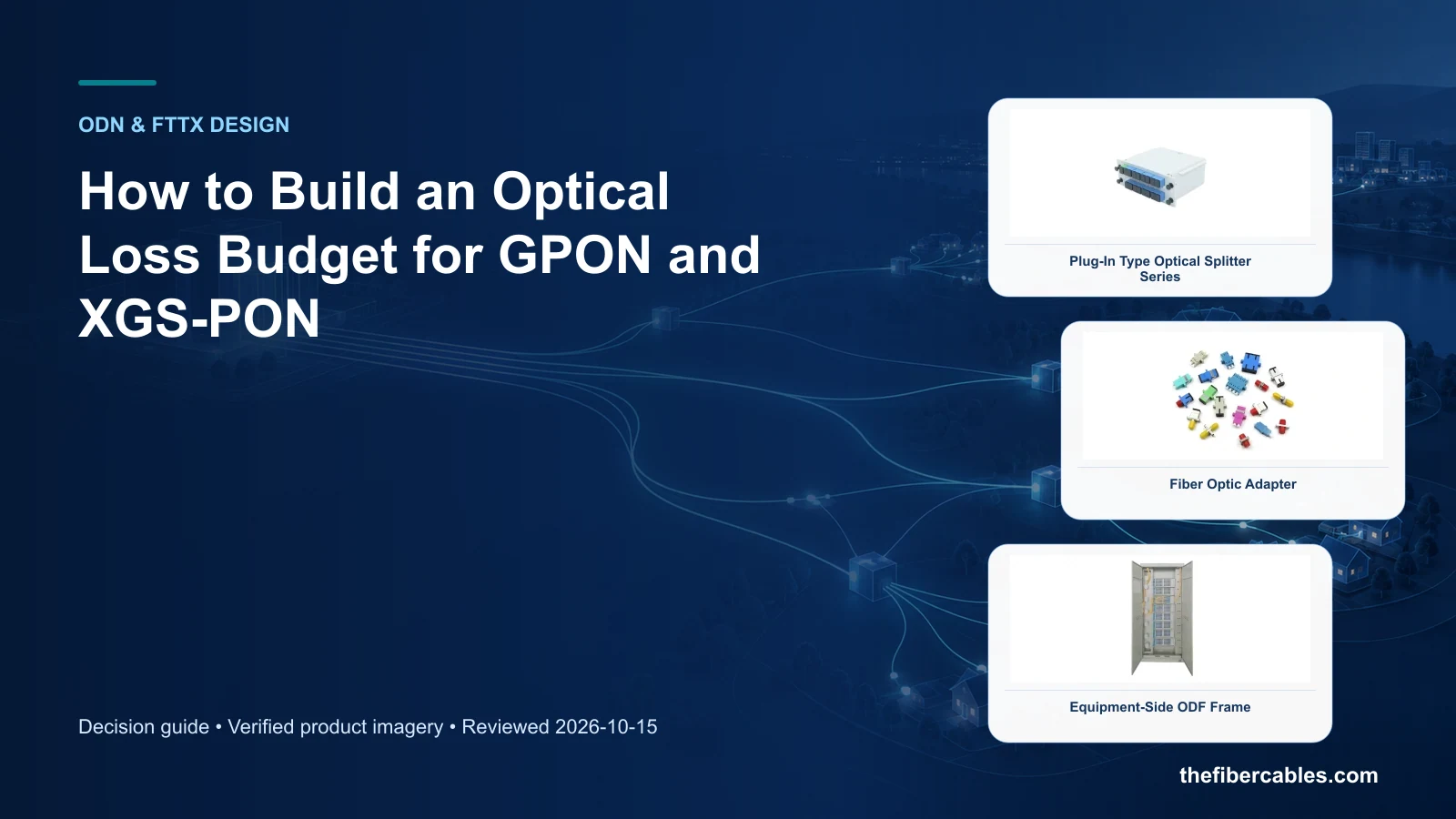
- Plug-In Type Optical Splitter Series — use this product page as a configuration reference when you identify the equipment optical path class and wavelengths. Confirm the offered model, interfaces, drawings and available evidence before quotation.
- Fiber Optic Adapter — use this product page as a configuration reference when you count every connector, splice and passive element. Confirm the offered model, interfaces, drawings and available evidence before quotation.
- Equipment-Side ODF Frame — use this product page as a configuration reference when you use component data rather than a generic splitter table where available. Confirm the offered model, interfaces, drawings and available evidence before quotation.
For adjacent configurations, browse ODN & Fiber Distribution and compare those options against the GPON optical loss budget inputs above, including pon generation and optical class.
What to include in the RFQ or design input
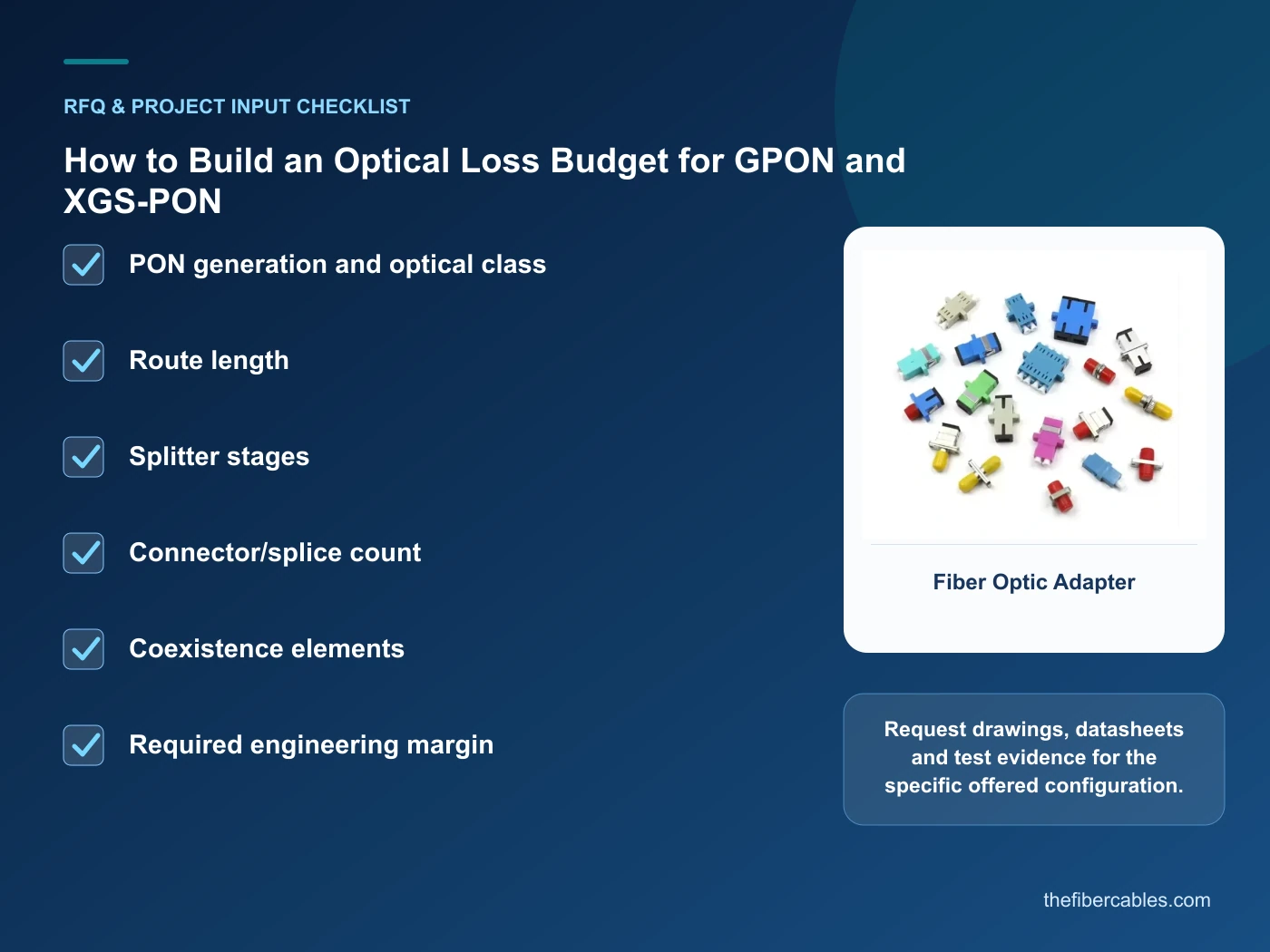
For GPON optical loss budget, a complete request reduces back-and-forth and prevents a catalogue image from being mistaken for a verified configuration. Record the following fields, identify which values are mandatory or provisional and attach route, interface or layout drawings where relevant.
- PON generation and optical class
- Route length
- Splitter stages
- Connector/splice count
- Coexistence elements
- Required engineering margin
Common mistakes to avoid
- Using only theoretical split loss.
- Combining GPON and XGS-PON assumptions without wavelength review.
- Converting nominal line rate into a per-user performance promise.
Questions engineers and buyers ask
Can GPON optical loss budget be sized from a nominal rating alone?
No. The calculation must include pon generation and optical class, route length, splitter stages plus applicable margins, derating and acceptance limits.
Which result should appear in the RFQ?
State the design inputs, calculation method, selected value, reserve or margin and evidence required from the offered configuration.
Sources and standards
For GPON optical loss budget, the references below define relevant terminology, scope or test methods. ITU-T L.250: Topologies for optical access networks is one documented boundary for this topic; neither a standards catalogue page nor a category page proves certification of the offered product. Apply the edition adopted by the contract, destination market and authority having jurisdiction.
- ITU-T L.250: Topologies for optical access networks (01/2024). Use it to verify the terminology and scope relevant to GPON optical loss budget; the source does not certify a specific offered product.
- ITU-T G.984.1: Gigabit-capable passive optical networks — General characteristics (03/2008 with amendments). Use it to verify the terminology and scope relevant to GPON optical loss budget; the source does not certify a specific offered product.
- ITU-T G.9807.1: 10-Gigabit-capable symmetric passive optical network (02/2023 with 05/2025 amendment). Use it to verify the terminology and scope relevant to GPON optical loss budget; the source does not certify a specific offered product.
- ITU-T G.9805: Coexistence of multiple PON generations (02/2022 with amendments). Use it to verify the terminology and scope relevant to GPON optical loss budget; the source does not certify a specific offered product.
Source review: Links and cited editions for GPON optical loss budget were checked on 2026-10-15. Confirm the edition adopted by the project contract and the authority having jurisdiction.
Related guidance
ODN Design Guide for FTTx: Splitting, Distribution, Splicing and Optical Loss • ODF vs Fiber Distribution Box vs Optical Cross-Connect Cabinet: Where Each Fits • Choosing 8-, 16-, 24- or 48-Core Fiber Distribution Boxes
Prepare a GPON optical loss budget configuration for review
Send pon generation and optical class, route length, splitter stages, connector/splice count, together with quantity and delivery destination. We will help narrow the relevant product family and identify the drawings or test evidence needed for quotation.
——END——